
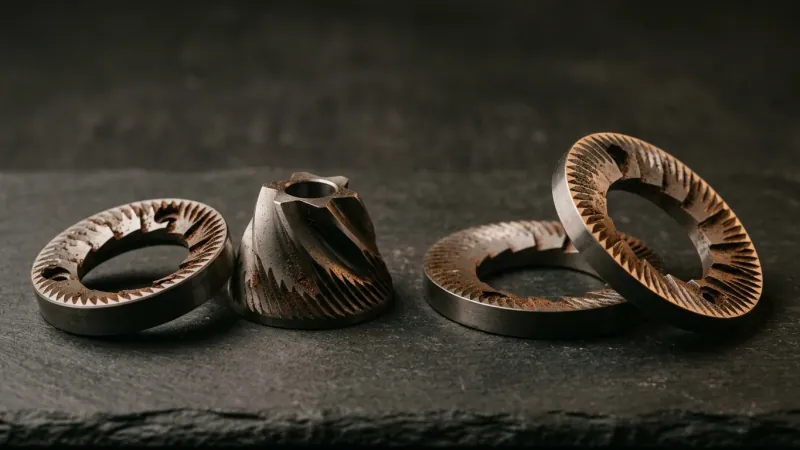
Every page that ranks for this question tells the same story. Conical burrs make two sizes of particle, and that gives you body; flat burrs make one size, and that gives you clarity. Conical runs slower, cooler and quieter and keeps less coffee inside; flat runs faster, hotter and louder and hoards it. So: flat for light roasts and pour-over, conical for dark roasts and milk.
I read twenty-odd of those pages. None of them shows a measurement. When I went looking for the measurements, the largest set I could find — 24 espresso grinders measured in a Swiss university lab, plus a blind tasting of the best nine by four professional tasters — says something less tidy. The rule holds on average. It tells you very little about any one grinder you might buy. In that blind final, a conical grinder came first. The other conical came last.
Below: what was actually measured, the two different questions the rule mixes up, the heat, noise and retention figures from a ten-grinder test, what the companies that make both kinds of burr say about the difference, and a table of common grinders by burr shape.
Affiliate links. Some links below go to Amazon. If you buy through one I earn a commission at no extra cost to you, and it never changes which product gets named or what the measurements say. Full disclosure.
Seven claims, checked
Here is the rule as the ranking pages give it, set against the numbers:
| The claim | What was measured | Where |
|---|---|---|
| Conical burrs make a “bimodal” grind, flat burrs a “unimodal” one | Every grinder measured makes a population of fines. Conicals averaged more of them at the same grind size, with a large overlap | ZHAW data, 24 espresso grinders |
| A conical’s extra fines give a shot more body | Dialled in for the same espresso recipe, the one conical in a ten-grinder test had the fewest fines in the field | Kaffeemacher, 2025 |
| Flat for light roasts, conical for dark | In a blind final, a conical won the lighter roast, and the flat that won the darker roast came last on the lighter one | Kaffeemacher, blind final |
| Conical burrs run cooler | The conical came fourth-coolest of ten; three flats ran cooler, and the testers judged the whole spread harmless | Kaffeemacher, 2025 |
| Conical burrs are quieter | True in that test, by 2 dB over the nearest flat — while the flats alone spread across 16.7 dB | Kaffeemacher, 2025 |
| Conical burrs keep less coffee inside | Two flat-burr grinders kept 0.1 g per dose; the conical kept 0.2 g | Kaffeemacher, 2025 |
| Conical grinders cost less | Broadly true: “Conical burrs are more economical than flat burrs,” as one kitchen test put it | America’s Test Kitchen, 2025 |
The last row is about the market, not the physics, and the noise row holds up. The rest is where the story comes apart — and the first row is the one everything else hangs on.
Every burr grinder makes fines
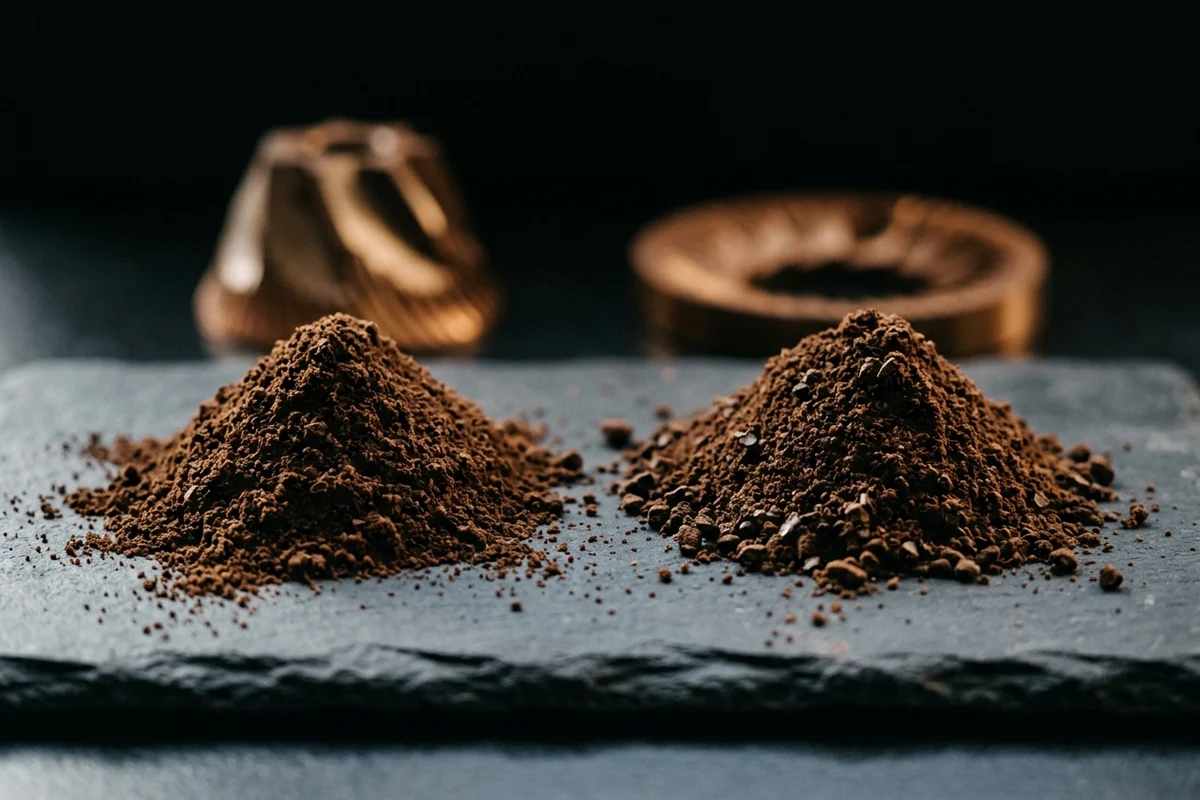
“Unimodal” is the word doing the damage. Taken literally, it means a grind with one peak — every particle close to one size. No burr grinder that has been measured does that, flat or conical. The peer-reviewed paper on how temperature changes the grind used a flat-burr Mahlkönig EK43, and once its particles are weighted by surface area, in the paper’s words, “the data appears distinctly bimodal”: a fines peak and a main peak. When Jonathan Gagné fitted the distributions from 24 espresso grinders, every one of them had a fines peak, and its position moved by no more than about 8 µm from grinder to grinder.
So the real question is never whether a grinder makes fines. It is how many, at a given size. That is what the one large dataset measures. Kaffeemacher, a Swiss and German coffee company that runs cafés and barista courses, put 24 espresso grinders through the same coffee; Marco Wellinger at the Zurich University of Applied Sciences measured about 300 samples on a Camsizer X2, an instrument that photographs particles as they fall; and Gagné, an astrophysicist who writes about coffee physics, analysed them. It is not peer-reviewed. It is public, with its method shown, and it is the only one of its size I found.
Gagné compared every grinder at the same median particle size, 340 µm, on two measures: how much of the grind was fines under 100 µm, and how far the coarse particles spread into boulders. His finding on burr shape is one sentence, and every word of it matters:
“Conical burrs appear on average less unimodal and less uniform, although there is a large overlap meaning that one can easily find a specific flat burr that is less unimodal and less uniform than a specific conical burr.”
On average, in other words, the rule is right. For choosing a grinder, the overlap is the part that counts. Ten of the 24 grinders were conical, and the four cheapest in the whole series — the €80–150 group — were all conical. In Gagné’s chart, one of those four, Tchibo’s own-brand grinder with a built-in scale, sits among the three most uniform grinders of the 24, next to two commercial flat-burr machines. Another of the four, a Graef, is the least uniform of all. Same shape, same price band, opposite ends of the chart.
The data has limits: one coffee, one unit of each grinder, and — Gagné’s own caveat — no way to know whether each grinder’s burrs were well aligned, which could move both measures. The same analysis also found that larger flat burrs were not systematically more uniform and that rotation speed showed no clear pattern, which I went through in the piece on grind size and flavour.
Same grind size, or same shot?
Here is where the rule quietly swaps one question for another.
“Conicals make more fines” is true at the same grind size — Gagné’s fixed 340 µm median. But nobody brews at a fixed median. You grind until the shot runs in the time you want, and Gagné’s other finding is that doing so is mostly an adjustment of fines: “when we dial in espresso, we are dialling in the amount fines more so than we are dialling in the average size of coarse particles.” A grinder that makes few fines builds little resistance, so you grind it finer to compensate — and finer means more fines. He found the effect overshoots: grinders that make fewer fines “actually require us to reach a slightly larger amount of fines per gram of coffee in our puck to be dialled in.”
The clearest demonstration I found is Kaffeemacher’s 2025 comparison of ten single-dose grinders at €500–1,000. Nine have flat burrs. The Niche Zero is, in the testers’ words, “the only grinder in this comparison built around conical burrs.” Each was dialled in for the same espresso recipe, and a sample of each espresso grind was measured:
| Grinder | Burrs | Median particle (x50) | Fines under 100 µm | Main peak width |
|---|---|---|---|---|
| Niche Zero | Conical, 63 mm | 343 µm | 19.8% — lowest | 270 µm — widest |
| Niche Duo | Flat, 83 mm | 271 µm | 26.4% | 255 µm |
| DF64V | Flat, 64 mm | 255 µm | 27.0% | 196 µm |
| DF83 | Flat, 83 mm | 249 µm | 28.4% | 204 µm |
| Timemore Sculptor 78S | Flat, 78 mm | 221 µm | 29.7% | 154 µm |
| Eureka Mignon SD Pro | Flat, 64 mm | 298 µm | 30.2% | 201 µm |
| Timemore Sculptor 64S | Flat, 64 mm | 205 µm | 31.0% | 145 µm — narrowest |
| Varia VS6 | Flat | 243 µm | 32.0% | 183 µm |
| DF83V | Flat, 83 mm | 251 µm | 34.4% | 232 µm |
| Profitec Twist SD54 | Flat, 54 mm | 285 µm | 34.5% — highest | 206 µm |
The puck from the conical grinder held the fewest fines in the field, by a wide margin, and it was ground the coarsest. That is not a contradiction of the 24-grinder average — it is the other question. Ask about the grinder, and the conicals lean towards fines. Ask about the puck in your portafilter, and in this field the conical’s had the fewest.
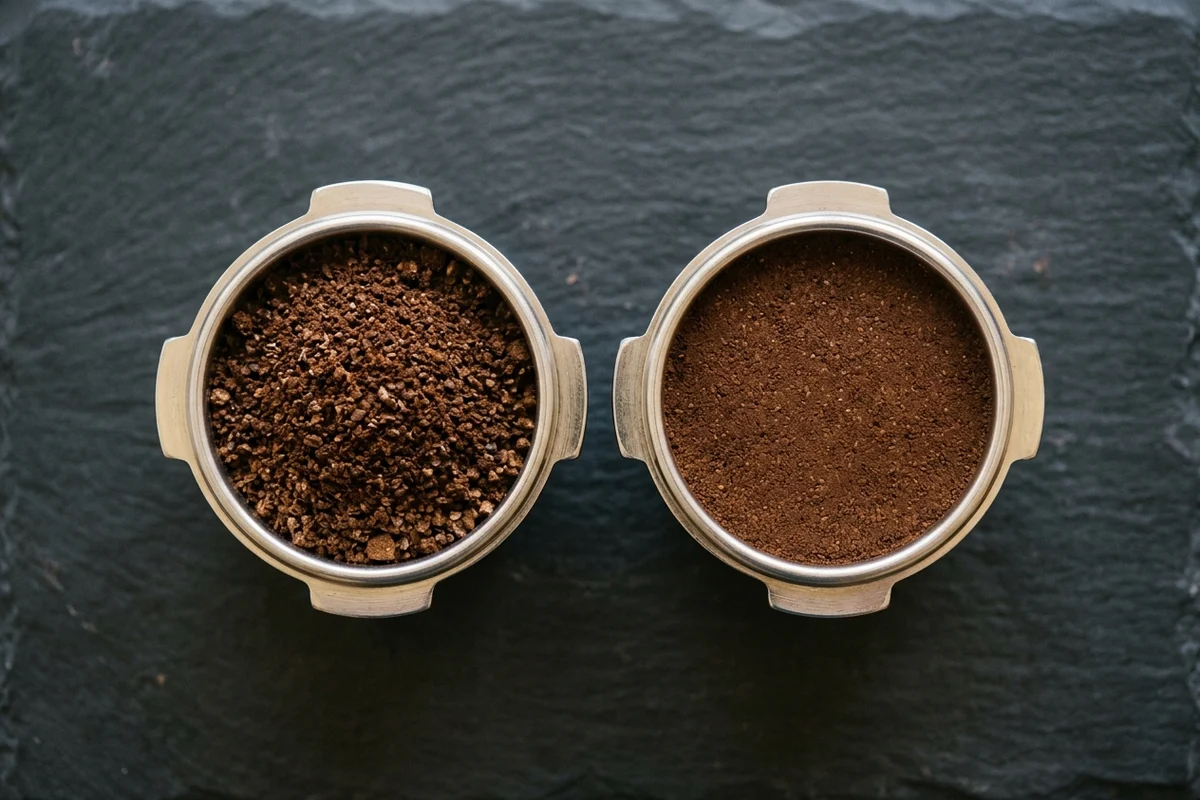
Then look at how the testers described the cups. The Niche Zero’s was “velvety, creamy, body-forward.” Two flat-burr grinders, the DF83V and the Profitec, sat on the body side too — “high body and punch,” “dense, sensuous” — and they had the most fines. The two Timemores, with the narrowest peaks, were “extreme clarity.” So body turned up at both ends of the fines scale, and nobody has published why. Gagné says as much: the finding makes it “harder to understand why the perceived body is lower” in shots from low-fines burrs, since those pucks likely hold more fines per gram, not fewer.
“Conical, therefore more fines, therefore body” is a chain with a link missing, and no one has measured the missing link.
The blind final
The same 24-grinder series ended with a tasting. The best nine from the six price groups went into a final, judged blind by four experienced tasters Kaffeemacher invited — Q Graders among them, and a two-time Swiss barista champion who has judged at the World Barista Championship. Each grinder got 20 minutes and its own recipe, set by the baristas, and two espressos over two days: Apas, a natural Brazil they describe as nutty, chocolatey and forgiving, and Doña Margarita, a lighter, more complex natural from Nicaragua. The published points:
| Grinder | Burrs | Apas, the darker espresso | Doña Margarita, the lighter one | Total |
|---|---|---|---|---|
| Niche Zero | Conical | 28.5 | 41.75 — first | 70.25 — first |
| Eureka Mignon XL | Flat | 29.75 | 32.25 | 62 |
| Baratza Forté | Flat | 31 — first | 29.5 — last | 60.5 |
| Mahlkönig X54 | Flat | 27 | 33.5 | 60.5 |
| Rocket Faustino | Flat | 26 | 34.5 | 60.5 |
| Eureka Mignon Specialità | Flat | 29.75 | 30.75 | 60.5 |
| Mahlkönig E65S GbW | Flat | 27 | 31.5 | 58.5 |
| G-Iota DF64 | Flat | 23.25 — last | 35 | 58.25 |
| Sage Smart Grinder Pro | Conical | 25.25 | 30.75 | 56 — last |
Look at the Forté’s row first. It won the darker coffee and came last on the lighter one — the roast the rule says a flat burr should flatter. The conical Niche Zero won that lighter coffee by almost seven points and the whole final by more than eight. And the only other conical in the final, the Sage Smart Grinder Pro, finished last overall. One conical first, one conical last: the shape did not sort them.
This is one team, four tasters, two coffees and published totals whose scoring scale the page does not explain. It is not peer-reviewed, and it is not the last word. It is the only blind tasting of this size I found, and it gives the rule nothing to stand on.
The two other tastings I found point the same way, more quietly. America’s Test Kitchen sieved and tasted ten grinders with coffee professionals from Counter Culture and George Howell, and wrote: “In our taste test, we didn’t find discernible differences between coffee made with grounds from a conical burr grinder and that from a flat burr grinder.” (All of its top picks were conical; its winner was one of Baratza’s.) And a hobbyist who pulled 29 pairs of shots from a Niche Zero and a flat-burr grinder across 15 roasts found no taste difference that was statistically significant — his flat burrs, he noted himself, were not aligned, and he was the only taster.
What I could not find is a peer-reviewed study that puts conical and flat burrs head to head. I searched the scholarly literature for one; the nearest was a 2026 preprint that used one grinder of each shape to test a way of summarising particle sizes, not to compare the shapes. On the question the whole search is asking, the published science is silent.
Heat, noise and what stays inside
The same ten-grinder comparison measured the three things the rule is most confident about. Noise was taken 20 cm from the grinder during a continuous 250 g grind; temperature in the grounds after five 18 g doses 20 seconds apart; retention by weighing what is left per dose.
| Grinder | Burrs | Noise | Grounds temperature | Left behind per dose |
|---|---|---|---|---|
| Niche Zero | Conical | 72.9 dB — quietest | 30.4 °C | 0.2 g |
| Timemore Sculptor 78S | Flat | 74.9 dB | 30.8 °C | 0.1 g |
| Varia VS6 | Flat | 75.7 dB | 28.6 °C | 0.35 g |
| Timemore Sculptor 64S | Flat | 76.7 dB | 31.3 °C | 0.1 g |
| Niche Duo | Flat | 77.6 dB | 30.6 °C | 0.6 g |
| Eureka Mignon SD Pro | Flat | 81.1 dB | 32.4 °C | 0.7 g |
| DF64V | Flat | 81.6 dB | 32.4 °C | 0.3 g |
| Profitec Twist SD54 | Flat | 84.3 dB | 25.4 °C — coolest | 0.6 g |
| DF83 | Flat | 85.2 dB | 29.1 °C | 0.4 g |
| DF83V | Flat | 91.6 dB — loudest | 34.6 °C — warmest | 0.4 g |
Noise is the claim that survives. The conical was the quietest — by 2.0 dB over the nearest flat-burr grinder, while the loudest and quietest flats were 16.7 dB apart. That is a gap between flat-burr grinders eight times the size of the gap between the shapes. If quiet matters to you, the number to look for is the grinder’s, not its burr shape.
Heat does not survive. The conical came fourth-coolest of ten; the coolest grinder in the test had flat burrs and ran 5 °C cooler than it. And the testers’ own verdict on the whole spread was that it “is completely uncritical and stays within a very narrow range. No flavor impact is to be expected from it.” For scale, the SCA’s grinder standard allows a filter grinder to warm the coffee by up to 10 °C. Warm burrs do change a grind — cold beans grind finer and narrower, which is one of the two things that move your grind without touching the dial — but at home, a few doses a day, the burr shape is not what decides it.
Retention survives only as a statement about grind paths. The two grinders that kept the least coffee in this field, 0.1 g per dose, were the flat-burr Timemores, and the testers put it down to “the vertical burr arrangement, a direct grinding path.” Gravity helps whatever is mounted so that coffee falls through it; Mahlkönig says it mounts the flat burrs of its EK43 vertically for exactly that reason. And conical grinders can hoard too: Kaffeemacher weighed 4 to 5 g, with higher peaks, in a Graef CM800. The SCA’s own grinder standard allows 1.5 g of a 30 g dose on average, and the test is simple enough to run on your own grinder with a scale that reads 0.1 g.
Rotation speed is the grain of truth under the heat and noise claims. Conical burrs do spin slower on average — Gagné’s data shows it, and Mazzer, which makes both, says so. But across the 24 grinders, rpm “does not correlate clearly” with how many fines or boulders a grinder makes. The one within-grinder observation I found comes from the testers: on a variable-speed grinder, they saw a narrower main peak at 500 rpm than at 1,600. That is a report from one grinder, not a published study — and in the ten-grinder field, every grinder with a speed dial had flat burrs.
Static, the other thing flat burrs are blamed for, has one peer-reviewed study behind it, and it used a single flat-burr grinder: the charge depended on the roast, the grind setting and, above all, the moisture left inside the beans, and burr shape was never compared. In the ten-grinder field, static was a problem on some flat-burr grinders and not on others.
What the companies that make both say
Mazzer, in Italy, has made grinders since 1948 and designs both conical and flat burrs in its own factory. Its answer to “what is the main difference?” is worth reading for what it leaves out:
“Whilst the conical burrs rotate at a lower speed than the flat burrs, they can achieve higher productivity levels than those of flat burrs with the same diameter. Due to the low grinding speed, the conical appliances ensure greater acoustic comfort. Furthermore, conical burrs wear much more slowly than flat burrs … Appliances with flat burrs offer greater reactivity to the adjustment change, due to the more compact grinding chamber.”
Speed, output, noise, wear and how quickly a change of setting shows up. Not fines, not clarity, not body. The one company I found that makes both kinds in its own factory does not claim the difference the internet is sure of.
Its wear figure is real, and irrelevant at home. Mazzer’s indicative service lives run from 300 kg to 1,800 kg for its flat burr sets, depending on model and coating, and 600–1,000 kg for its conicals. At 20 g of coffee a day, 300 kg is 41 years.
The other makers of both shapes blur the rule from the inside. Baratza describes its conical burrs as producing “balanced and delightfully sweet cups,” its steel flat burrs as “high-clarity” — and its 54 mm ceramic flat burrs as the choice “for anyone who love a full-bodied cup of coffee,” with “rounded, syrupy textures.” Two flat burr sets from one company, sold as opposites. A German maker of hand grinders sells its conical burr as “engineered for clarity.” Fellow sells its flat-burr Ode for brewing and states plainly that it “is not suitable for espresso,” while its espresso grinder, the Opus 2, is conical. Niche makes a conical grinder, the Zero, and a flat one, the Duo — which it designed around two burr sets, one for espresso and one for filter.
The makers of flat burrs only are the ones who state the rule as fact. Mahlkönig’s home grinder page says flat burrs “achieve a significantly higher proportion of particles with the same shape and size than conical burr grinders.” Turin contrasts “conical burr grinders that produce micro fines at espresso settings” with the “consistent, uniform grind” of its own flat-burr grinder. Neither shows a measurement, and the ten-grinder table above has flat-burr pucks carrying more fines than the conical’s.
What all of this points at is the burr set, not the shape: tooth geometry, the pre-breaker, coating, alignment, speed, the path to the exit. Gagné’s conclusion from the 24-grinder data was the same — “burr teeth geometry and coating appear much more important as driving factors” than size — and it is why two grinders of the same shape can land at opposite ends of a chart.
Buying for espresso
The rule’s espresso version — conical for body, flat for clarity — is the one the blind final argued with hardest, so set the shape aside and look at what the measurements did separate:
- Adjustment. Espresso lives in the last few microns. America’s Test Kitchen’s rule of thumb for an espresso grinder was “at least 40 settings and lots of finer options”; Kaffeemacher’s testers rate grinders on whether they return exactly to a setting after a big change. Stepless or finely stepped, and repeatable, matters more than cone or disc.
- The style you want. In the ten-grinder field, the flat burrs with the narrowest peaks gave “extreme clarity” and a puck the testers called fragile, prone to a slow build and then a sudden rush — a job for careful distribution and for watching for channeling. The conical was the forgiving, body-forward one; two flats were body-forward too. Choose a style from a grinder’s published results, not from its burr shape.
- What it keeps. If you single-dose, weigh it. The best and worst in the field were both flat.
And when a flat-burr maker writes that “dedicated espresso grinders almost universally feature flat burrs,” it leaves out a lot. Mazzer’s Robur S, a café espresso grinder, runs 71 mm conical burrs; Weber Workshops’ HG-2 hand grinder uses 83 mm conical burrs made by Mazzer. When you have your grinder, dialling it in is the same job whichever shape it is.
Buying for pour-over
Some of the people typing “conical vs flat” with “pour over” are asking a different question: the shape of the dripper. That one has a documented answer. The SCA’s brewer certification standard specifies one grind for cone-shaped baskets and a different one for flat-bottomed baskets, and the bands move by hundreds of microns — the detail is in the grind size chart piece.
For the burrs, the one laboratory that tests home grinders on filter coffee — the European Coffee Brewing Centre in Oslo, which sieves the grind, runs a six-kilogram endurance test and brews with the result — has approved both shapes. On its list today: the Grindersupreme, whose maker describes a conical burr, and six flat-burr grinders including the Wilfa Uniform and the Moccamaster KM5. What that seal does and does not tell you is in the piece on grinder certification.
Two more cautions from the data. A grinder’s ranking at espresso sizes need not carry over to filter sizes: in a set of hand grinders that Lance Hedrick measured by laser diffraction, Gagné found one that behaved like the high-fines grinder of the set at espresso sizes and like the low-fines one at coarser, filter sizes. And in the 24-grinder series, the testers’ two best results for filter coffee in one price group came from a flat-burr ECM and the conical Niche Zero. Flat burrs made for brewing exist — Fellow sells its Ode for exactly that — but no measurement I found says flat is the price of a good pour-over.
Common grinders, by burr shape
Burr shape and size are from each maker’s own page, read on 26 September 2026. The right-hand column gives the independent result on record, where there is one. No prices — they change, and this list is not a ranking.
| Grinder | Burrs, as the maker gives them | Independent result on record |
|---|---|---|
| Baratza Encore ESP | Conical, 40 mm steel; 550 rpm | America’s Test Kitchen’s winner, 2025 |
| Baratza Sette 270 | Conical, 40 mm; 650 rpm | Test Kitchen’s “best upgrade”; the most fines of the 24 at the 340 µm reference |
| Breville / Sage Smart Grinder Pro | Conical, stainless steel | Best of its €150–250 group; last in the blind final |
| Niche Zero | Conical, 63 mm | First in the blind final; quietest of ten in 2025 |
| Comandante C40 MK4 (hand) | Conical — “heptagonal conical” Nitro Blade | — |
| Weber Workshops HG-2 (hand) | Conical, 83 mm, by Mazzer | — |
| Mazzer Robur S (café) | Conical, 71 mm | — |
| Fellow Ode Gen 2 | Flat, 64 mm; not for espresso | The first-generation Ode is ECBC-approved; the list does not say which generation |
| Niche Duo | Flat, 83 mm; espresso and filter burr sets | Lowest fines of the nine flats in 2025 |
| Timemore Sculptor 064S / 078S | Flat, 64 / 78 mm; variable speed | Narrowest peaks and least retention in 2025 |
| Turin DF64 | Flat, 64 mm | Not the unit Kaffeemacher tested — its tests covered the G-Iota DF64 and the DF64V |
| Eureka Mignon Specialità | Flat, 55 mm; 1,350 rpm | Tied third in the blind final |
| Mahlkönig X54 | Flat, 54 mm; 1,050 rpm idle | Tied third in the blind final |
| Mahlkönig EK43 | Flat, 98 mm; 1,450 / 1,760 rpm | The grinder in the temperature and static studies |
Both hand grinders in the list are conical. On the evidence above, that is not a compromise to worry about.
What I would actually do
Take burr shape off the list. It is a real difference on average and a poor predictor for any one grinder, and the one company I found that makes both kinds says so by omission. The things that separated grinders in the measurements — adjustment, retention, noise, the particular burr set — are all on a spec sheet or in an independent test.
On a starter budget, for espresso and filter, I would buy the Encore ESP and not think about its shape again. It is the grinder America’s Test Kitchen chose after sieving and tasting ten; it has a dedicated espresso range of twenty settings; and it is conical, as were all of that test’s top picks — which, on the evidence here, is not the thing to worry about.
Spending more for espresso, pick a style, not a shape. The published measurements now map grinders from forgiving and body-forward to clear and fussy, and both shapes turn up at the forgiving end. Read the results for the grinder you are considering; ignore the adjective attached to its burrs.
For filter only, a flat burr made for brewing is a fine choice, and so is a good conical. If you want a third-party floor, the ECBC’s seal is the one that exists, and it has been given to both.
Whatever you buy, weigh what it keeps in the first week. Ten rounds of 30 g, beans in and grounds out, on a scale that reads 0.1 g. If it averages more than 1.5 g, it fails the SCA’s own bar — conical or flat.
The shape of the burrs is a real difference on average. It is not the difference you are buying.
Sources
Every figure in this piece traces to one of these. Dates are when the source was read — lists and prices move.
- What I learned from analyzing 300 particle size distributions for 24 espresso grinders Jonathan Gagné — Coffee ad Astra, 21 September 2023; samples by Kaffeemacher, measured by Marco Wellinger at the Zurich University of Applied Sciences on a Retsch Camsizer X2 Read in full, figures included. Not peer-reviewed. Source of the finding that conical burrs were on average less unimodal and less uniform than flat burrs 'although there is a large overlap', of the absence of a clear relationship between rotation speed and the grind, and of the 'over-shooting' effect: grinders that make fewer fines end up with more fines per gram once dialled in. The positions of individual grinders described in this piece were read from its figure plotting fines against boulders at a 340 µm median. Read 26 September 2026
- Best Espresso Grinders for Home – The XL Review Kaffeemacher Source of the 24-grinder series in six price groups and of the blind final: nine grinders, two espressos, four sensory judges, recipes set per grinder. The ranks and totals are read from the published results graphic, which labels the Mahlkönig E65S Grind by Weight as '64s GBW'. Not peer-reviewed; the scoring scale is not explained on the page. Read 26 September 2026
- The Best Single Dosing Grinder Between €500 and €1,000: The Big Comparison Test Kaffeemacher Source of the noise, grounds temperature, retention and particle distribution tables for ten single-dose grinders, one of them conical, and of the testers' verdict that heat across the field was 'completely uncritical'. The Niche Zero's values were measured in October 2025, per Kaffeemacher's Niche Zero review. Read 26 September 2026
- Espresso Grinder Test Protocol: How we test Kaffeemacher How the figures above were taken: noise 20 cm from the grinder during a continuous 250 g grind, grounds temperature after five 18 g doses 20 seconds apart, retention by dismantling and weighing, particle distribution at the ZHAW Coffee Excellence Center. Also the source of the team's observation on rotation speed in one variable-speed grinder. Read 26 September 2026
- Niche Zero Test: the single-dosing grinder with almost no retention Kaffeemacher Source of the date of the October 2025 remeasurement and of the statement that, as the only conical grinder in its field, the Niche Zero had the broadest main peak and the lowest fines content. Read 26 September 2026
- The Best Burr Grinders for Coffee America's Test Kitchen — Valerie Sizhe Li, last updated 9 July 2025 Read in a browser. Ten grinders, 110 pounds of coffee, Kruve sieves and tastings with coffee professionals. Source of 'we didn't find discernible differences between coffee made with grounds from a conical burr grinder and that from a flat burr grinder', of 'all our top models' being conical, and of the winner. The page does not say whether the tastings were blind or how many people tasted. Read 26 September 2026
- Conical vs Flat Burr Coffee Grinders Robert McKeon Aloe — TDS Archive, Medium, 10 May 2022 A community test, not peer-reviewed: 29 paired espresso shots over 15 roasts, one taster, not described as blind, with the author noting the flat burrs were not aligned. Source of the non-significant taste differences (p = 0.231 and 0.302) and the slightly higher extraction with the flat burrs. Read 26 September 2026
- The effect of bean origin and temperature on grinding roasted coffee Uman, Colonna-Dashwood, Colonna-Dashwood, Perger, Klatt, Leighton, Miller, Butler, Melot, Speirs & Hendon — Scientific Reports 6, 24483 (2016) Open access, read in full. A flat-burr Mahlkönig EK43 at 1,480 rpm; source of the statement that its grind 'appears distinctly bimodal' when weighted by surface area. Read 26 September 2026
- Moisture-controlled triboelectrification during coffee grinding Méndez Harper, Hendon and colleagues — Matter (2024) Read in full. The one peer-reviewed study of grinder static I found; it used a single flat-burr grinder and does not compare burr shapes. Read 26 September 2026
- SCA Standard 320-2021: Home Coffee Grinders — Specifications and Test Methods Specialty Coffee Association (Internet Archive copy of the SCA's file) Source of the retention limit (1.5 g of a 30 g dose on average) and the heat limit (10 °C). The words 'conical' and 'flat' do not appear in it. Read 26 September 2026
- Approved home grinders European Coffee Brewing Centre Eight approved grinders, unchanged since 24 September 2026. Burr shapes from the makers' own pages: Grindersupreme conical; Wilfa Uniform, Uniform Evo and Zense, Moccamaster KM5, Ceado Life X and Fellow's Ode flat. Read 26 September 2026
- Burrs tutorial Mazzer A maker of both shapes. Source of its account of the difference — speed, output per diameter, noise, wear and response to adjustment — and of its indicative burr service lives, 300–1,800 kg for flat sets and 600–1,000 kg for conical ones. Read 26 September 2026
- Burrs 186C Mazzer 71 mm conical burrs for the Robur S doser and Robur S electronic, Mazzer's café espresso grinders. Read 26 September 2026
- Shop by Burr Type Baratza Source of Baratza's descriptions of its own burrs: conical 'balanced and delightfully sweet', flat steel 'high-clarity', and 54 mm flat ceramic 'full-bodied … rounded, syrupy'. Read 26 September 2026
- Encore ESP Baratza Specification table read in a browser: 40 mm conical steel burrs, 550 rpm with no load, settings 1–20 for espresso and 21–40 for filter, a 54 mm dosing cup with a 58 mm adapter. Read 26 September 2026
- Ode Brew Grinder Gen 2 Fellow 64 mm stainless steel flat burrs; 'Ode is not suitable for espresso.' The same site sells a conical grinder, the Opus 2, for espresso. Read 26 September 2026
- Niche Zero · Niche Duo Niche Coffee Niche Zero: 63 mm conical burrs. Niche Duo (nichecoffee.co.uk/products/niche-duo): 83 mm flat burrs, designed around two burr sets, one for espresso and one for filter. Read 26 September 2026
- Comandante — Nitro Blade Comandante Describes its Nitro Blade as 'the world's first heptagonal conical burr developed specifically for specialty coffee'; the C40 product page calls it 'engineered for clarity'. Read 26 September 2026
- The HG-2 Weber Workshops A hand grinder with 83 mm Mazzer conical burrs. Read 26 September 2026
- X54 Allround Home Grinder · EK43 Mahlkönig X54: 54 mm flat burrs, 1,050 rpm idle, about 500 kg burr life. EK43 (mahlkoenig.com/products/ek43): 98 mm flat burrs, 1,450 rpm at 50 Hz and 1,760 rpm at 60 Hz. Read 26 September 2026
- Mignon Specialità Eureka 55 mm flat hardened-steel burrs, 1,350 rpm, 300 kg burr life. Read 26 September 2026
- Sculptor series · Sculptor burrs Timemore 064S 64 mm and 078S 78 mm flat burrs; variable speed. Read 26 September 2026
- Grindersupreme Home Appliance Nordic The maker describes a conical stainless-steel burr ('konisk kvern i rustfritt stål'). The flat burrs of the other ECBC-approved grinders are from wilfa.com (Uniform 58 mm, Uniform Evo 64 mm, Zense 40 mm), us.moccamaster.com (KM5, 50 mm) and ceado.com (Life X, 50 mm). Read 24 September 2026
- Kaffeemühle EKM 300 mit Kegelmahlwerk · Kaffeemühle CM800 Rommelsbacher · Graef Both makers describe a stainless-steel conical burr (Kegelmahlwerk); Graef's page is graef.de/de/p/kaffeemuehle-cm800. With Kaffeemacher's own descriptions of the conical mechanisms in the De'Longhi KG521 and the Tchibo grinder, this is the basis for saying the four grinders in the series' €80–150 group were all conical. Read 26 September 2026
- Flat vs Conical Burrs: Which Is Better? Mahlkönig USA A maker of flat burrs only. Source of 'dedicated espresso grinders almost universally feature flat burrs' and of its statement that the EK43 and Guatemala 'use vertically mounted burrs specifically to reduce retention by letting gravity assist the grind path'. Read 26 September 2026