
Almost every page answering this question gives you the same three sentences. Finer grind, more surface area, faster extraction, bitterness. Coarser grind, less contact, sourness and weakness. It is not wrong, exactly. It is just missing the only thing you actually wanted to know, which is how much.
So here is the number nobody on the first page of this search prints. In a drip experiment at the University of California, Davis, changing the median grind by 266 µm — enough to make the brew 15 to 21% stronger — produced a coffee that 45 people could not reliably tell apart from the original in a blind triangle test. In the same session, those same people could tell apart two coffees brewed at identical grind in differently shaped brew baskets.
Grind size matters. It is just not the master dial, and the way it reaches your tongue is less direct than the standard explanation suggests.
| What was measured | Who measured it | Kind of evidence |
|---|---|---|
| A 266 µm grind change was not discriminable — while the same panel detected a change of brew basket shape | Frost, Ristenpart & Guinard, 2019 | Triangle tests, N = 45 |
| Bitterness rose with strength, not with extraction yield | Batali and colleagues, 2020 | 270 brews, 31 attributes, trained panel |
| In espresso, finer eventually means less extraction — yield peaks and then falls | Cameron and colleagues, 2020 | Café experiment against a model |
| What you adjust is the share of fines, not the size of the coarse particles | Smrke 2024 · Gagné 2023 | Sieved fines added back · 24 grinders |
Affiliate links. Some links below go to Amazon. If you buy through one I earn a commission at no extra cost to you, and it never changes which product gets named or what the measurements say. Full disclosure.
The experiment that put a number on it
In 2019, Scott Frost, William Ristenpart and Jean-Xavier Guinard set out to test something else entirely — whether the shape of a drip brew basket changes the coffee — and in the process ran the cleanest published measurement of how noticeable a grind change is.
The setup was tight. One brewer model, programmed to a fixed flow rate of 4 mL/s with water leaving the shower head at 95 °C. The same coffee, 66 g into 1,200 g of water, every batch brewed fresh. Tasting in individual temperature-controlled booths under red lights, so nobody could judge by colour. And the grind settings measured on a laser diffraction analyser in triplicate rather than described by eye.
Then six triangle tests, each with 45 participants. In a triangle test you get three cups, two of them identical, and you say which is the odd one. Guessing gets you a third of them right.
| What changed between the cups | Correct out of 45 | P |
|---|---|---|
| Basket shape, at the same grind | 23 | 0.024 |
| Basket shape, at the same grind (second pair) | 25 | 0.004 |
| Grind, in a flat-bottom basket | 18 | 0.292 |
| Grind, in a semi-conical basket | 15 | 0.394 |
The two bottom rows are the result. Changing the grind, with everything else held as constant as a laboratory can hold it, did not produce a coffee that people could pick out of a line-up.
And this was not a trivial grind change. From the discussion:
“The difference between the median particle size at the fine and medium grind was 266.0 ± 23.7 µm (SD). This difference provided for a mean TDS increase (in absolute terms) of 0.16 %TDS in the semi-conical and 0.15 %TDS for the flat-bottom brewing basket … These correspond to relative strength increases of 15% and 21%, respectively. The increase in %TDS, as a result of a finer grind, was not sufficient to produce a discriminable difference by triangle [test].”
A fifth stronger, and it slipped past. The same paper estimates the difference threshold at 0.24 %TDS — the amount of concentration change it took before people noticed.
For scale: on the same grinder in a later study, the three settings measured 770, 928 and 1,115 µm. So 266 µm is roughly one full step on the dial of a professional grinder, and one step was not enough.
One thing I should flag rather than smooth over, because it is in the paper: the methods section describes the discrimination design as using the fine and medium grinds, while one sentence in the results calls the same comparison fine against coarse. The discussion and the 266 µm figure both match the methods, so that is the pairing I have used.
What a trained panel did see
Twelve people, five training sessions over two weeks, eight coffees in a factorial design of roast × basket geometry × grind, each tasted in triplicate, scored on a 15 cm line scale. This is the other half of the same study, and it is where grind stops being invisible.
The counts are the story:
| Factor changed | Attributes that differed significantly |
|---|---|
| Roast level | 11 |
| Grind | 6 |
| Basket geometry | 3 |
Grind is real, and it is roughly half of what roast level does.
The six attributes it moved were brown roast flavour, burnt wood/ash flavour, cocoa flavour, dark green flavour, hay-like flavour and smoke aroma — and the direction was consistent: “In each case, attribute intensity increased at the fine grind compared with the coarse grind.”
Two of the interactions are more interesting than the main effects, though.
Coarse grinding let the light roast show its fruit. For dried fruit flavour and floral aroma, there was no difference between roasts at the fine grind. At the coarse grind, the lighter roast scored higher on both. Grind coarser and the delicate end of a light roast becomes visible; grind finer and it gets buried under the roast attributes above.
Bitterness fell at the coarse grind in both basket geometries. Which is the one piece of conventional advice on this search that the data supports — but hold that thought, because the next study explains why, and the explanation is not the one you have been given.
⚠️ The honest limit on all of this: the study did not hold brew strength constant between grinds. The finer grind produced a stronger cup, so some unknown share of those six attributes is the grind and some is simply more coffee in the water. The authors’ own archive labels this study as having no control for concentration. Separating the two took a different experiment.
The mechanism: grind moves strength, and strength moves flavour
The following year the same group built the experiment that separates them.
They brewed the same coffee to nine different combinations of strength and extraction yield across the classic brewing control chart, at three water temperatures — 27 sample types in all, from 270 separate brews — and had a trained panel score 31 attributes, blind, in triplicate. To hit each target, they adjusted grind size, brew ratio and flow rate as needed. Grind was a tool here, not the variable.
Two results matter for this question.
The first rewrites the bitterness story. The classic chart labels the high-extraction end of the map “bitter”. The panel found otherwise:
“…the chart implies that ‘Bitter’ increases with PE, whereas bitterness and several other attributes were found here to increase solely with TDS.”
Bitterness tracked concentration, not extraction yield. Put that next to the 2019 finding that a finer grind raises TDS by 15–21%, and the causal chain that survives is:
finer grind → stronger cup → more bitterness
not “finer grind → over-extraction → bitterness”. Same observation at your kitchen counter, different mechanism, and a different fix — because if it is strength, you can also fix it by changing the ratio without touching the grinder. Which attributes moved with strength and which moved against extraction is set out in more detail in the piece on sour and bitter espresso.
The second result is the one that puts grind in its place. When strength and extraction were held equal, brews that differed in temperature — and in the grind, ratio and flow rate used to get there — were not distinguishable:
“…coffees brewed at temperatures as low as 87 °C were indistinguishable from those brewed at 93 °C (provided the grind size, brew ratio, and flow rate were adjusted to hold the TDS and PE constant).”
I want to be precise about what that does and does not show, because it is easy to over-read. It is a result about brew temperature. It does not prove that grind size has no independent effect at fixed strength and extraction — that experiment, with grind as the isolated variable, is not one I could find published for drip.
What it does show is that in this design, several parameter combinations that included different grinds landed on the same sensory profile once strength and extraction matched. The grind was doing its work through those two numbers, not around them.
And one more from that paper, worth keeping: a highly prized attribute, black tea, was strongest at the lowest strength tested. Grinding finer for a “stronger, better” cup does not move every quality upward. It moves some of them down.
Espresso is the exception, and it is a big one
Everything above is filter brewing. Espresso behaves differently, because there the grind does not just change extraction — past a point, it changes whether the water flows evenly at all.
The 2020 Matter study modelled espresso extraction and then went and tested it in a café: an EK43 across its espresso range, 20 g in and 40 g out, 6 bar, and an automated tamper at a fixed 98 N so that tamping could not confound anything.
The model predicted what everyone expects — finer grind, more extraction. The experiment did not agree. Extraction yield peaked at around one setting and fell off on both sides of it. Below the peak, the finer they ground, the less coffee came out.
The gap between prediction and measurement gives the size of the problem: 13.1%, 6.1% and 2.6% at the three finest settings. Parts of the bed were effectively not being extracted at all — channels open, water takes the easy route, and the average in your cup hides both halves:
“…the onset of nonhomogeneous flow should be accompanied by a perceived mixture of both under- and overextracted flavors; this experience is very familiar in specialty coffee. Consumers may describe the same espresso as tasting both bitter and acidic.”
That is the mechanical explanation for the shot that is sour and bitter at once, and it also explains why chasing it with the grinder alone can make things worse.
There is a corollary that ought to bother anyone who uses extraction yield as a scoreboard:
“…examining our data reveals that one can obtain two 22% EY shots by keeping the brew ratio fixed and setting the G S to either 1.3 or 2.0.”
Two different grinds. Same number on the refractometer. Necessarily different drinks, since the fast shot and the slow shot cannot have dissolved the same compounds in the same proportions. The measurement does not identify the coffee.
The authors also note, carefully, that the industry tends to grind inside the badly behaved region — and they speculate that the conventional 20 to 30 second shot window is part of the reason, since hitting that time with a normal dose requires it. Their own fix runs the other way: drop the dose to 15 g and grind coarser, which reached the same extraction yield with better reproducibility and 25% less coffee. They are equally clear that this changes the drink — faster shots, lower concentration, and, in their words, flavour differences that “were noted but not quantified.”
What you are actually adjusting
Here is the part that reframes the whole question.
When you move the grinder, you are not sliding one number up and down a scale. Ground coffee comes out in two populations — boulders, whose size is set by the burr gap, and fines created at the fracture surface — and turning the dial finer does not make the fines finer. In one laser diffraction study, as the setting was reduced “the relative proportion of fines increases, but their size remains constant.”
You are changing a ratio. And the analysis of 300 particle size distributions across 24 espresso grinders says that ratio is the thing you are dialling:
“When we dial in espresso, we are dialling in the amount of fines more so than we are dialling in the average size of coarse particles.”
⚠️ That analysis is not peer-reviewed. It is an independent study of laboratory data — the measurements were made at Zurich University of Applied Sciences on an imaging particle analyser — and I am naming that rather than dressing it up, because it is doing real work in this article.
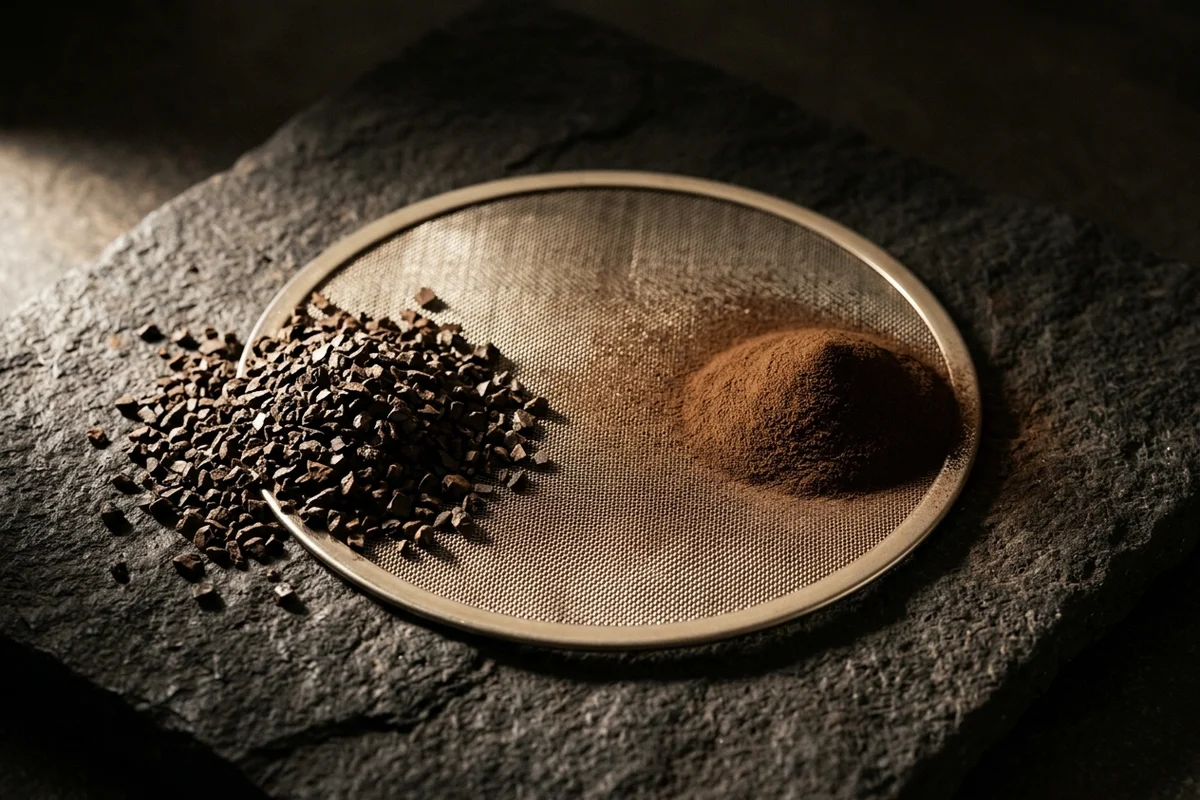
The peer-reviewed side of this is the Zurich espresso study that did the clean experiment: sieve the fines out at 120 µm, then add measured amounts back — 1 g, 2 g, 4 g — so that the median size and the fines share can be moved independently, which no grinder lets you do.
Modelling the whole distribution rather than a single number, the coefficients came out positive below 150 µm and negative above 250 µm: fines lengthen the shot, the coarse peak shortens it. And both the fines share and the median contributed to the model with similar normalised weight. That fines drive permeability and flow is something the same group established and this site has covered; what is new here is the consequence for your dial.
Which the same paper states flatly, and which no chart can express:
“For a given median grind size, different grinding technologies can yield a different share of fines.”
Two grinders. Same median. Different coffee.
So does the grinder itself matter?
This is where the search gets loudest and the evidence gets thinnest, so let me sort it into what has been measured and what has not. (If you were hoping a certification would settle it for you, no grinder carries the SCA’s — and the one lab that approves home grinders keeps its results private.)
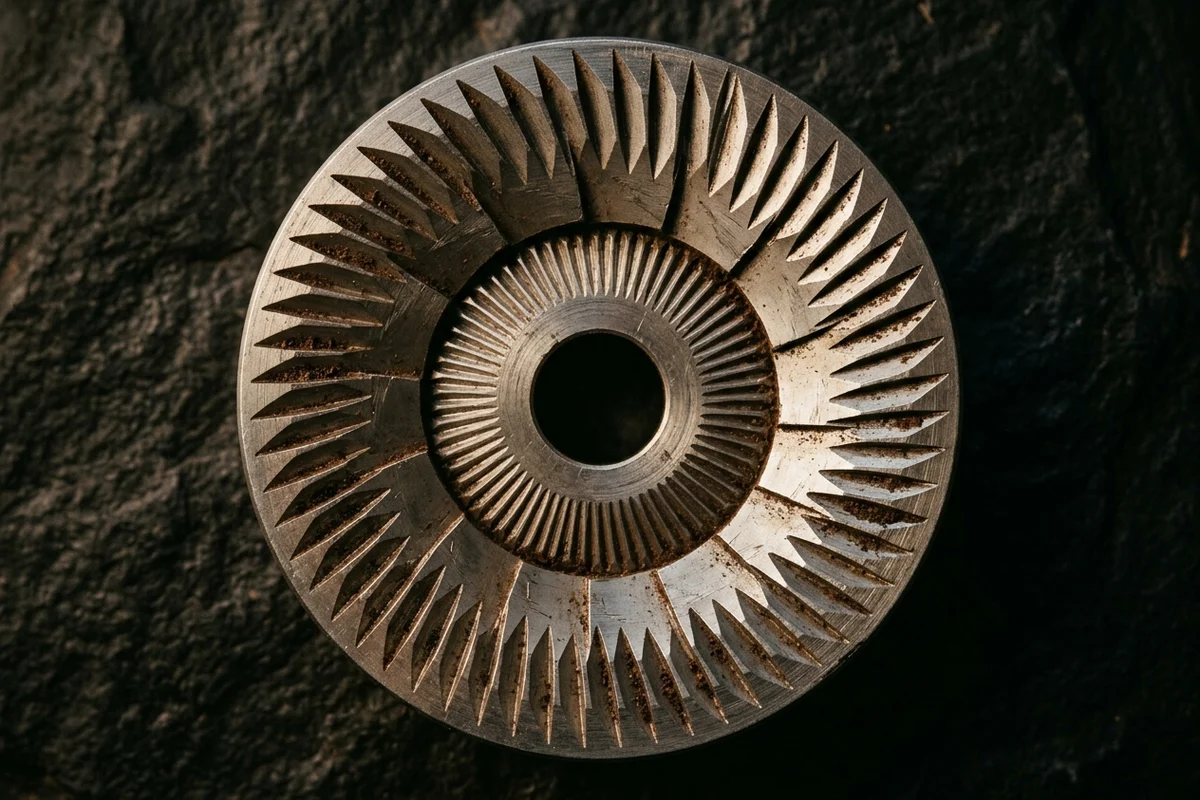
Measured: grinders differ in fines production at the same median. That is the Zurich finding above, and the 24-grinder dataset quantifies the spread. It is a real, physical difference between machines, and it changes how a shot flows.
Measured: well-maintained units of the same model agree closely. Four Mahlkönig EK43 units sifted at the cupping setting agreed to within 0.77 g — 1.54% standard deviation — across seven screens, and within 0.6% on most of them. Your grinder is probably not the odd one out.
Measured, and against the folklore: in the 24-grinder analysis, “contrary to popular hearsay, more unimodal grinders appear to also be more uniform on average,” and larger flat burrs did not systematically produce more uniform grinds in that dataset. Rotation speed showed no clear relationship either. The same data is the only large set that splits grinders by burr shape, and what it says about conical versus flat burrs has a piece of its own.
Measured, and the most useful caution in this article: the highest-rated grinders in that analysis were not at the extreme of either measure. They sat in the middle. Which implies particle distribution alone does not determine whether a grinder makes good coffee — the author suggests clumping and heating during grinding as other candidates.
Not measured: blade grinders. Page after page on this search asserts that blade grinders produce a chaotic distribution with fines and boulders side by side, and several attribute the claim to the Oregon group’s published work. Those studies used a single commercial burr grinder; no blade grinder appears in them. The physical argument is easy to believe — an impeller smashing beans repeatedly has no mechanism for sorting by size — but I could not find the measurement, and a claim everyone repeats with a citation that does not support it is worth marking as such.
Not measured: price against taste. I found no study relating what a grinder costs to how its coffee is rated under blind conditions. The chain that is evidenced is: grinder → fines share → flow and extraction. The last link — to a cup that people prefer — is the one I could not find published.
Two things move your grind without you touching the dial
If your setting works one day and not the next, it may not be the coffee getting stale.
Roast level. Sifting light against dark roasts of the same coffee across every setting on a calibrated grinder, the dark roast averaged “more than 4 percent fewer boulders and chaff, but more than 10 percent more fines.” That is a large move in the exact variable that governs flow, produced by changing bags rather than settings.
Temperature. Grinding beans straight from the counter against beans chilled hard, the modal particle size fell by 31% and the distribution narrowed. Which is why cafés creep the grind finer as the morning goes on and the burrs warm up — and why the correction is only ever approximate:
“Simply grinding finer with warm burrs will not produce the same result as grinding coarsely with cold burrs.”
You can match the median. You cannot match the distribution. One thing that turns out not to matter, usefully: the same study found particle size distribution to be independent of bean origin and processing method.
What I would actually do
Stop treating grind as the flavour dial, and start treating it as the strength dial. The measured chain runs grind → extraction time and strength → flavour. If a cup is too bitter, you now have two levers rather than one, and the cheaper one is the ratio. If it is thin and sour, the same applies in reverse.
Change one thing, and measure the thing that changed. A grind adjustment that moves strength by less than about a quarter of a percent TDS is, on the published threshold, below the level at which people reliably notice. If you are adjusting the grinder while your dose wanders by a gram, you are not running an experiment, you are shuffling variables. This is the whole argument for weighing the dose and for holding a recipe still while you dial.
In espresso, treat “finer” as having a ceiling. Past the point where the bed stops flowing evenly, finer buys you less extraction and a cup that tastes under- and over-extracted at the same time. If a shot is bitter and sour, grinding finer to “fix the sour half” is the one move guaranteed to make it worse. Try the other direction — coarser, with a little less coffee — because that is what the measured protocol did.
And if you are shopping for a grinder, buy for consistency, not for a number. What is actually evidenced is that grinders differ in how many fines they make at a given size, and that those fines set your flow. What is not evidenced is that the most extreme machine on that measure makes the best coffee — the top-rated units in the only large comparison I found sat in the middle.
The honest version of the answer to this search is short. Grind size changes your coffee, mostly by changing how strong it is; a single step is a smaller change than the advice implies; and the thing you are really adjusting is not a size at all, but how much dust ends up in the bed.
Sources
Every figure in this piece traces to one of these. Dates are when the source was read — lists and prices move.
- Effect of Basket Geometry on the Sensory Quality and Consumer Acceptance of Drip Brewed Coffee Frost, Ristenpart & Guinard — Journal of Food Science (2019) Full text read. Source of the triangle test results with 45 participants — 23 and 25 correct when basket geometry changed, 18 and 15 when grind changed at constant geometry — of the 266.0 ± 23.7 µm median particle size difference, of the resulting 15% and 21% relative strength increases, of the estimated 0.24 %TDS sensory difference threshold, and of the descriptive analysis counts of eleven attributes by roast, six by grind and three by geometry. The study did not hold brew strength constant across grinds, which is stated in the article. Read 17 September 2026
- Brew temperature, at fixed brew strength and extraction, has little impact on the sensory profile of drip brew coffee Batali, Ristenpart & Guinard — Scientific Reports 10, 16450 (2020) Open access, read in full. 27 sample types across nine positions on the brewing control chart at three temperatures, 270 separate brews, 31 attributes, trained panel, blind and in triplicate. Source of the finding that bitterness and several other attributes increased solely with TDS rather than with percent extraction, and of the statement that coffees brewed at 87 °C were indistinguishable from those at 93 °C provided grind, brew ratio and flow rate were adjusted to hold TDS and PE constant. Read 17 September 2026
- Systematically Improving Espresso: Insights from Mathematical Modeling and Experiment Cameron, Morisco, Hofstetter, Uman, Wilkinson, Kennedy, Fontenot, Lee, Hendon & Foster — Matter 2(3), 631–648 (2020) Read in full. Source of the peaked relationship between extraction yield and grind setting, of the 13.1%, 6.1% and 2.6% model-experiment discrepancies at the three finest settings, of the observation that two different grind settings can produce the same 22% extraction yield, of the description of non-homogeneous flow producing simultaneously under- and over-extracted flavours, and of the downdosing protocol that cut coffee mass by 25%. The authors note flavour differences were observed but not quantified. Read 17 September 2026
- The role of fines in espresso extraction dynamics Smrke, Eiermann & Yeretzian — Scientific Reports 14, 5612 (2024) Open access, read in full. Fines sieved at 120 µm and added back in known amounts so that median size and fines share could be varied independently. Source of the partial least squares coefficients that are positive below 150 µm and negative above 250 µm, of the finding that fines share and median size contribute to the extraction time model with similar normalised coefficients, and of the turbo shot yields of 17–18% in under 15 seconds. Its sensory assessment was a single Q-grader scoring hedonically, which the authors state was not a systematic double-blind test. Read 17 September 2026
- What I learned from analyzing 300 particle size distributions for 24 espresso grinders Jonathan Gagné — Coffee ad Astra, 21 September 2023; measurements by Marco Wellinger, Zurich University of Applied Sciences Read in full. Not peer-reviewed: an independent analysis of laboratory data measured on a Retsch Camsizer X2 at ZHAW, across 24 grinders and three dial-in recipes. Source of the statement that dialling in espresso dials in the amount of fines more than the average size of coarse particles, of the finding that more unimodal grinders are also more uniform on average, of the absence of a systematic advantage for larger flat burrs in this dataset, and of the observation that the highest-rated grinders sit in the middle of these measures rather than at an extreme. Read 17 September 2026
- Grinder Alignment: An Evaluation of Consistency, Cupping Settings, and the Impact of Roast Degree Chris Kornman and Elise Becker, with Sandra Elisa Loofbourow — Royal Coffee / The Crown, 4 August 2021; first published in Roast Magazine, May–June 2021 Read in full. Five Mahlkönig EK43 units sifted on seven Kruve screens. Source of the roast-degree differential — a dark roast averaging more than 10% more fines and more than 4% fewer boulders than a light roast of the same coffee across all settings — and of the unit-to-unit agreement of 1.54% standard deviation or better at the cupping setting. Trade press, not peer-reviewed; method and screen-by-screen figures published. Read 17 September 2026
- The effect of bean origin and temperature on grinding roasted coffee Uman, Colonna-Dashwood, Colonna-Dashwood, Perger, Klatt, Leighton, Miller, Butler, Melot, Speirs & Hendon — Scientific Reports 6, 24483 (2016) Open access, read in full. Source of the finding that particle size distribution is independent of bean origin and processing method, of the 31% reduction in modal particle size when beans are ground at −196 °C rather than room temperature, and of the conclusion that grinding finer with warm burrs does not reproduce grinding coarsely with cold burrs. The grinder used was a single EK43; no blade grinder was tested. Read 17 September 2026
- Coffee Grind Size: How Does Grind Size Affect Coffee Moccamaster USA Read in full as one of the strongest-ranking pages for this search, and quoted for the shape of the answer it gives: the over-extraction and under-extraction pairing, with no figure, no threshold and no citation anywhere on the page. Read 17 September 2026