
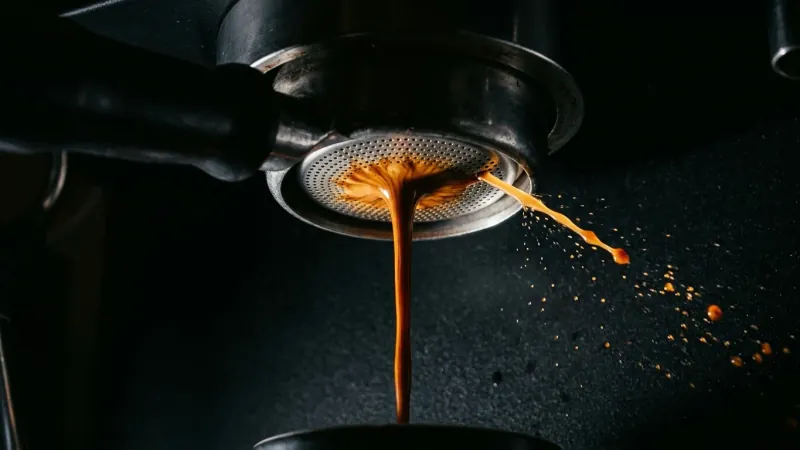
Your shot sprays sideways out of the basket. You search, and every page tells you the same three things caused it — grind, distribution, tamp — and the same three things will fix it. Use needles, tamp level, adjust the grind.
Most of that advice is sound. I gave a version of it myself in the piece on puck preparation. But it rests on an assumption that the published physics does not support, and the assumption is doing real damage to how people diagnose their shots.
The assumption is that channeling is a fault: a thing that either happened or didn’t, caused by a mistake, curable by fixing the mistake.
Here is what four independent groups have measured and modelled instead.
| What happens | Who showed it | What kind of evidence |
|---|---|---|
| The imbalance is born. The bed takes about 6.7 seconds to wet, and the water does not start moving in every part of it at the same moment | Foster and colleagues, 2025 | X-ray film at 1,000 frames per second |
| The imbalance grows. Extraction opens pores, pores raise permeability, permeability pulls more flow — so any difference amplifies itself | Lee, Smith and Arshad, 2023 | Model fitted to measured yields |
| A second amplifier joins in. Above a stress threshold, flow tears fine grains out of the gaps between coarse ones | Mahadevan and colleagues, 2012 | Experiment in a bead-packed cell |
| The bed is permanently rearranged. After the shot, micro-CT shows it more porous at the outlet than at the inlet | Mo and colleagues, 2023 | Micro-CT before and after |
Not one of those four links appears on the first page of these searches. Together they say something the guides do not: uneven flow is not an event in your shot. It is a process running in every shot, and the spray is only the point at which it became visible.
Nothing defines it
Before the mechanism, the housekeeping. This site spends a lot of time reading standards, so: no standard defines channeling, or flow uniformity, or anything adjacent.
The only in-force third-party certification for espresso is the Italian one, and its parameter table fixes dose, water temperature, cup temperature, inlet pressure, percolation time, volume in the cup, viscosity, fat and caffeine. There is no parameter for how evenly the water went through.
The closest thing to a published definition is a line in the 2026 poroelastic study, and it is more useful than the usual one:
“In a channelled coffee, the flow through a puck is focused in one or several channels instead of uniformly penetrating the sample. As a result, even at relatively high flow rates, the extraction yield of coffee remains low.”
Read the second sentence carefully, because it inverts a thing people find confusing. A shot that runs fast and tastes weak is not a contradiction. It is the signature. Fast flow plus low yield is what a channel produces, by definition.
Where the imbalance comes from: the first seven seconds
Every model of channeling starts by assuming a small initial difference in the bed and then showing what happens to it. Until last year, nobody had checked whether that difference exists or where it comes from, because the part of the shot in which it forms had never been measured. The 2025 paper opens by saying so:
“In espresso brewing, models have typically neglected the first third of the brewing process in which the liquid infiltration front moves through the bed.”
The first third of your shot is the part where the water is still finding its way into a dry bed. That is the part nobody had modelled.
So the team built something to look at it. Not a normal CT scanner — in a normal scan the object rotates, which would disturb the very thing they wanted to watch. Instead they used a rotating x-ray system at the Fraunhofer institute, where the source and detector orbit the machine on a slip ring and the coffee stays still. Running at 160 kV and 5 mA, one full rotation per second, 1,000 frames per second, into a detector with 64 GB of onboard memory.
The espresso machine was a De’Longhi Dedica, physically modified to remove metal parts that were wrecking the reconstruction without changing how it brewed. Ten grams of 100% Arabica, tamped by hand with the portafilter sitting on a scale until it read 12 kg. Then 30,000 projections over 30 seconds, sliced into thirty one-second 3D reconstructions — an x-ray film of water entering a coffee puck.
They tracked the wetting front down five separate vertical lines through the bed. Here is the sentence that matters:
“There is some variation in the initiation of the front movement at different locations.”
The water does not start moving through every part of the bed at the same moment. Ponding above the bed begins at 0.823 seconds; the bed does not become fully saturated until 6.669 seconds. For most of that window, some of your coffee is already brewing and some of it is still dry.
That is the initial difference. It is not a mistake you made. It is what happens when a pump pushes water into a dry granular bed.
Two honest notes, both from the authors. Their model assumes a flat, one-dimensional front, and they say relaxing that would be “relatively straightforward” — they have the spatial data, they just have not done it yet. And they report results for the fine grind only, because, in their words, “the wavefront of the coarse grind has a more complex shape.” The coarse grind wetted less tidily and was set aside.
There is also a small, striking gap they note in passing: there is no clear data in the literature on the capillary pressure generated by coffee beds. One of the basic properties governing how water enters a puck has not been published.
Why the imbalance grows instead of evening out
Now the amplifier. This is the part every guide gets half-right.
The usual phrasing is that “water finds the path of least resistance.” True, and incomplete in a way that matters. The 2023 two-pathway model states the full loop:
“This proposed mechanism is based on a positive feedback loop in which flow and extraction reinforce each other. Extraction causes an increase in porosity and thus permeability. This increase in permeability will in turn lead to more flow and so more extraction will occur. This suggests that small differences in porosity in the coffee bed will become amplified over time.”
Read that as a cycle:
coffee dissolves → pores open → permeability rises → more water goes that way → more coffee dissolves.
Water does not merely find the easier path. The path becomes easier because water went through it. That is why a small difference does not average out over thirty seconds — it runs away.
And the scale is not marginal. As the authors note, “usually up to around 30% of the coffee is removed during the extraction, so there is scope for considerable variation in porosity and thus permeability.” Almost a third of the bed’s solid mass leaves during the shot. The structure you tamped is not the structure the water finishes in.
The finding that reframes the question
The team built this model to explain a specific puzzle: the 2020 Matter experiment had found that as you grind finer, extraction yield rises, peaks, and then falls — which no simple theory predicted. Their working assumption was that the peak marked the moment uneven flow began.
It didn’t.
“In building this model the initial assumption was that the peak in extraction yield would indicate the onset of uneven flow between the different pathways. In fact the model suggests that uneven flow between pathways is always present and that the peak in extraction yield is due to dissolution of all soluble coffee from one part of the coffee bed.”
Always present. At every grind size, including the ones on the sensible side of the peak, including the shots that pour beautifully.
And then the sentence I would put on the wall of every home espresso setup:
“differences in porosities between pathways will always be amplified but as the amount of coffee extracted from one region decreases, an overcompensating increase in the extraction of coffee from other regions masks this trend until all the soluble coffee is dissolved.”
The imbalance is masked. While one region is falling behind, the faster region over-extracts enough to keep the total looking normal. Your yield is fine. Your shot time is fine. The bed is already lopsided.
So “my shot looks good” and “there is no channeling” are not the same statement. The first is about whether the compensation is still holding.
When it stops hiding
The mask comes off when the fast pathway runs out of coffee to give.
In the model at the finest setting, that happens at a dimensionless time of about 0.8 — comfortably before the shot ends:
“At τ ≈ 0.8 all the available coffee has been dissolved from the grains in pathway 1 … coffee in solution is washed out of the system by the flow but is not replaced by further dissolution.”
For the last stretch of that shot, a large fraction of your coffee bed is finished. It has nothing left to contribute and is simply being rinsed with hot water that then goes into your cup. Meanwhile the slow region never caught up.
At the coarse setting the gap between the two pathways still widens — the instability is still running — but neither side exhausts. That difference, exhaustion versus mere imbalance, is what produces the peak in the yield curve.
Which is the real answer to does grinding finer fix channeling. Past a point, finer does not give the water more coffee to work with, it gives the imbalance more room to run.
Same number, different drink
There is a taste prediction that falls straight out of this, and it connects to something I wrote about earlier.
“beyond the turnover point we expect at least some part of the coffee bed to be significantly over extracted, in fact for all soluble compounds to be dissolved, we would expect the coffee brewed beyond this point to have a more bitter taste than coffee brewed with the same overall extraction yield at the high grind size.”
Two shots, identical extraction yield, different flavour — because in one of them a region went all the way to exhaustion. This is the mechanism under the shot that tastes sour and bitter at the same time: not a shot sitting between two errors, but two errors happening in different parts of one puck.
The authors draw the obvious conclusion themselves: “the non-uniform extraction suggests that the average extraction yield may not be a good guide to taste, particularly at fine grind sizes.”
One caveat the authors raise and I will not bury. To reproduce the falling branch of the curve, the model needed a saturation concentration twice the measured value — a number they call unphysical. They also treat the grind as single-sized when it is famously bimodal. The mechanism is well supported; the precise numbers are a simple model straining to match a hard experiment.
The second amplifier: erosion
Dissolution is not the only thing opening pores. Grains move.
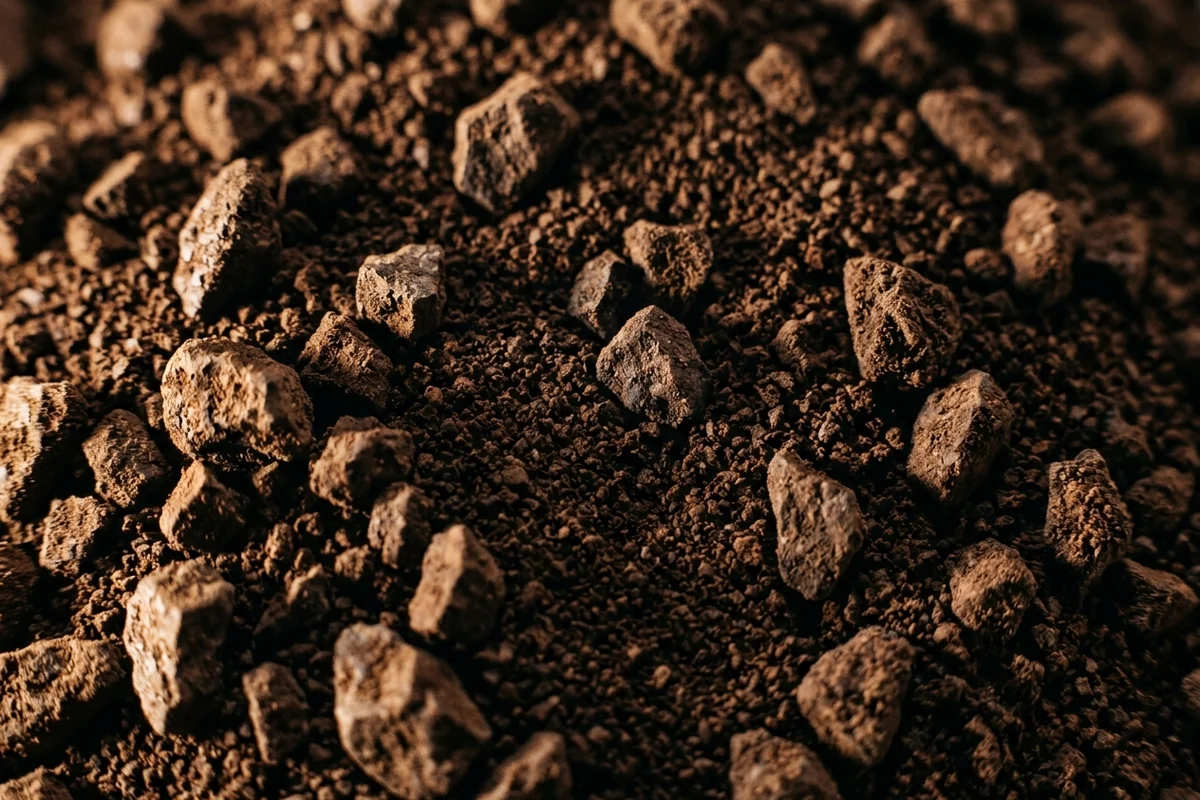
The cleanest experiment on this is not about coffee at all, which is what makes it useful — it isolates the mechanics from the chemistry. A team published it in EPL in 2012, using a vertical Hele-Shaw cell packed with a bidisperse mixture of glass beads:
| Large beads | 4 ± 0.1 mm, 60% of the volume |
| Small beads | 0.7 ± 0.1 mm, 24% of the volume |
| Cell width | 1.2 × the large bead diameter |
| Flow ramp | 0.65 → 3.27 cm/s over three hours, in steps of 0.13 cm/s with 600 s to settle |
That bed is a rough mechanical model of a coffee puck: two particle sizes, the coarse fraction holding the structure, the fine fraction sitting in the gaps. Coffee’s own distribution is bimodal in exactly this way — fines around 30–40 µm, coarses somewhere between 100 and 200 µm depending on the grinder.
What happens under flow:
“the process involves the dislodgment and movement of the smaller grains from the interstices between the larger grains. This leads to a local increase in the hydraulic conductivity and a readjustment of the flow.”
Same outcome as dissolution — local conductivity rises, flow reroutes — by a completely different route. Nothing needs to dissolve; small particles simply get pulled out of the gaps.
What actually cuts the channel
And now the finding that changes what you do, which took me by surprise:
“As the material erodes and porosity increases, the pressure gradient drops below the critical erosive stress threshold and erosion stops. Thus, for every increment in the flow rate, the pressure gradient is raised above the threshold and leads to further erosion for a short while before it stops.”
Unpack that:
- Erosion has a threshold. Flow has to push hard enough to dislodge a grain.
- Once it does, the channel opens — and opening the channel lowers the local pressure gradient.
- The gradient falls back below the threshold and erosion stops by itself.
- But every increase in flow rate pushes it back over the threshold, and it starts again.
At steady pressure, erosional channeling is self-limiting. It is the changes that keep cutting.
Hold that next to a result from the 2026 poroelastic study, which came at this from an entirely different direction. They photographed pucks with micro-CT before and after brewing, and the post-brew images show something structural: horizontal delamination, and the bed partly lifted off the bottom filter mesh with a layer of air in between. To find out where that came from, they brewed at 8 bar for about 75 seconds and then cycled the pump on and off:
“Upon repeated brewing, we witness a significant increase of the flow rate without additional dissolution, which suggests that a reconfiguration of the sample takes place each time the pressure is applied.”
Flow went up. Extraction did not. That is a channel forming, watched in real time. Their conclusion:
“any brewing process that involves a temporary pause or repeated application of pressure might be prone to channelling and therefore should be avoided.”
The mechanism they identify is the three-way valve that every modern espresso machine has: when pressure drops, it pulls water back off the top of the puck and the bed moves. That valve is also the reason a spent puck looks dry at all, which makes the tidy dry-puck-good story harder to hold than it sounds.
Two literatures that never cite each other, arriving at the same place. Glass beads in a physics lab and coffee under an x-ray both say the damage is done by the transition, not by the plateau.
I want to be careful about how far to push this. The 2026 team showed it on their own rig, over long brews, with deliberate on-off cycling, and they did not test commercial pre-infusion profiles — so neither will I claim they did. But if your puck preparation is meticulous and your shots still channel, the profile is a place to look that no one is pointing at.
| Dissolution feedback | Erosion | |
|---|---|---|
| What moves | Soluble coffee, into the water | Fine particles, through the bed |
| Threshold? | No — runs at any flow | Yes — needs a critical stress |
| Self-limiting? | No, it accelerates | Yes — stops as the gradient falls |
| What restarts it | Nothing; it never stops | Any increase in flow or pressure |
| Shown in | Lee et al., 2023 (model) | Mahadevan et al., 2012 (experiment) |
What the bed looks like afterwards
If all of that is happening, the spent puck should carry evidence. It does, and the evidence is not what you would guess.
A 2023 study scanned coffee before and after extraction with micro-CT at 16.8 µm per voxel — 80 kV, 3,201 projections per scan — and simulated the flow through the reconstructed structure. Their finding:
“By comparing the microCT images of pre- and post-extraction coffee matrices, it is found that a decreasing porosity profile (from the bottom-outlet to the top-inlet) always develops after extraction.”
After the shot, the bed is more open at the bottom than at the top. The authors flag how odd that is themselves:
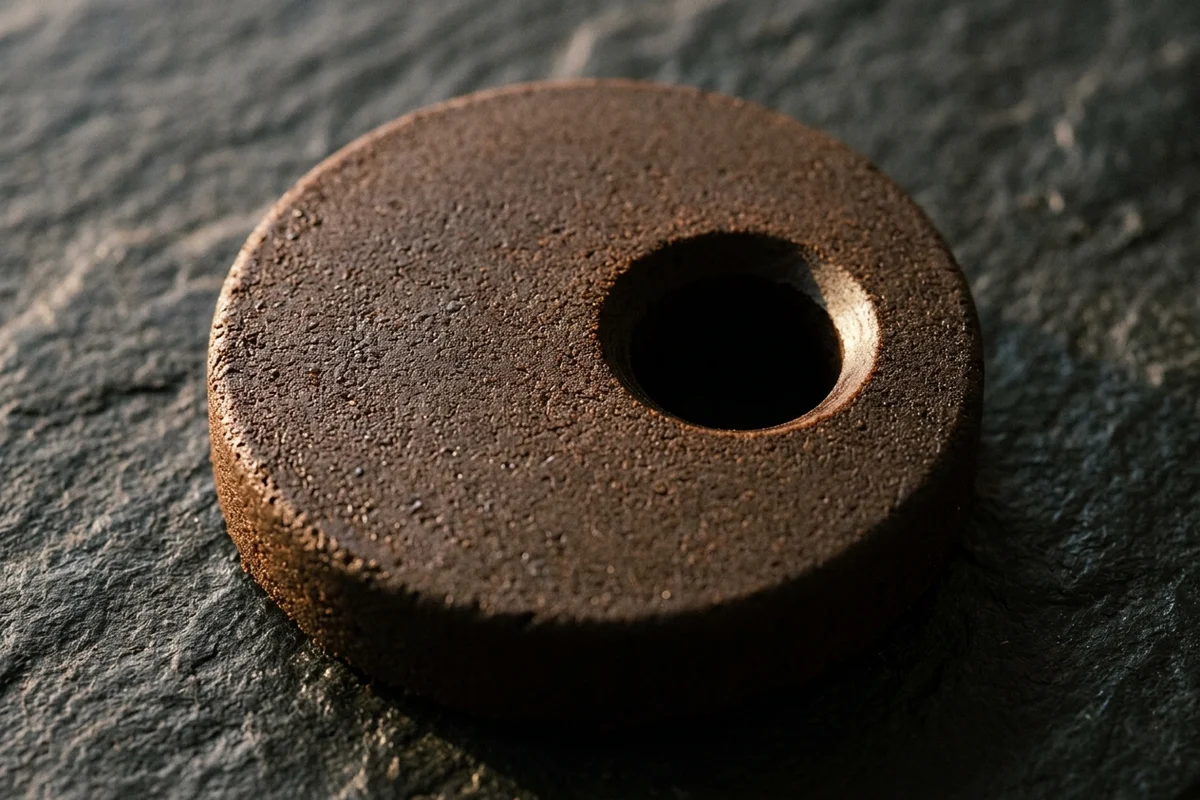
“This phenomenon is counterintuitive since we would expect the gravity will drive the residual water and other fragments to the bottom making the lower part of the matrix less porous. During extraction the applied external pressure should also have consolidated the matrix more efficiently on the bottom.”
Gravity should pack the bottom. Pressure should pack the bottom. The bottom comes out looser anyway — which they attribute to pressure-dependent erosion, the mechanism from the previous section, running hardest where the pressure gradient is steepest.
The same paper contains a second result worth knowing if you read coffee physics: at espresso pressure gradients the Reynolds number ran between 0.84 and 3.86, high enough that inertia matters and Darcy’s law stops applying. Use Darcy anyway and you get “a permeability decreasing with an increasing pressure gradient” — an artefact, not a property. That, they argue, is why published permeability figures for coffee disagree with each other: the low-pressure measurements and the high-pressure measurements were never measuring the same thing.
The boundary on this one is real and I will state it plainly: that study was run on capsule espresso — illy Iperespresso capsules, 6.7 g, in a capsule machine at 13 bar — not a 58 mm portafilter. The mechanism transfers. The numbers do not. The authors also note that once the coffee is wet, micro-CT cannot cleanly separate liquid from solid, so they work with relative spatial variation rather than absolute porosity values.
Why your refractometry cannot see any of this
If you own a refractometry setup and measure extraction yield, there is a limit on it you should know, and it is published rather than folklore.
The 2020 Matter team put it directly: “estimating the level of inefficiency in a given extraction is not possible using the refractive index measurement alone.” And they explain why — in inhomogeneous flow “there are regions of the granular bed that have been extracted far higher than measured with an average EY.”
An extraction yield is a single number describing a bed that was never at that number anywhere. Combine it with the masking result above and the situation is uncomfortable: the instrument that tells you how your extraction went is structurally blind to the thing most likely to be wrong with it.
That is not an argument against measuring. It is an argument for knowing what the measurement covers. Yield tells you how much came out. It tells you nothing about where from.
Depth versus sideways
One more blind spot, and this one is an admission from inside the field.
Simulations of coffee brewing have largely studied how extraction varies with depth — top of the bed versus bottom. That variation is real and unavoidable: in a modelled bed with a constant flow through it, extraction ran roughly five percentage points higher at the inlet than at the outlet. (That figure comes from a 59 mm bed holding 60 g of coffee at 250 ml/min — filter scale, not espresso, so treat it as mechanism rather than measurement.)
But depth is not where channeling lives. From the 2023 conclusions:
“This result also has implications for simulations of coffee brewing. These have typically focussed on variations with depth but have not considered lateral variations in extraction.”
Vertical variation is physics you cannot prevent. Lateral variation is the part your preparation touches. And it is the part the modelling literature had mostly not looked at.
Fines: three sources, one correction
A popular explanation runs: fines migrate down, clog the basket, and force water to find another way out. It is intuitive and the evidence is mixed against it.
- Fines do lower permeability. Sieving fines out at 20 µm and adding measured amounts back into a 20 g dose, a 2024 study found that a rising share of fines “decreases coffee bed permeability, leads to reduced flow rates and longer extraction times.”
- Fines are the mobile phase. In the bead experiment it was precisely the small fraction that got dislodged and carried.
- But clogging is not what makes yield fall. Clogging was the original hypothesis for the peak in the yield curve. The 2023 modelling tested it — clogging appears in that framework as a large initial permeability difference — and rejected it: “the same value of γ is used for all the simulations, so the model does not support the idea that the onset of clogging is responsible for the turnover in the trend.”
So fines are involved in all of it and are not the villain of the specific story usually told about them.
What a bottomless portafilter actually shows you
The honest answer has two halves, and the guides only give one.
What it shows. Where the flow leaves the bed, in real time, with no spout to hide it. A jet firing sideways means one region is moving fast enough that its stream has not merged with the others before clearing the basket. That is genuine information and you cannot get it any other way.
What it does not show. Everything below that threshold — which, given the “always present” result, is every shot you have ever pulled. And the best home evidence says the sub-threshold portion is not small. In a careful 24-shot experiment on a machine that controls its own pressure profile, with deep needle work and a self-levelling tamper, the observation was:
“All the spent pucks from today’s experiment had a slight hollow near the center, indicating that water flowed unevenly”
Every puck. So:
| What you observe | What it tells you | What it does not tell you |
|---|---|---|
| A jet spraying sideways | One region crossed the visible threshold | How much unevenness the other shots had |
| A clean, converging stream | No region crossed the threshold | That flow was even — it wasn’t |
| Shot time moving between pulls, everything else held | The starting imbalance is varying — a preparation problem | Where in the bed it is |
| Fast flow, weak taste | The published signature of a channel | Whether it was one channel or many |
| A hollow in the spent puck | Water preferred the centre | Whether that mattered in the cup |
| A spotless puck surface | Almost nothing | Anything about what happened inside |
Used as a threshold detector, it is excellent. Used as a uniformity meter, it will tell you that you have solved a problem you have only made quieter.
Does a better basket fix it?
Precision baskets are sold on this. One widely available 18 g basket lists 661 holes at 0.30 mm, a 70 mm edge and a 24 mm height — all verifiable, specific numbers, which I appreciate — and then claims the holes are “distributed … to eliminate channeling.”
No published comparison supports that. The specification is real; the claim attached to it is not tested.
The closest peer-reviewed work is a study on drip baskets, and its result is a good lesson in why this is hard. Semi-conical and flat-bottom baskets were reliably distinguishable by a panel (P < 0.05, N = 45), and the differences drove consumer liking. But the semi-conical basket also brewed at significantly higher %TDS — and the estimated sensory difference threshold was 0.24 %TDS. Geometry and strength moved together, so the study cannot say the shape alone did it.
That is a drip study and I am not carrying it into a portafilter. What carries is the shape of the problem: if you want to claim a basket geometry reduces channeling, you have to hold concentration constant, and nobody has published that for espresso.
What I would actually do
Ordered by how much the evidence supports it, which is not the order the searches give you.
| Step | What the evidence says | Worth doing? |
|---|---|---|
| Reduce the starting imbalance — de-clump, tamp level, and get the puck prep right | The imbalance gets amplified whatever its size, so a smaller start finishes smaller. This is the whole game | Yes. It is the only lever on the input |
| Stop reading a clean pour as proof | Uneven flow is always present and is masked until a region exhausts | Yes — it changes what you conclude, which changes what you do next |
| Watch shot-to-shot variation, not one shot | A time that moves with everything else held constant is the preparation signal | Yes. More informative than any single pour |
| Look hard at pressure changes in your profile | Erosion restarts at every flow increment; cycling the pump raised flow with no extra extraction | Yes, with the caveat that commercial pre-infusion has not been tested |
| Grind finer to build resistance | Past the peak, finer gives the imbalance more room; one pathway can exhaust before the shot ends | No. This is the reflex that most often backfires |
| Trust an extraction-yield number to detect it | Published limitation: an average cannot show inefficiency | No. Measure, but do not ask it this question |
| Buy a basket that claims to eliminate channeling | Specifications are real; the channeling claim has no published test | Not for this |
| Expect to eliminate it | Always present, at every grind size | No. Manage it |
Affiliate links. Some product names below link to Amazon. If you buy through one I earn a commission at no extra cost to you, and it never changes which product gets named or what the measurements say. Full disclosure.
The one piece of hardware genuinely worth the money here is a bottomless portafilter, and for a specific reason: it is the only tool that converts an invisible process into something you can watch. It does not fix anything. It tells you when you have crossed the line — and, if you have read this far, you now also know how much it is not telling you.
Which leaves the reframe I would want someone to take away.
Stop asking whether your shot channelled. It did, a little, like every shot, because a pump pushing water into a dry bed cannot wet all of it at once and because the first place water goes becomes the easiest place for the next water to go. The real question is how far the imbalance got before the water ran out — and the honest instruments for that are a bottomless view, a variation in shot times, and a cup that tastes like two mistakes at once.
Your job is not to prevent it. It is to keep it small enough, and steady enough, that the same thing happens tomorrow.
Sources
Every figure in this piece traces to one of these. Dates are when the source was read — lists and prices move.
- Dynamics of liquid infiltration into an espresso bed using time-resolved micro-computed tomography: Insights from experiment and modeling Foster, Lee, Moroney, Prjamkov, Salamon, Smith, Petrassem-de-Sousa & Vynnycky — Physics of Fluids 37(1), 013383 (2025); Open Access, CC BY-NC Full text read. A rotating x-ray system at 160 kV filming at 1,000 frames per second through a modified espresso machine, 30,000 projections over 30 seconds. Source of the observation that the infiltration front does not begin moving at the same moment in different parts of the bed, of the ponding and saturation times, and of the authors' note that models had previously neglected the first third of the brewing process. Read 11 September 2026
- Uneven Extraction in Coffee Brewing Lee, Smith & Arshad — Physics of Fluids (2023); arXiv:2206.12373v2 Full text read. A two-pathway model of an espresso bed. Source of the positive feedback loop between flow and extraction, of the finding that uneven flow between pathways is always present, of the exhaustion of one pathway at a dimensionless time of about 0.8, of the prediction that the same average yield can taste more bitter, and of the authors' own admission that reproducing the observed trend required an unphysical saturation concentration. Read 11 September 2026
- Flow-induced channelization in a porous medium Mahadevan, Orpe, Kudrolli & Mahadevan — EPL (Europhysics Letters) 98, 58003 (2012) Published version read in full. A Hele-Shaw cell packed with a bidisperse bead mixture — 60% at 4 mm, 24% at 0.7 mm — with flow ramped from 0.65 to 3.27 cm/s. Source of the erosion threshold, of the finding that erosion stops once porosity rises and the pressure gradient drops back below that threshold, and of the observation that each increment in flow rate restarts it. Read 11 September 2026
- Exploring the link between coffee matrix microstructure and flow properties using combined X-ray microtomography and smoothed particle hydrodynamics simulations Mo, Johnston, Navarini & Ellero — Scientific Reports 13, 16374 (2023) Open-access full text read via PubMed Central. Micro-CT at 16.8 µm per voxel with flow simulated by smoothed particle hydrodynamics. Source of the finding that a decreasing porosity profile from outlet to inlet always develops after extraction, which the authors call counterintuitive, and of the Reynolds numbers showing that inertia breaks Darcy's law at espresso pressure gradients. Run on capsule espresso, not a 58 mm basket. Read 11 September 2026
- Under pressure: poroelastic regulation of flow in espresso brewing Waszkiewicz, Myck, Białas, Puciata-Mroczyńska, Dzikowski, Szymczak & Lisicki — Physics of Fluids 38, 063113 (2026); arXiv:2512.21528v2, CC BY 4.0 Full preprint text read. Source of the published definition of a channelled coffee, of the micro-CT images showing horizontal delamination and partial lift-off of the bed from the filter mesh, and of the experiment in which cycling the pump raised the flow rate without additional dissolution. Read 11 September 2026
- Systematically Improving Espresso: Insights from Mathematical Modeling and Experiment Cameron, Morisco, Hofstetter, Uman, Wilkinson, Kennedy, Fontenot, Lee, Hendon & Foster — Matter 2(3), 631–648 (2020) Full text read. Source of the peaked relationship between grind setting and extraction yield that the later modelling work set out to explain, and of the statement that the level of inefficiency in an extraction cannot be estimated from a refractive index measurement alone. Read 11 September 2026
- The role of fines in espresso extraction dynamics Smrke, Eiermann & Yeretzian — Scientific Reports 14, 5612 (2024) Open-access full text read. Fines separated on a 20 µm sieve and added back in known amounts to a 20 g dose on a VST basket at 9 bar. Source of the finding that a rising share of fines lowers bed permeability and lengthens extraction. Read 11 September 2026
- Analysing extraction uniformity from porous coffee beds using mathematical modelling and computational fluid dynamics approaches Moroney, O'Connell, Meikle-Janney, O'Brien, Walker & Lee — PLOS ONE 14(7), e0219906 (2019) Open-access full text read. A 59 mm cylindrical bed holding 60 g of coffee at a constant 250 ml/min. Cited only for the mechanism that extraction varies with depth inside a single bed; its numbers are filter-scale, not espresso-scale. Read 11 September 2026
- Effect of Basket Geometry on the Sensory Quality and Consumer Acceptance of Drip Brewed Coffee Frost, Ristenpart & Guinard — Journal of Food Science (2019) Full text read. Semi-conical and flat-bottom drip baskets were distinguishable in triangle tests, but the semi-conical basket also brewed at significantly higher %TDS, so geometry and strength moved together. Cited here as the boundary on what a basket-shape claim can be said to show. Read 11 September 2026
- A Study of Espresso Puck Resistance and How Puck Preparation Affects it Jonathan Gagné — Coffee ad Astra, 16 January 2021 Read in full. Twenty-four shots at 18.0 g on a Decent DE1. Source of the observation that every spent puck in the experiment carried a slight hollow near the centre despite deep needle work and a self-levelling tamper. Read 11 September 2026
- The Certified Italian Espresso and Cappuccino Istituto Nazionale Espresso Italiano The institute's own booklet, read in full for an earlier piece. Its certification table fixes dose, temperature, pressure, percolation time, cup volume, viscosity, fat and caffeine, and contains no parameter for flow uniformity. Read 10 September 2026