
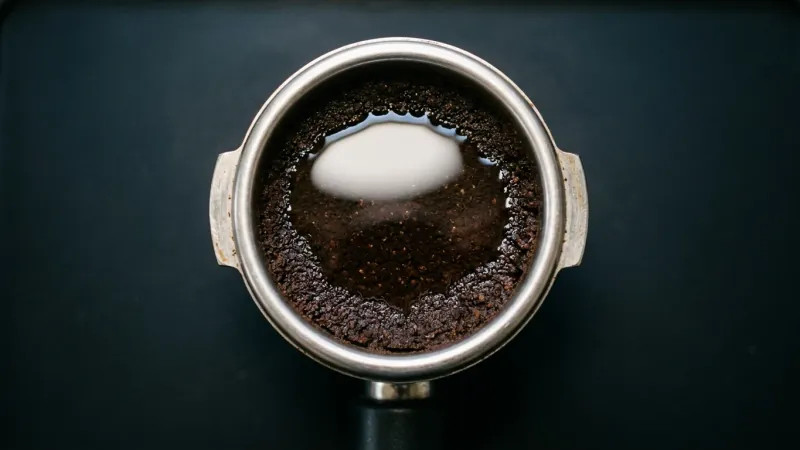
You pull a shot, unlock the portafilter, and there is a puddle sitting on the coffee. Or the bed is a slurry that will not knock out. Or the whole puck has stayed up in the machine and you are looking at an empty basket.
Search any of that and you get the same six causes in a different order every time: under-dosing, grind too coarse, grind too fine, uneven tamp, channeling, air pockets. Sometimes a line about a three-way valve. Almost always a reassuring closer about how taste is what matters.
The closer is right. Most of the rest is guessing, and the guessing shows: a major machine manufacturer and a major specialty retailer give opposite advice about the same symptom, and both are on the first page.
The reason nobody can settle it is that “wet puck” is not one thing. It is two separate volumes of water that get looked at together:
- the water inside the coffee bed, which has been measured, is about the same in every shot, and is not going anywhere;
- the water on top of the bed, which your machine is supposed to remove at the end of the shot, and which some machines do not remove at all.
Once you separate them, most of the advice on this subject sorts itself into “true of the second one” and “not true of either.”
| What was measured | Who measured it | Kind of evidence |
|---|---|---|
| A 20 g puck keeps 20.85 g of water — more than its own dry weight — on a commercial machine at a verified 9 bar | Socratic Coffee, 2015 | 86 shots, weighed |
| That figure barely moves. New burrs against burrs with 1,500 kg through them: a difference of 0.09 g | Same experiment | t-test, p = 0.30 |
| The valve clears the surface, not the bed. Its published job is to vent the chamber above the coffee to atmosphere | Carimali patent, 2021 · Waszkiewicz and colleagues, 2026 | Granted claim · peer-reviewed |
| And that venting tears the bed. Micro-CT after a shot shows horizontal cracks and the puck peeled off the filter mesh, air in the gap | Waszkiewicz and colleagues, 2026 | Micro-CT, before and after |
Read the last two rows together, because they are the uncomfortable part. The dry puck you want is produced by the event that wrecks the puck’s structure. A dry puck is evidence that your valve fired. It is not evidence that your shot was good.
The 21 grams
Here is the number the whole search is missing.
In April 2015, two people working under the name Socratic Coffee set out to test a claim from Scott Rao’s The Professional Barista’s Handbook — quoted in their write-up from page 8 — that with small, dull, flat burrs, “20 to 25% of each puck was still completely dry.” I have not read the book, so I am passing that on as they reported it, not citing it directly.
Their method was blunt in the best way. Weigh the portafilter dry. Weigh it with the dose. Pull the shot. Weigh it again. The difference is the water the bed kept.
| Part of the rig | What it was |
|---|---|
| Machine | La Marzocco Linea, single group, 0.8 mm restrictor, double-spout portafilter with the original basket |
| Pressure | 9 bar, verified with a Scace II |
| Grinder | Mazzer Major E |
| Sharp burrs | about 2 kg of coffee through them in their life, plus a 1.3 kg purge on the day |
| Dull burrs | about 1,500 kg of coffee through them |
| Coffee | single-origin Guatemala, Agtron 71 whole bean and 76 ground |
| Recipe | 20 g in, 40 g out |
| Shots | 43 on the sharp set, 43 on the dull set |
| Scales | Ohaus for the dry dose and the wet puck, AWS for the beverage |
The result:
- sharp burrs: 20.85 g of water retained, standard deviation 0.72 g
- dull burrs: 20.94 g, standard deviation 0.81 g
A one-tailed equal-variance t-test gave p = 0.30; two-tailed, 0.59. In their words, “no statistical difference was seen between the sharp and dull blade post-brew water retention weights, demonstrating the quantity of water saturating the espresso puck did not vary based on burr condition.”
Sit with the size of that first number for a moment. Twenty grams of dry coffee went in. Twenty-point-eight-five grams of water stayed behind.
| Figure | Where it comes from | Value |
|---|---|---|
| Dose | measured | 20 g |
| In the cup | measured | 40 g |
| Left in the basket | measured | 20.85 g |
| Water per gram of dry coffee | 20.85 ÷ 20 | 1.04 g |
| Liquid left behind, against what reached the cup | 20.85 ÷ 40 | 52% |
| Share of all water entering the group that never left the basket | 20.85 ÷ 56.85 | about 37% |
Derived here, not in the source. The last row assumes a 20% extraction yield, because that study did not measure concentration; the first two rows assume nothing. Take the middle row as the headline: the spent bed is holding slightly more water than its own dry weight, and it is doing that in every shot, including the ones you were happy with.
And there is a second finding hiding in the t-test. Burr sharpness is one of the most obsessed-over variables in home espresso, and these two burr sets were about as far apart as burr sets get. The water in the puck did not care. Whatever a wet puck is telling you, it is not sensitive enough to detect something that dramatic.
The authors also checked Rao’s claim with arithmetic rather than by argument, and that is worth copying: “if 20-25% of the grinds were not saturated, that would imply the same amount of water in the dull condition is being held in 75-80% of the total puck space. This seems unlikely.”
What this study is not: peer-reviewed. It is a carefully documented hobbyist experiment with published raw data, one coffee, one machine and one grinder. It did not measure concentration or flow rate. The authors themselves flag the alternative reading — that retention stayed constant while penetration varied, meaning the same water spread differently — which is the subject of the piece on channeling, not this one.
Why that water will not leave
The intuition behind “dry puck good, wet puck bad” is that a bed of 200-micron particles ought to drain, like sand.
It ought to. It does not, and the reason was measured in 2026 by a group at the University of Warsaw who put an espresso bed through an x-ray micro-CT scanner and a calibrated café machine at pressures from 1 to 12 bar.
They ran a control that settles it. Fill the same basket with the same volume of 200-micron glass beads, and at brewing pressures they give “virtually no resistance to flow compared to coffee grounds of similar size.” Same particle size, same volume — the water goes straight through.
The difference is what happens when coffee gets wet:
“A 1000-fold decrease in permeability can be explained by a 30-fold decrease in effective pore diameter, which leads to estimated pore sizes of the order 6 µm.”
A wet espresso bed is not a 200-micron sieve. It is closer to a 6-micron sponge. There is no mechanism by which it drains in the ninety seconds between your shot and you looking at it. The 21 grams is not sitting in gaps between particles waiting to fall through; it is held in pore space thirty times finer than the particles themselves.
The same paper gives the sentence that explains why a good spent puck feels the way it does:
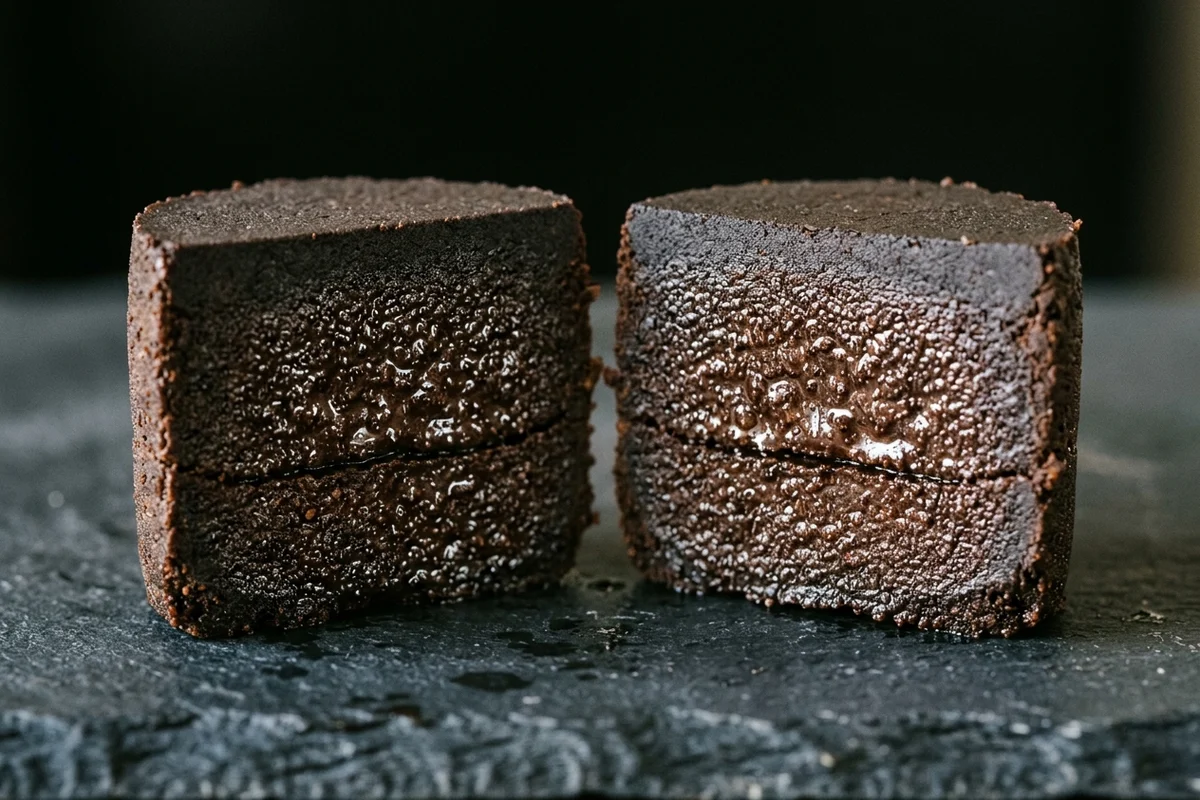
“Spent coffee pucks resemble sugar cubes or dry cookies that can be carefully handled but crumble under moderate stress. This behaviour contrasts strongly with that of dry coffee grounds.”
That cohesion — the thing you are reading as “dry” when you knock out a clean puck — is a product of swelling and compaction, not of the bed being free of water. A puck can be a firm, handleable disc and still be more than half water by mass.
What the valve actually does
Now the second volume of water: the pool on top.
Nearly every page on this search mentions the three-way solenoid valve, and most of them describe it as a gate that closes so no more water gets in. That is not what it is, and the difference matters.
The clearest definition I found is in a granted patent — US 11,147,409 B2, assigned to Carimali SpA, filed January 2019 and granted October 2021. I opened it on Google Patents and read the claims rather than taking the line from a blog, because this site has been burned by unchecked patent citations before:
“The dispensing valve 34 is typically a 3-way solenoid valve that, in the deactivation step, puts the brewing chamber 36 in communication with a duct at atmospheric pressure, so as to discharge the residual overpressure of the brewing chamber 36 that is generated at the end of the dispensing of the beverage.”
Three ports, not two: in from the pump, out to the group, and out to the drip tray. When the shot stops, the third port opens and the pressure above the coffee dumps to atmosphere. La Marzocco’s own technical write-up describes the consequence in plainer language — the valve removes the water sitting on top of the coffee, and the pressure difference carries it out to the discharge drain.
And the 2026 physics paper says the same thing, from the other direction, in a figure caption:
“…partial backflow through the three-way valve found in all modern espresso machines, which evacuates water from the puck’s surface after brewing.”
Surface. Not bed. The valve’s entire job is the pool, and the pool is the only part of a wet puck that a valve, a grind change or a dose change can do much about.
One correction to that sentence, made carefully because it is peer-reviewed and I am not. “All modern espresso machines” is true of the café-grade machines that paper was written around. It is not true of a great many home machines, where a thermoblock and a vibration pump replace the boiler-and-solenoid architecture. Rather than publish a list of which models have what — which I cannot verify from the inside — there is something better available, and it is in your kitchen drawer.
The manufacturer put it in the feature list
I downloaded four official Breville instruction books as PDFs and read them. The results are more useful than anything on the search results page.
| Model | “DRY PUCK FEATURE” in the feature list | What the troubleshooting page says about a wet puck |
|---|---|---|
| BES870XL Barista Express | Yes | “If the puck is wet, refer to the ‘Under Extraction’ section” |
| BES500 Bambino, Plus version | No | Same sentence |
| BES450 Bambino | No | Same sentence |
| BES876 Barista Express Impress | No | Does not mention a wet puck at all |
Here is the BES870XL feature entry, verbatim:
DRY PUCK FEATURE — “Removes excess water from the ground coffee in the filter basket after extraction for easy disposal of the coffee puck.”
That is a machine manufacturer listing water removal from the puck as a product feature, next to the pressure gauge and the temperature control. Not a technique. Not something you dial in. A thing the machine does or does not do.
So the first question to ask about a wet puck is not what your grind is doing. It is: does my machine claim to do this? Open your own instruction book, find the page that lists what the machine does, and look. It takes a minute and it is the only part of this whole subject you can check first-hand.
Two caveats on that table. A feature list is marketing copy as well as documentation, so its absence is weaker evidence than its presence — I am not claiming the three machines without the entry lack the hardware, only that their makers do not advertise the function. And the BES876 is the newest of the four and simply does not address the symptom.
The advice splits, and the manufacturer is on the unpopular side
While those manuals were open, I found the contradiction that makes this search so confusing.
Breville’s own troubleshooting flow sends a wet puck to the under-extraction page. The fix on that page is: grind size finer, increase grind amount.
The highest-ranked specialty retailer page says the opposite — that grinding too fine leaves water the puck cannot absorb, so go coarser. A large consumer-tech site repeats the coarser advice, sourced to a YouTube channel, and then two paragraphs later says sogginess “is a great indicator though that your coffee hasn’t been extracted well” — which, if true, means coarsening would make it worse.
| Source | What it says causes it | What it says to do |
|---|---|---|
| Breville instruction books | under-extraction | grind finer, raise the dose |
| A specialty retailer’s guide | grind too fine | grind coarser |
| Major consumer-tech site | too little coffee; grind too fine | raise the dose; grind coarser |
| What the measurements support | two different volumes of water, only one of which responds to any of this | raise the dose to cut headspace; grind for taste, not for the puck |
Both halves of the split contain something real. Raising the dose genuinely reduces the space above the bed, which is where the visible pool sits — that is Breville’s “increase grind amount”, and it is the single most reliable lever here. Grinding coarser genuinely shortens the shot, which means less total water pushed through, which can leave less standing on top on a machine that does not vent. Neither is a fix, because neither addresses the 21 grams, and neither should override what the shot tastes like. If you are changing the grind, change it by taste.
Headspace is normal, and it is smaller than you think
“You under-dosed” is the most common single diagnosis on this search, and it is the one that falls apart fastest under a published rig description.
The 2026 physics paper documents its basket exactly:
“We used IMS Competizione baskets (type B682TCH26.5E), which have an internal diameter of 58 mm, and a height of 26.5 mm. The dry coffee filled it to a height of 14 mm.”
That is a dose of 18.50 ± 0.05 g, de-clumped with needles, levelled in a blind shaker for ten seconds and tamped by a Perfex CPP-145 at 20 kg. A careful, correct, laboratory-grade dose — with 12.5 mm of empty basket above it, or roughly 47% of the basket’s depth.
A quick cross-check on their own two numbers: 18.5 g in a bed 14 mm deep across 2.64 × 10³ mm² works out at about 0.50 g/cm³, which is a normal density for a tamped bed. That is not a thin dose in a deep basket. That is what a correct dose looks like.
So headspace is not a symptom. It is the baseline condition of an espresso basket.
What complicates the arithmetic — and nobody on this search mentions it — is that the gap between your bed and the shower screen is not the basket depth minus the bed depth, because the screen assembly hangs down into the basket. A published Decent Espresso protocol specifies its shower screen’s “protrusion into the basket” at 9.6 mm. On that machine, most of the 12 mm of nominal headspace is occupied by hardware before any water arrives.
Roast level shifts it too, and here the retailers are directionally right. Ground coffee’s bulk density falls steadily as roast goes darker — 0.39 g/cm³ light against 0.28 g/cm³ dark in a 2019 characterisation of Arabica — while particle density stays flat at 0.91–0.92 g/cm³ across every roast level. The whole difference is void space; bulk porosity rises from about 44% to 62%. So the same 18 g of a light roast really does occupy less of the basket than 18 g of a dark one, and switching beans really can hand you a few millimetres of new headspace overnight. Those figures come from a tapped cylinder rather than a tamped basket, so treat the direction as established and the exact millimetres as yours to find. If you want to change headspace deliberately, the only honest way is to weigh the dose and move it a gram at a time.
Does the coffee swell? A hundred years of assuming so
Every page that mentions the bed rising says the grounds “expand.” It sounds obviously true. It is one of the genuinely contested questions in coffee physics, it has been contested for a century, and I would rather lay out who measured what than pick the convenient side.
The assumption is old enough to be built into hardware. A 1921 patent for a coffee maker relied on ground coffee swelling during extraction to form a filter bed that would strain the brew. By 1970 a paper was telling process engineers to grind pre-wetted coffee finer to compensate for the mass-loading a swollen column loses. A 2019 espresso simulation simply assumes “irreversible progressive swelling of the coffee particles” and builds from there.
Then people started measuring, and stopped agreeing:
| Study | How it was measured | What it found |
|---|---|---|
| Spiro and colleagues, 1989 | 1 mm particles in 80 °C water, read by eye under an 8× magnifier | green +20 ± 5%, roasted +17 ± 5% |
| Mateus and colleagues, 2007 | laser diffraction, 15 minutes | volume up to +23% |
| Corrochano, 2015 | — | no swelling; suggests water chemistry and roast explain the difference |
| Hargarten and colleagues, 2020 | laser diffraction and microscopy in a purpose-built sealed cell, erosion removed beforehand | +15% diameter, isotropic |
| Maille and colleagues, 2021 | laser diffraction and in situ microscopy in a recirculating loop | no significant increase |
Everything in that table except the 2020 row I read in the introduction of the 2021 paper, not in the originals. I read the 2020 study in full.
For. The 2020 study, from the Technical University of Munich, measured particles wetting in a flow cell the university’s own workshop built for the purpose — sealed specifically so that gas coming out of the coffee would not be mistaken for particles changing size. Total diameter increase: about 15%, homogeneous in all directions, and independent of both starting particle size and roast level.
Their timing table is the part that matters for espresso:
| Time and water temperature | Medium roast | Light roast |
|---|---|---|
| 30 seconds at 80 °C | 83% | 71% |
| 30 seconds at 25 °C | 82% | 59% |
| 4 minutes at 80 °C | 109% | 101% |
| 4 minutes at 25 °C | 111% | 108% |
Those are percentages of the final steady-state swelling, not of the particle. Readings above 100% come from referencing everything to the twenty-minute measurement, which the authors flag as carrying experimental error.
Read the first row against a 25–30 second shot: when your shot ends, the grounds have reached only about 71–83% of the swelling they are going to do. They keep swelling in the portafilter while it sits on the counter. The puck you look at is not the puck that was in the machine.
Against. A 2021 paper in the Journal of Food Engineering set out to test the same claim across eight coffees — caffeinated and decaffeinated, three roast levels — in deionised water, in a 420 ppm bicarbonate solution and in hot water. Once they accounted for how long particles took to be carried into the measuring loop, laser diffraction “did not detect statistically significant increase in particle size during wetting,” and in situ microscopy saw no increase either. Their conclusion: coffee particles “do not swell appreciably over the time scale of interest (0.5–5 min), in contradiction to several previous studies.”
They also name what they think everyone else has been seeing. Their own summary of the paper is that ground coffee releases gas from its pores on wetting and that bubble formation distorts size measurements in water — so the apparent growth is gas, not matter.
Both teams found the same artefact and drew opposite conclusions from it. The Munich group built a sealed cell precisely because degassing confounds this measurement, corrected for it, and still measured 15%. The 2021 group says the correction is the whole effect. That is the disagreement in one line, and nobody has broken the tie on espresso’s terms.
Two things are worth knowing before you weigh them, and they cut in different directions.
The 2021 study’s coffee was not fresh. One of its eight samples was ground immediately before testing; the other seven had been ground four to six months earlier. Most of its data was taken at ambient temperature, with hot-water runs used as a check. Stale pre-ground coffee at room temperature is a defensible thing to test — it is what a lot of people brew — but it is close to the opposite of espresso, where the coffee meets 90-odd degree water seconds after leaving the burrs and where, on the Munich numbers, temperature changed how fast light roasts took up water.
And the 2021 study carries a disclosure that the 2020 one does not. Three of its four authors are employees of Keurig Dr Pepper; the fourth consults to industry on particle characterisation. The study was funded by Keurig Dr Pepper, and the declaration states that the funders “played a role in the conceptualization, provision of materials, and the writing and editing of the manuscript.” The Munich paper declares no funding at all — its acknowledgements thank a local roaster for beans and the university workshop for the cell.
I am reporting that because it is disclosed and because it is the kind of thing this site exists to point at, not because it settles anything. There is no obvious commercial direction to “coffee does not swell”; the fact worth carrying is that a funder helped write the manuscript, and you now know it when you read the result. The disclosure is in the paper. That is the system working.
The 2026 micro-CT work sides with swelling on its own evidence, calling the before-and-after difference in sample thickness “considerable” and building swelling into its permeability model, where “under mechanical confinement in the portafilter basket, this swelling reduces the available void space.”
And here is the gap all three leave open: nobody has published the height of a real, tamped, confined espresso bed before and after a shot. The Munich team says so themselves, and it is the most important sentence in their paper for anyone reading it about espresso:
“Regarding espresso extraction, however, it has to be considered that the effect of an elevated pressure on the swelling dynamics is not covered by this study and potential effects from this parameter require further investigations.”
So when someone tells you the puck rises because the coffee expands: the mechanism has been assumed for a century, measured five times with three different answers, actively disputed in the peer-reviewed literature as recently as 2021, and never once measured in a basket at 9 bar.
What the dry puck costs
The 2026 study did something nobody else has: it scanned the same puck before and after brewing.
“(B) Coffee puck after brewing. The post-brew image reflects two distinct structural processes: microscopic particle-scale swelling upon wetting, and macroscopic horizontal delamination and partial lift-off of the bed from the bottom filter mesh, with a layer of air left in between.”
And on the cause:
“In the bottom part, close to the filter mesh, the coffee puck has peeled off the basket and a void space was created in between the filter mesh and the puck. However, we associate this with the operation of the overpressure valve which may reverse the direction of flow for an instant after the brewer flow is turned off to relieve the built up pressure.”
The horizontal cracks in a spent puck, then, are not a record of your shot. They are a record of your shot ending. The authors call them “signatures of post-shot stress release, where confinement by the side walls primarily permits expansion in the vertical direction.”
That last clause is also the mechanical answer to the third question people bring to this subject, which is the puck sticking to the group head. Wall-confined, the bed can only grow one way: up.
It also means the tidy story — dry puck good, wet puck bad — has the causation inverted. The same rapid depressurisation that pulls the pool off the top is what delaminates the bed underneath. You cannot have one without the other. A machine with no valve leaves you a soupy surface and a less disturbed bed; a machine with a valve hands you a clean-looking disc that has been pulled apart internally. Neither of those facts tells you anything about what is in the cup.
Why the edge looks wetter than the middle
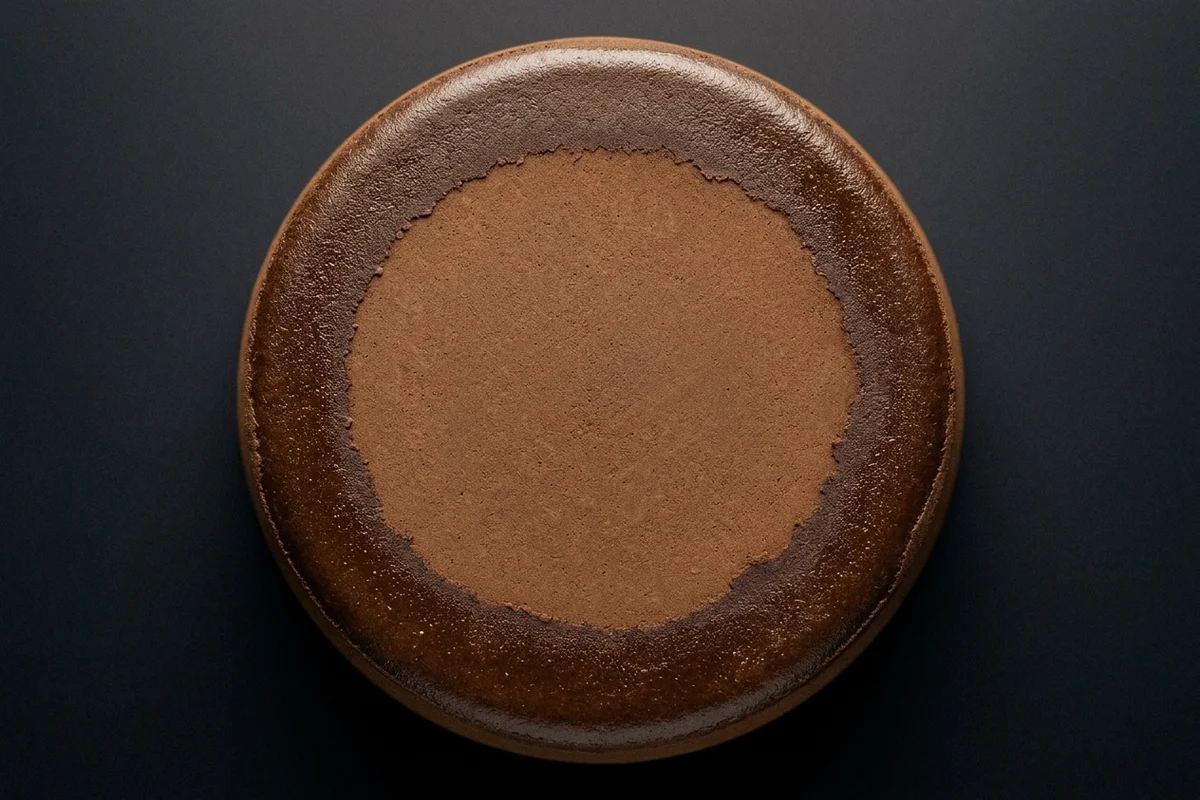
If your puck is evenly damp but the outer ring looks darker and sloppier, that is not your imagination, and it is not necessarily your distribution either.
In 2021 Stéphane Ribes published a protocol through Decent Espresso’s document archive in which spent beds were divided into zones and each zone’s extraction measured separately. The finding:
“Without the BPLUS contact screen, the extraction of the outer grinds of the puck (ca. 30% of the total dose weight) is limited to 2/3 of the extraction of the center grinds.”
Zone by zone, without a screen, the centre came out around 25–26% while the outer ring sat at 16–17%. Roughly 30% of your dose, by weight, is doing about two thirds of the work of the middle. Less extracted coffee is coffee that gave up less of itself to the water — which is exactly the part of the bed you would expect to look wetter and hold together worse.
That test deserves its limits stated. It ran on a Decent DE1PRO with a blooming profile capping at 7.5 bar rather than a conventional 9, 19 g in 20 g baskets with a two-stage needle distribution routine and a 26 lb flat tamp. Each data point is three to five readings of one sample rather than three to five shots, and the number of shots per condition is not reported anywhere in the document. It is a well-specified experiment, not a controlled trial.
There is one more reason the surface misleads. A 2023 micro-CT study of spent beds found, in the authors’ own word, something “counterintuitive”: “after extraction we observe larger porosity in the lower part (outlet) than in the upper part (inlet).” The top layer of a spent puck is its least porous. It is also the only layer you can see. That work was done on capsule espresso at 13 bar rather than a 58 mm basket, and the authors note that once the bed is wet their scanner cannot separate liquid from solid, so they report relative differences rather than absolute porosity.
If the puck sticks to the shower screen
This is the version of the problem that is genuinely worth fixing, because it is mechanical rather than cosmetic, and because it makes a mess.
The chain is short and each link is sourced. The bed takes on water. Confinement by the basket walls permits expansion upward. The shower screen assembly already protrudes into the basket — 9.6 mm on one documented machine. If the rising bed meets it, the puck comes away with the group instead of the portafilter.
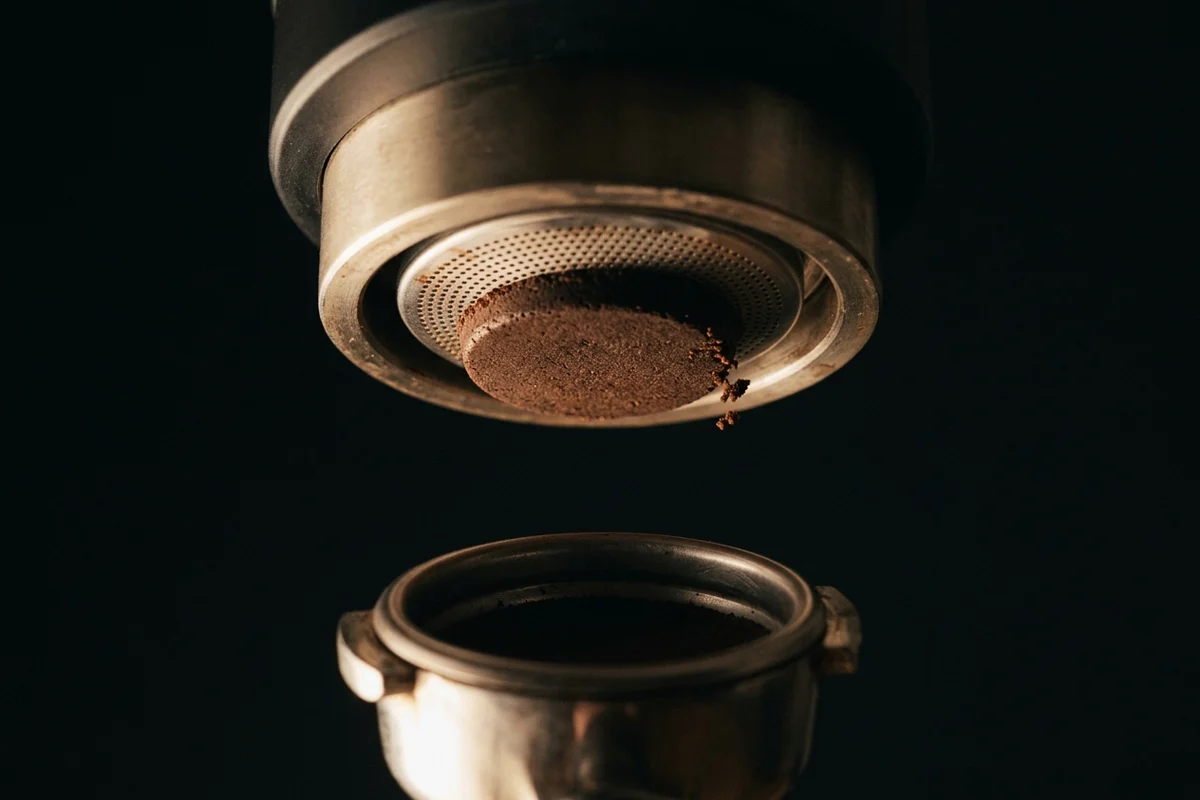
Which gives three fixes, in order of how much I would trust them:
Affiliate links. Some product names below link to Amazon. If you buy through one I earn a commission at no extra cost to you, and it never changes which product gets named or what the measurements say. Full disclosure.
- Drop the dose by a gram and try again. It is free, it directly changes the only variable in the chain that you control, and it is the same lever Breville’s own troubleshooting uses in the opposite direction.
- Clean the shower screen. Old coffee oil on the screen is the one cause every page agrees on and nobody has measured, but it costs nothing to eliminate and the screen needs doing anyway.
- Put a disc between the bed and the screen. A puck screen is a thin perforated stainless disc that sits on the coffee. For this specific problem the mechanism is too simple to argue with — the coffee cannot touch the screen if something else is in the way — and a side benefit is a group head that stays cleaner.
What a puck screen does to flavour is a different question, and the honest answer is that it is unsettled by a wide margin:
| Test | Shots | Statistics | Effect on extraction yield |
|---|---|---|---|
| Robert McKeon Aloe, 2024, on a dataset from Lance Hedrick | 10 shots × 6 conditions | paired two-tailed t-test | +0.4 points, significant |
| Stéphane Ribes / Decent Espresso, 2021 | not reported | none | +2 to +3 points |
| Clive Coffee, 2025 | not reported | none | “3%”, called “a 20% relative increase” |
Note the shape of that table. The test with the most shots and an actual statistical test reports the smallest effect. The test reporting the largest effect published no shot count, no baseline reading, no standard deviation and no raw data — and sells the screen it tested. Its own two numbers do not reconcile either: if three points is a 20% relative increase, the baseline shots were extracting at 15%, which would be a badly under-extracted espresso at 20 g to 40 g in 30 seconds.
McKeon Aloe, who found the significant result, is the one hedging hardest: “while there were statistically significant improvements, do those warrant an extra step? I’m not sure.”
So: a puck screen for a puck that sticks, yes, on mechanism. A puck screen because it will transform the cup, not on this evidence. If you buy one, the size is the thing people get wrong — 58.5 mm for a 58 mm portafilter, 53.3 mm for Breville and Sage machines — and screens run from about 0.2 mm to 1.7 mm thick, with the thicker ones eating into the headspace you may have been trying to preserve.
So when is a wet puck actually telling you something?
Almost never on its own. It becomes information when it changes, or when it arrives with company.
| What you see | What it probably is | What to do |
|---|---|---|
| Damp, cohesive puck, knocks out in one piece | the normal 21 grams | nothing |
| Standing water on top, shot tastes fine | your machine does not vent the group, or does it weakly | check the feature list in your manual; then ignore it |
| Soup that will not knock out, and the shot ran fast | genuinely too little resistance, or a badly disrupted bed | grind finer and re-taste; check distribution |
| It changed suddenly with nothing else changed | new bag, different roast level, different bulk density, different bed height | re-weigh the dose and re-dial |
| Puck comes up with the group | bed rising into a screen that protrudes into the basket | drop a gram, clean the screen, or fit a disc |
| Wet ring at the edge only | the documented radial gradient — outer 30% extracting at about two thirds | worth chasing through distribution, not through the puck |
And the timing detail that closes the circle. A shot takes 25 to 30 seconds. X-ray filming at 1,000 frames per second found that an espresso bed ponds at 0.823 seconds and does not reach saturation until 6.669 seconds — meaning roughly the first quarter of your shot is the bed filling up, not coffee being brewed. That run used a 10 g dose in a modified single-boiler machine rather than a standard double, so read the shape rather than the decimal places. The wetting of the puck is not a side effect of the shot. It is the opening act.
What nobody knows yet
In keeping with the rest of this site, the list of things I could not establish:
- No one has published how much taller a tamped espresso bed gets during a shot. The micro-CT paper calls the difference “considerable” and prints no number.
- No one has measured swelling under brewing pressure at all. That is the Munich group’s own statement about their own work.
- The two most careful measurements of whether coffee particles swell disagree, identify the same confounding artefact, and draw opposite conclusions from it. Neither used freshly ground coffee at espresso temperature under pressure.
- No published capillary-pressure data exists for coffee beds, according to the authors of the 2025 infiltration study — which is precisely the property that would predict how much water a bed holds against gravity.
- The 20.85 g figure has been measured once, by one team, on one machine, with one coffee. It is the best number available on this question and it should not be the only one.
Until some of that changes, the practical position is the one the measurements support rather than the one the search results give you: the water inside the bed is not yours to manage, the water on top of it is mostly your machine’s business, and the only thing in the whole arrangement that reliably tells you about your shot is the shot. Taste it. If you want a number to go with the taste, dial in by weight and time and leave the puck alone.
Sources
Every figure in this piece traces to one of these. Dates are when the source was read — lists and prices move.
- Espresso Grinding: The Impact of Burr Sharpness on Post-Brew Water Retention Joe and Jeremy — Socratic Coffee, 19 April 2015 Read in full, comments included. 86 shots on a single-group La Marzocco Linea with a 0.8 mm restrictor at 9 bar verified with a Scace II, 20 g in and 40 g out, one burr set with about 2 kg of lifetime use against one with about 1,500 kg. Source of the 20.85 g and 20.94 g retention figures and their standard deviations, of the t-test result, and of the arithmetic used to test the claim that a fifth of a puck stays dry. Not peer-reviewed; method and raw data published. Read 11 September 2026
- Under pressure: poroelastic regulation of flow in espresso brewing Waszkiewicz, Myck, Białas, Puciata-Mroczyńska, Dzikowski, Szymczak & Lisicki — Physics of Fluids 38, 063113 (2026); arXiv:2512.21528v2, CC BY 4.0 Full preprint text read. Source of the statement that the three-way valve evacuates water from the puck's surface after brewing, of the micro-CT images showing horizontal delamination and partial lift-off of the bed from the filter mesh with a layer of air between, of the basket and bed dimensions that give the 12.5 mm of empty basket above a lab-standard dose, of the thousandfold permeability collapse and the roughly 6 µm pore estimate, and of the spent-puck-as-sugar-cube description. Read 11 September 2026
- US 11,147,409 B2 — Device and process for controlling the extraction pressure of coffee in an espresso coffee machine Carimali SpA; inventor Davide Cappellini. Filed 17 January 2019, granted 19 October 2021 Opened and read on Google Patents — title, assignee, dates and claim text all checked rather than cited from a secondary source. Source of the patent-language definition of what a three-way solenoid valve does at the end of a shot, which appears both in the description and in claim 18. Read 11 September 2026
- Swelling properties of roasted coffee particles Hargarten, Kuhn & Briesen — Journal of the Science of Food and Agriculture 100, 3960–3970 (2020); Technical University of Munich Open-access full text read as PDF. Laser diffraction and microscopy in a sealed flow cell built to exclude degassing artefacts. Source of the roughly 15% total diameter increase, of the table showing 71–83% of that increase reached in the first 30 seconds, of the finding that swelling is homogeneous in all directions and independent of roast degree, and of the authors' own statement that the effect of elevated pressure on swelling is not covered by their study. Read 11 September 2026
- Critical examination of particle swelling during wetting of ground coffee Maille, Sala, Scott & Zukswert — Journal of Food Engineering 295, 110420 (2021) Highlights, abstract, introduction, discussion, conclusions and competing-interests declaration read; the results figures and data tables sit behind the publisher's paywall and were not seen. Source of the finding that laser diffraction and in situ microscopy detected no significant increase in particle size during wetting, of the authors' proposal that gas released from the pores forms bubbles that distort size measurement, of the century of prior work summarised in its introduction, of the sample history — one of eight coffees ground immediately before testing and the rest four to six months earlier, most data taken at ambient temperature — and of the declaration that three of four authors are employees of Keurig Dr Pepper, that the study was funded by Keurig Dr Pepper, and that the funders played a role in writing and editing the manuscript. Read 11 September 2026
- the Barista Express Instruction Book (BES870XL/A), the Bambino Plus Instruction Book (BES500), the Bambino Instruction Book (BES450) and the Barista Express Impress Instruction Book (BES876) Breville Four official PDFs downloaded and read as text. Source of the DRY PUCK FEATURE entry in one feature list and its absence from the other three, of the troubleshooting instruction routing a wet puck to the under-extraction page, of the pre-infusion description, and of the dose and tamping figures. Read 11 September 2026
- Espresso Extraction Radial Uniformity — BPLUS Contact Screen Stéphane Ribes — Decent Espresso document archive, April 2021 PDF read in full. 19 g doses in 20 g VST and Pullman baskets on a Decent DE1PRO with a blooming profile peaking at 7.5 bar, extraction yield measured zone by zone across the spent bed. Source of the finding that the outer grounds — about 30% of the dose by weight — extract at roughly two thirds of the centre, and of the 9.6 mm shower screen protrusion into the basket. The number of shots per condition is not reported, and the method for measuring each zone is not described. Read 11 September 2026
- Exploring the link between coffee matrix microstructure and flow properties using combined X-ray microtomography and smoothed particle hydrodynamics simulations Mo, Johnston, Navarini & Ellero — Scientific Reports 13, 16374 (2023) Open-access full text read via PubMed Central. Source of the finding that a decreasing porosity profile from outlet to inlet always develops after extraction — meaning the top of a spent bed is its least porous layer — which the authors themselves call counterintuitive, and of their caveat that micro-CT cannot separate liquid from solid once the bed is wet. Run on capsule espresso at 13 bar, not a 58 mm basket. Read 11 September 2026
- Dynamics of liquid infiltration into an espresso bed using time-resolved micro-computed tomography: Insights from experiment and modeling Foster, Lee, Moroney, Prjamkov, Salamon, Smith, Petrassem-de-Sousa & Vynnycky — Physics of Fluids 37(1), 013383 (2025); Open Access, CC BY-NC Full text read. A rotating x-ray rig filming at 1,000 frames per second through a modified espresso machine. Source of the ponding time of 0.823 s and the bed saturation time of 6.669 s, and of the observation that the wetting front does not begin moving at the same instant everywhere in the bed. Read 11 September 2026
- Puck Mesh Screens for Espresso: Another look at other data Robert McKeon Aloe, 5 January 2024, analysing a dataset collected by Lance Hedrick Read in full. Six conditions of ten shots each at 20 g in and 50 g out, compared with a paired two-tailed t-test. Source of the 0.4 percentage point improvement in extraction yield, of its statistical significance, of the confounding observation that output yield differed between conditions, and of the author's own doubt about whether the gain justifies the step. Read 11 September 2026
- The Dreaded Soggy Puck: What is it and How Can I Fix it? and Puck Screens: How Much do They Really Impact Extraction? Sean Jemison — Clive Coffee, 5 April 2025 and 17 July 2025 Both read in full as the strongest pages currently ranking for these searches. Cited here for the shape of the advice they give and for the claim of a 3% extraction gain described as a 20% relative increase, published without a shot count, a baseline reading or a standard deviation, on a screen the same site sells. Read 11 September 2026
- what is a 3 way solenoid valve and how does it keep your espresso machine working? La Marzocco USA A machine manufacturer's own description of the valve, agreeing with the patent and the physics paper that what it removes is the liquid sitting on top of the coffee, routed to the discharge drain. Read 11 September 2026
- Physical characterization of Arabica ground coffee with different roasting degrees Nakilcioğlu-Taş & Ötleş — Anais da Academia Brasileira de Ciências 91(2), e20180191 (2019) Open-access full text read. Source of the measured bulk densities of ground coffee by roast degree — 0.39 g/cm³ light against 0.28 g/cm³ dark — and of the finding that particle density stays at 0.91–0.92 g/cm³ across every roast level, so the entire difference is void space. Measured on finely ground Arabica by tapped-cylinder method, not in a tamped espresso basket. Read 11 September 2026