
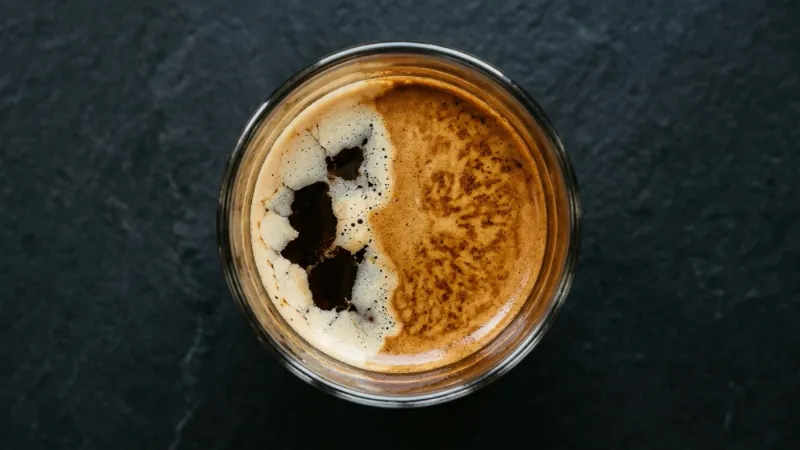
There are two standard answers to this question and they point in opposite directions. Sour means under-extracted, so grind finer. Bitter means over-extracted, so grind coarser. Pick the one that matches your shot and turn the dial.
I read the pages at the top of these searches, and two things stood out.
The first is that almost none of them names a single compound. The page ranking first for why is my espresso so bitter lists six causes of bitterness without naming one molecule, and cites nothing. The one page that does name a compound names tannic acid — and that is not what published work has found in coffee.
The second is more useful. None of them addresses the shot that is sour and bitter at the same time, which is the one most home baristas actually describe. They treat the two tastes as opposites requiring opposite fixes, so a cup exhibiting both has nowhere to go in their framework.
It has somewhere to go. The mechanism is published, and it explains why turning the dial in either direction makes that particular shot worse.
What the internet says the compound is
The page that names tannic acid also explains how it works: the tannin “builds up in the outer exterior of the coffee beans,” and it is “a heavier compound” that therefore requires “high temperature and high pressure to be extracted.”
Every part of that is invented. There is no published isolation identifying tannic acid as the bitter principle of coffee, no basis for locating it in the outer layer of a roasted bean, and molecular weight is not what determines whether something extracts — solubility and contact time are.
What makes it worth mentioning rather than quietly skipping is what the page does next: it links to a research page on tannins as its authority, and does not quote a word of it. I followed the link. It returns 402 Payment Required. So a reader who wants to check the one chemical claim on the page arrives at a paywall.
That is a specific kind of failure, and it is worse than citing nothing. A bare assertion announces that you are being asked to take it on trust. A citation that cannot be opened looks like evidence and functions as decoration.
Here is what the isolation studies actually found.
What actually makes espresso bitter
The work was done at the Technische Universität München, in Thomas Hofmann’s group, and its method is the reason I trust it: they did not reason about which known compounds ought to taste bitter. They took brewed coffee apart and followed the bitterness.
Sensory-guided fractionation means splitting the brew into fractions — by solvent extraction, ultrafiltration and RP-HPLC — tasting each fraction, keeping the bitter ones, and splitting again, until what is left can be identified. The 2006 paper reports where that led:
“Sensory-guided fractionation of a roasted coffee brew by means of sequential solvent extraction, ultrafiltration, and RP-HPLC demonstrated a group of ethyl acetate soluble compounds formed from O-hydroxycinnamoyl quinic acid derivatives upon coffee roasting as the key compounds contributing to the bitter taste of roasted coffee beverages.”
Those are chlorogenic acid lactones, usually called quinides. The paper names seven of them individually, plus a further intensely bitter fraction made of quinic acid lactone isomers esterified with caffeic, ferulic, coumaric and dimethoxycinnamic acids. And it did something nobody had:
“For the first time, bitter taste recognition thresholds were determined for the individual compounds showing that, strongly depending on their chemical structure, the bitter threshold levels ranged between 9.8 and 180 μmol/l (water).”
The 2007 paper went after the other half — the harsher bitterness of dark roasts — and started from a clue worth quoting in full:
“As caffeic acid was found to generate intense bitterness reminiscent of the bitter taste of a strongly roasted espresso-type coffee, the reaction products formed were screened for bitter compounds by means of taste dilution analysis.”
Ten bitter compounds came out of that screen, including eight multiply hydroxylated phenylindanes, five of them previously unreported, with thresholds between 23 and 178 µmol/L. Their origin is the oligomerisation of 4-vinylcatechol, released from caffeic acid during roasting.
| Quinides | Phenylindanes | |
|---|---|---|
| Chemical parent | Chlorogenic acids | Caffeic acid, via 4-vinylcatechol |
| Made by | Roasting | Roasting, further along |
| Measured threshold | 9.8–180 µmol/L | 23–178 µmol/L |
| Described as | Key bitter contributors in brewed coffee | “A strongly roasted espresso-type coffee” |
| Present in green beans | No | No |
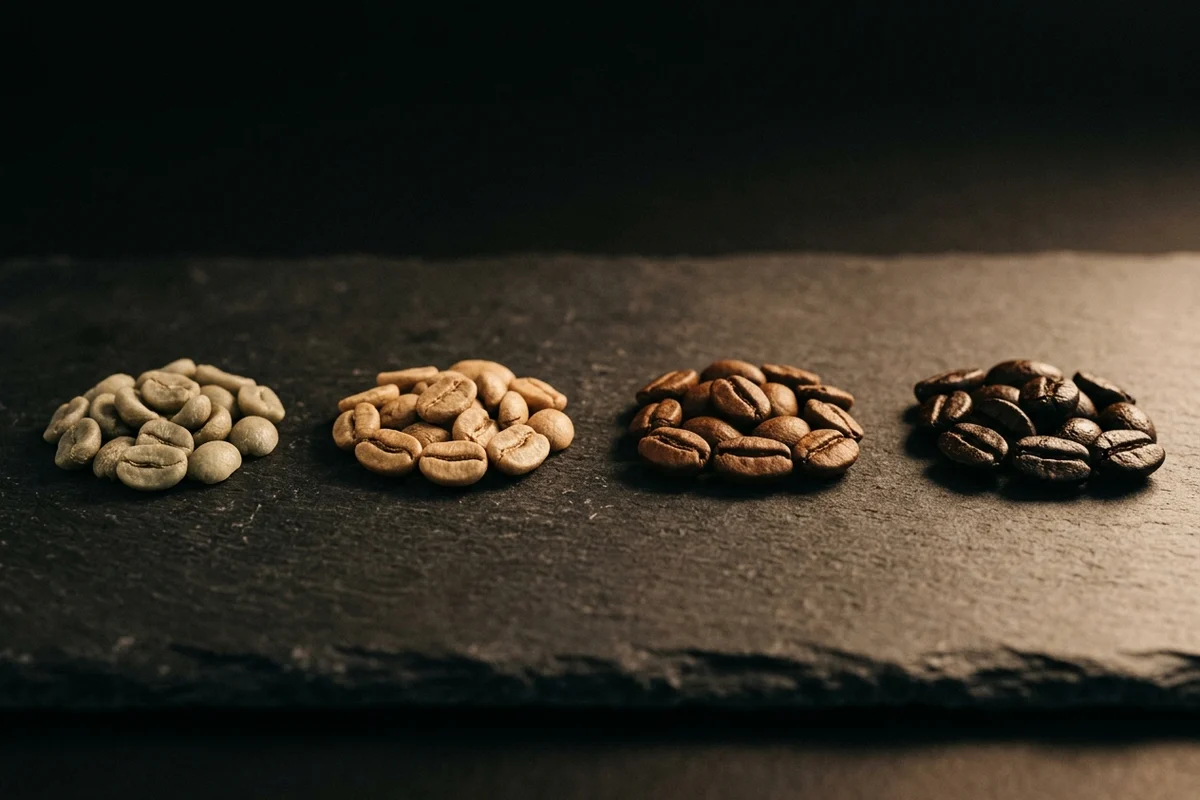
Read down the “made by” row, because it reframes the whole question. These compounds do not exist in green coffee. They are manufactured during roasting. Nothing you do at the machine creates bitterness; the roaster already did that, and your extraction decides how much of it ends up in the cup.
Which means “my espresso is bitter” has two quite different solutions living inside it, and the guides only offer one. You can extract less of what is there. Or you can buy coffee with less of it in the first place.
Caffeine is a minor character, and I cannot tell you how minor
Caffeine is bitter. Everyone knows this, so caffeine gets the blame.
It is not what either isolation study came back with. Both followed the bitterness through a real brew and arrived at roast-generated compounds, not at the alkaloid.
There is a widely repeated number attached to this — that caffeine accounts for about 15% of coffee’s bitterness. I went looking for it in the papers and it is not in either abstract. It traces to a presentation Hofmann gave at an American Chemical Society meeting in 2007 and to the press coverage that followed.
So I will say exactly what I can support and no more. A conference statement reported by science journalists put caffeine at roughly 15%. The peer-reviewed papers do not publish that figure. What the peer-reviewed papers do establish is that when you fractionate coffee and chase the bitter taste, what you isolate is quinides and phenylindanes.
If the 15% is right, decaf should taste nearly as bitter as regular. In my experience it does, which is weak evidence and I am offering it as nothing more.
Sour is not the same thing as pH
Now the other half, where there is a genuinely useful distinction that no dial-in page makes.
A 2024 study out of the University of Camerino ran eight different brewing methods across specialty and mainstream coffees at different roast levels, measured the organic acids, chlorogenic acids, caffeine and physicochemical parameters, and correlated all of it against perceived sourness scored by tasters. The result:
“Statistical tools revealed that a major impact of chlorogenic acids emerged in pH and titratable acidity, while the sensorial sourness appeared more correlated with organic acids concentration. Thus, these findings suggests that organic acids could be potential predictors of beverage perceived acidity.”
Two different sets of acids. The ones that set the pH are not the ones you taste. Chlorogenic acids dominate the measurement; organic acids — citric, malic, acetic and their relatives — track what the panel actually perceived as sour.
The practical consequences are immediate. A pH meter in your cup is measuring the wrong thing. “Low acid coffee” marketed on pH numbers is measuring the wrong thing. And when your shot tastes sharp, the question is not how acidic the coffee is in the titration sense — it is which acids came out and how concentrated they are.
Which leads to the finding that broke the model I was carrying into this piece.
Some acids go up with roasting
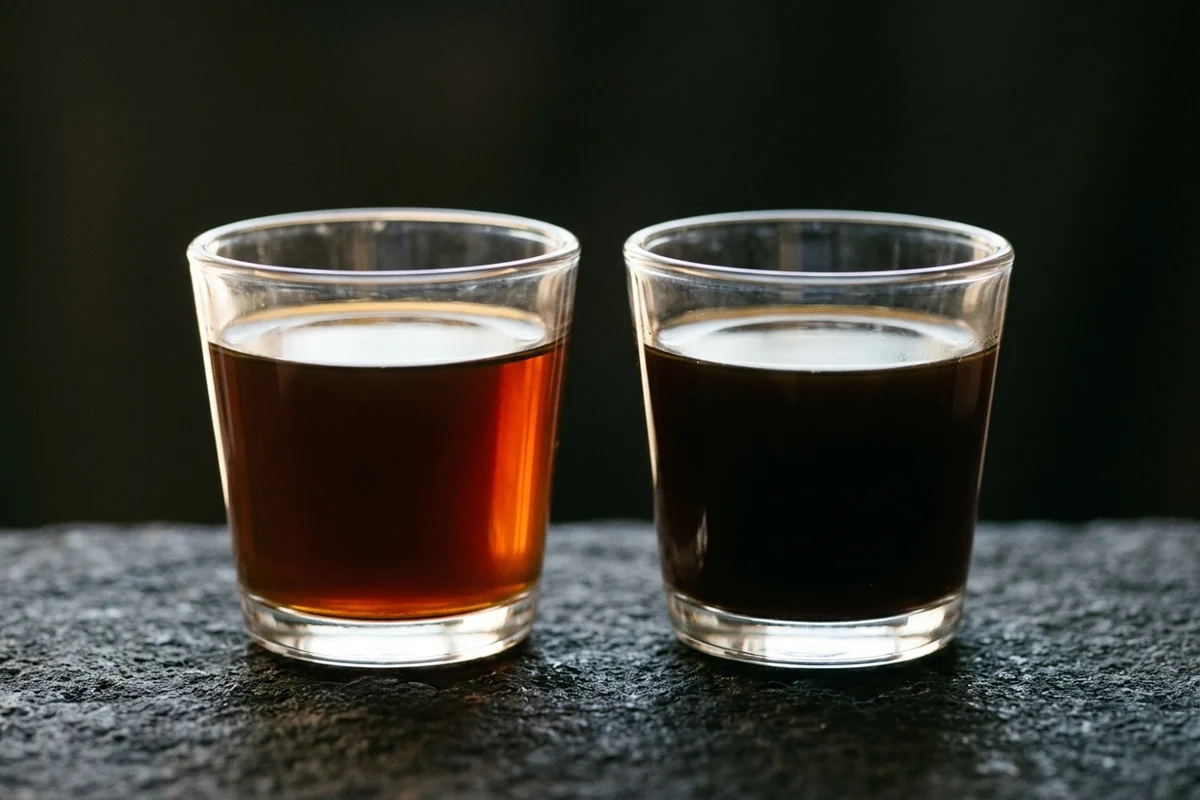
The universal folk scheme is that light roasts are acidic and dark roasts are bitter, so sourness is fixed by roasting darker or buying darker.
The largest survey of the underlying data does not support that cleanly. Yeager, Batali, Guinard and Ristenpart at the UC Davis Coffee Center — the same group behind the sensory work below — assembled a systematic review and meta-analysis of the published literature on coffee acids: 129 publications, 8,634 distinct data points, covering arabica and robusta, green and roasted, across roast levels.
| Finding | What the meta-analysis reports |
|---|---|
| Species | Roasted robusta has “2 to 5 times as much total OAs” as arabica, with much larger amounts of formic and acetic acid |
| Chlorogenic acids | 5-CQA is the major component in both species, and “progressive roasting decreases the concentration of all CGAs” |
| What drives CGA content | “More dependent on roast level than the type of coffee” |
| The closing line | “The increases in certain OAs with roast level might play more of a role in the sensory profile of dark roast coffees than previously suspected” |
The last row is the one that matters here. Chlorogenic acids do fall with roasting — that part of the folk model holds. But certain organic acids increase with roast level, and those are precisely the acids the Camerino study found tracking perceived sourness. The authors’ own suggestion is that this may matter more in dark roasts than the field had assumed.
So a dark roast can taste sour, and it will not be because you under-extracted it. “If it is sour, go darker” is advice that can move you toward the problem.
The species row is worth keeping too. If a blend has robusta in it, it is carrying two to five times the total organic acids — and much more formic and acetic acid specifically — before anything happens at your machine.
Astringency is a third thing, not a degree of bitterness
Most people report three sensations as two. Bitter is a taste, detected by receptors on the tongue. Astringency is a mouthfeel — a drying, puckering tightness, closer to what strong tea leaves behind than to anything on the bitter scale. Lump them together and you will reach for the wrong correction.
The sensory literature keeps them apart. Batali’s trained panel scored “Bitter” and “Astringent” as separate attributes. And the Italian Espresso National Institute, which certifies espresso against a published sensory profile, treats them as separate requirements:
“Its taste is round, substantial and smooth. Sour and bitter are well balanced and neither one prevails over the other. Astringency is absent or barely perceptible.”
Read that as a specification and it says something the dial-in guides never do. Balance is not the absence of sour and not the absence of bitter. Both are supposed to be there, with neither winning. Astringency is the one that should not be there at all.
Andueza’s ratio study points the same way. When that team compared two coffee-to-water ratios, the attributes that distinguished them were “bitterness, astringency and burnt, acrid and earthy/musty flavours” — bitterness and astringency listed separately, as different things the ratio was moving.
I am not going to tell you which compound causes astringency in coffee. The candidates I found circulating trace back to a 1983 citation I could not verify, and I am not passing on a reference I have not read. What I can say is that the word most often used for it — tannin — is not what the isolation work found, and that the literature treats the sensation as distinct from bitterness regardless of what is producing it.
When it is both at once
This is the shot that sends people looking, and the one none of the top pages answers.
The reason it has no answer in their framework is that the framework assumes something untrue: that a shot has an extraction. One number, one place on the scale, somewhere between under and over. If that were true, sour and bitter really would be opposite ends and a cup could not be at both.
A shot does not have one extraction. From Cameron and colleagues’ modelling and experiment:
“suggests that in many circumstances where flow is inhomogeneous, there are regions of the granular bed that have been extracted far higher than measured with an average EY.”
When water channels through the puck rather than moving evenly through it, the bed splits into territories. Where the water ran, the coffee is stripped well past the average. Where it did not, the coffee is barely touched. Both drain into the same cup. You get the harsh, drying signature of over-extraction and the sharp sourness of under-extraction in one mouthful, because both are literally present.
The scale of the discrepancy is measurable. Comparing their model against experiment and assuming the extreme case where some regions have no flow at all, the authors report differences between predicted and measured extraction yield of 13.1%, 6.1% and 2.6% at grind settings of 1.1, 1.3 and 1.5 — the discrepancy growing as the grind gets finer and the bed clogs more unevenly.
Affiliate links. Some product names below link to Amazon. If you buy through one I earn a commission at no extra cost to you, and it never changes which product gets named or what the measurements say. Full disclosure.
And this is why a refractometer does not rescue you here:
“estimating the level of inefficiency in a given extraction is not possible using the refractive index measurement alone”
The instrument reads the mixture. An average of 20% can be a bed uniformly at 20%, or half the bed at 30% and half at 10%, and those two cups taste nothing alike. The number is the same — and it will sit comfortably inside whichever published extraction window you are checking it against, because those windows were written for a figure that assumes the bed extracted evenly. This is the one place where measuring the shot genuinely cannot tell you what you need to know.
So the correct response to sour-and-bitter is neither of the two standard instructions. Grinding finer clogs the bed further and widens the split. Grinding coarser reduces the overall extraction without making the flow any more even — you get a weaker version of the same defect. The variable to change is the uniformity of the bed: distribution, the state of the basket, whether the puck was level. Fix that, pull again, and only then read the taste as information about extraction.
A caveat on diagnosis by eye: crema will not tell you either. It responds mostly to how much carbon dioxide the coffee still holds, which is a freshness signal rather than a quality one, and a channelled shot can produce a perfectly convincing layer of it.
What the dial actually moves
If the shot is clearly one thing and not both, then the standard advice is pointed in a defensible direction — and it helps to know how much of a move each variable is worth.
Grind size is measurable in espresso, and it works the way you expect within its range. The Camerino group ground coffee to specified particle sizes and measured what came out across three basket designs:
“Extracting with smaller particles escalates the quantity of bioactive compounds. The amount of caffeine/cup increased moving from 500-1000 µm to 200-300 µm particle size, both in Arabica and Robusta for all filter baskets.”
That is the mechanism behind “grind finer to extract more,” stated in microns and measured rather than asserted. But it holds only up to the point where the bed stops flowing evenly — past that, finer stops meaning more, and you are back in the previous section.
Dose moves less than you would guess. Holding beverage volume constant, the same team found the compounds extracted at 12 g were “only around 9% lower than at 14 g” — a 14% cut in coffee costing 9% of the extract. Their companion study quantified acetic, citric, caffeic, malic and tartaric acids directly across two baskets, four perforated-disc heights and both doses, with a sensory panel alongside.
Ratio moves flavour more than it moves extraction. Andueza’s team reported that once the other technical parameters were optimised, raising the coffee-to-water ratio did comparatively little to the extraction of soluble and solid compounds — what changed were bitterness, astringency and the burnt and earthy notes. If you want to move bitterness without moving much else, that is the lever with published support, and it is a different lever than the one you use to change strength.
Temperature is real but you may not be able to taste your way to it. Andueza’s temperature study tested 88, 92, 96 and 98 °C on three coffees and selected 92 °C for all three. The awkward part for taste-led advice is the method note: “physicochemical, taste and mouthfeel parameters were not very useful for selecting the water temperature.” The choice came from volatile compounds and the flavour profile, not from the taste and mouthfeel scores. Anyone telling you to taste your shot and adjust the boiler is recommending the approach that did not work in the study.
And strength is a confound running under all of it. Batali’s panel, scoring nine points across the brewing control chart, produced this:
| Attribute group | Behaviour |
|---|---|
| Bitter, Astringent, Rubber, Earthy, Viscous | Increased with TDS only |
| Sour, Citrus, Dark Green, Smoky, Brown Spice, Fermented | Increased strongly with TDS, negative correlation with percent extraction |
Bitterness tracked concentration, not extraction. Sourness went both ways — down with extraction, which is the folk rule, and up with concentration, which the folk rule has no slot for.
I have to flag the limit clearly, because it is a large one: that is a drip study, run between 1.00 and 1.50% TDS. Espresso sits around 8 to 12%, an order of magnitude outside anything they measured, and I will not carry their numbers across that gap. What survives the gap is narrower and still worth having — in the one controlled experiment that separated strength from extraction, both of the tastes a dial-in guide reads as extraction signals moved with strength as well. A 1:2 espresso is an extremely concentrated drink. Some of what you are tasting as over-extraction may be concentration.
So what do you actually change
The order matters more than the individual moves, because the first question determines whether the rest of the table applies at all.
| What you taste | Most likely reading | What to change |
|---|---|---|
| Sour and bitter together, or drying and sharp at once | Uneven flow — the bed has both over- and under-extracted regions | Distribution and puck prep. Not the grind, in either direction. Re-pull, then re-taste |
| Sour, thin, finishes fast | Under-extraction, on the coarse side of the curve | Grind finer, one step |
| Sour but full and heavy | Possibly concentration, not extraction | Lengthen the ratio before touching the grind |
| Bitter and drying, long finish | Over-extraction or too fine | Grind coarser, or shorten the ratio |
| Bitter across every setting you try | The roast, not the brew | A different coffee. The bitter compounds were made before you bought it |
| Astringent, mouth-drying, not especially bitter | A separate defect from bitterness | Treat separately; do not chase it with grind adjustments aimed at bitterness |
Two of those six rows do not exist on any page I read for this piece, and they are the two that account for most of the shots people describe as unfixable.
None of this is a recipe, and that is deliberate. What the chemistry gives you is not a setting — it is a better reading of the cup. The molecules that make your espresso bitter were made in a roaster before you owned the coffee. The acids that make it sour are not the ones that set its pH. And the shot that tastes like both at once is not sitting between two errors; it is two errors at the same time, in different parts of the same puck.
Knowing which of those you have is most of the work. The dial is the easy part.
Sources
Every figure in this piece traces to one of these. Dates are when the source was read — lists and prices move.
- Bioresponse-guided decomposition of roast coffee beverage and identification of key bitter taste compounds Frank, Zehentbauer & Hofmann — European Food Research and Technology 222, 492–508 (2006) Abstract read in full. Sensory-guided fractionation of an actual roasted coffee brew by solvent extraction, ultrafiltration and RP-HPLC, identifying compounds formed from O-hydroxycinnamoyl quinic acid derivatives during roasting as the key bitter contributors, with taste recognition thresholds measured for the first time at 9.8 to 180 µmol/L. Read 10 September 2026
- Structure determination and sensory analysis of bitter-tasting 4-vinylcatechol oligomers and their identification in roasted coffee by means of LC-MS/MS Frank, Blumberg, Kunert, Zehentbauer & Hofmann — Journal of Agricultural and Food Chemistry 55(5), 1945–1954 (2007) Abstract read in full via PubMed (PMID 17269788). Caffeic acid generated bitterness the authors describe as reminiscent of strongly roasted espresso-type coffee; ten bitter compounds were isolated with thresholds of 23 to 178 µmol/L, including eight multiply hydroxylated phenylindanes, five of them reported for the first time. Read 10 September 2026
- Acids in coffee: A review of sensory measurements and meta-analysis of chemical composition Yeager, Batali, Guinard & Ristenpart — Critical Reviews in Food Science and Nutrition 63(8), 1010–1036 (2023) Abstract read in full via PubMed (PMID 34553656). A systematic review of 129 publications yielding 8,634 data points. Source of the arabica–robusta organic acid comparison, of the finding that progressive roasting decreases all chlorogenic acids, and of the closing observation that increases in certain organic acids with roast level may matter more in dark roasts than previously suspected. Read 10 September 2026
- Comprehensive investigation of coffee acidity on eight different brewing methods through chemical analyses, sensory evaluation and statistical elaboration Santanatoglia, Angeloni, Caprioli, Fioretti, Ricciutelli, Vittori & Alessandroni — Food Chemistry 454, 139717 (2024) Abstract read in full via PubMed (PMID 38810441). Source of the separation between the acids that drive pH and titratable acidity (chlorogenic) and those that track perceived sourness (organic). Read 10 September 2026
- Optimization of espresso coffee extraction through variation of particle sizes, perforated disk height and filter basket aimed at lowering the amount of ground coffee used Khamitova, Angeloni, Borsetta, Xiao, Maggi, Sagratini, Vittori & Caprioli — Food Chemistry 314, 126220 (2020) Abstract read in full via PubMed (PMID 31982858). Caffeine per cup rose moving from 500–1000 µm to 200–300 µm particle size in both arabica and robusta across all baskets; holding beverage volume constant, bioactive compounds at 12 g were only about 9% lower than at 14 g. Read 10 September 2026
- The impact of different filter baskets, heights of perforated disc and amount of ground coffee on the extraction of organic acids and the main bioactive compounds in espresso coffee Khamitova, Angeloni, Fioretti, Ricciutelli, Sagratini, Torregiani, Vittori & Caprioli — Food Research International 133, 109220 (2020) Abstract read in full via PubMed (PMID 32466917). Espresso dose reduced from 14 g to 12 g across two filter baskets and four perforated-disc heights, with acetic, citric, caffeic, malic and tartaric acids quantified by HPLC-VWD alongside a sensory panel. Read 10 September 2026
- Brew temperature, at fixed brew strength and extraction, has little impact on the sensory profile of drip brew coffee Batali, Ristenpart & Guinard — Scientific Reports 10 (2020) Open access, read in full. Source of the attribute correlations: bitter, astringent, rubber, earthy and viscous rose with TDS only, while sour, citrus, dark green, smoky, brown spice and fermented rose strongly with TDS but correlated negatively with percent extraction. A drip study run at 1.00–1.50% TDS. Read 10 September 2026
- Systematically Improving Espresso: Insights from Mathematical Modeling and Experiment Cameron, Morisco, Hofstetter, Uman, Wilkinson, Kennedy, Fontenot, Lee, Hendon & Foster — Matter 2(3), 631–648 (2020) Read in full. Source of the finding that where flow is inhomogeneous there are regions of the bed extracted far above the measured average, of the 13.1%, 6.1% and 2.6% model-experiment discrepancies at grind settings 1.1, 1.3 and 1.5, and of the statement that a refractive index measurement alone cannot estimate the inefficiency of an extraction. Read 10 September 2026
- Influence of extraction temperature on the final quality of espresso coffee Andueza, Maeztu, Pascual, Ibáñez, de Peña & Cid — Journal of the Science of Food and Agriculture 83, 240–248 (2003) Abstract read in full via the publisher's Crossref deposit. Water at 88, 92, 96 and 98 °C across three coffees, 92 °C selected for all three, and the reported finding that physicochemical, taste and mouthfeel parameters were not very useful for making that selection. Read 10 September 2026
- Influence of coffee/water ratio on the final quality of espresso coffee Andueza, Vila, de Peña & Cid — Journal of the Science of Food and Agriculture 87, 586–592 (2007) Abstract read in full via the publisher's Crossref deposit. The attributes proposed as relevant to selecting between 6.5 and 7.5 g per 40 ml were bitterness, astringency and burnt, acrid and earthy/musty flavours. Read 10 September 2026
- The Certified Italian Espresso and Cappuccino Istituto Nazionale Espresso Italiano The institute's own institutional booklet, read in full. Source of the certified sensory profile in which sour and bitter are balanced with neither prevailing, and astringency is absent or barely perceptible. Read 10 September 2026