
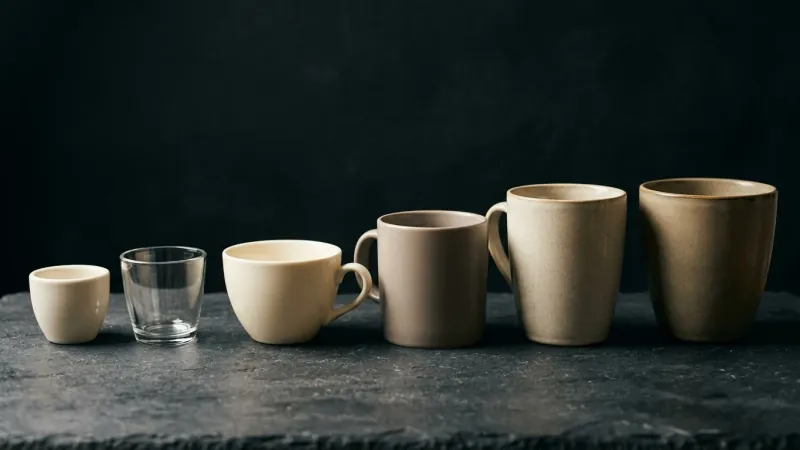
Ask the internet how many grams of coffee go in a cup and you get a number: ten, usually. Sometimes seven. Sometimes eleven.
None of those answers is wrong, exactly. They are just answers to different questions, because nobody involved has said what a cup is — and in a kitchen, that word has at least six different values. The smallest of them is the one printed on your coffee maker.
So the short answer has two halves. There is no grams-per-cup figure until you define the cup, and the definitions run from 125 ml to 240 ml — a factor of nearly two. And the answerable question is grams of coffee per gram of water, where the number of genuinely published answers is much smaller than the internet suggests: the Specialty Coffee Association has exactly one, it appears in two of its documents, and it is not the one usually attributed to it.
First, whose cup?
Every figure below was read from the organisation or manufacturer that publishes it, on 8 September 2026.
| Whose cup | One “cup” | As water |
|---|---|---|
| Moccamaster KB — labelled 1.25 L / 10 cups | 125 ml | 125 g |
| Cuisinart DCC-5 — “a cup of coffee is 5 oz” | 148 ml | 148 g |
| SCA cupping protocol | 150 ml | 150 g |
| National Coffee Association — six ounces | 177 ml | 177 g |
| US customary cup — half a liquid pint | 236.6 ml | 236 g |
| US legal cup — 21 CFR 101.9(b)(5)(viii) | 240 ml | 240 g |
The federal definition is the tidiest, and it is worth having in full because it also settles the tablespoon:
For nutrition labeling purposes, a teaspoon means 5 milliliters (mL), a tablespoon means 15 mL, a cup means 240 mL, 1 fl oz means 30 mL, and 1 oz in weight means 28 g.
Between the top and bottom of that table there is a 1.92× spread. At any fixed ratio, that is the difference between 6.9 g of coffee and 13.2 g — for a word every one of those sources uses without hesitation.
A cup and a serving are not the same thing
The clearest illustration I found is inside a single document, and it belongs to a machine that gets everything else right.
The Mr. Coffee Perfect Brew is on the SCA’s certified list. Its brew-size menu offers 8, 12, 16 oz or 8-cup carafe, and the carafe is described as an 8-cup Carafe (40oz) — which makes one cup five fluid ounces.
So the only thing that document ever calls a cup is 5 oz, while the smallest drink it will pour you is 8 oz. Both usages are ordinary: a cup is a carafe-capacity counter, a serving is a serving. But it means the machine’s “cup” and the machine’s smallest cup of coffee differ by 60%, and a reader carrying “a cup is 8 oz” in from the rest of the kitchen will misread the carafe by that much.
Moccamaster does not define a cup at all. The KB is labelled 1.25 L / 40 oz / 10 cups, and you divide it yourself. (Divide the litres and a cup is 125 ml; divide the ounces and it is 118 — the two figures on that label are not quite each other.)
What the SCA actually says, and what it doesn’t
The phrase “the SCA’s golden ratio” turns up across the pages answering this question with four different numbers attached: 1:15, 1:16, 1:17 and 1:18. They cannot all be right, and in fact only one of them is close.
The SCA publishes a brew ratio in two places, and both give the same figure.
Standard 310-2021, the document behind the Certified Home Brewer programme, sets the standard brew ratio at 55 g of coffee per 1.000 kg of fresh water.
Coffee Standards (2018), §3.1, sets the cupping ratio at 8.25 g of whole-bean coffee, with a tolerance of ± 0.25 g, and states the ratio itself as:
0.055 g coffee per 1 ml water
Both are 0.055 g of coffee per gram of water — 1:18.2. Two different documents, two different purposes, one number. (The public mirror of Coffee Standards drops a run of text inside §3.1, so the vessel volume is not readable in it. Dividing 8.25 by 0.055 gives 150 ml, but that is my arithmetic, not a quotation.)
Now the part that matters for anyone repeating the claim. The document everybody names — the Golden Cup Standard, §5.1 of the same Coffee Standards — contains no brew ratio at all. It defines a brew strength of 11.5 to 13.5 grams per litre and an extraction yield of 18 to 22 percent, and stops there. Strength and extraction, not a recipe.
So “according to the SCA’s Golden Cup Standard the golden ratio is 1:18” is right about the number and wrong about the source. The 1:18.2 figure is real; it lives in Standard 310 and in the cupping protocol.
This is the second time this pattern has come up here. The Golden Cup box everyone quotes turned out not to contain the words “Golden” or “18–22%” in the standard it is usually attributed to either. A number can be perfectly correct and still be hanging off the wrong document, and the only way to tell is to open the document.
Every published recommendation, in one unit
To compare recommendations you have to convert them, and converting tablespoons to grams needs a density. Coffee’s is not a constant: measured on one Arabica roasted three ways, bulk density runs 0.39 g/cm³ at a light roast, 0.33 at a medium and 0.28 at a dark one, while the density of the particles themselves does not change. Roasting opens the bean up; a scoop is a volume; the same scoop holds progressively less.
At a US tablespoon of 14.79 ml, that gives:
| Roast | One tablespoon | Two tablespoons |
|---|---|---|
| Light | 5.8 g | 11.5 g |
| Medium | 4.9 g | 9.8 g |
| Dark | 4.1 g | 8.3 g |
Now the published advice, in a common unit:
| Source | As published | As a ratio |
|---|---|---|
| SCA Standard 310-2021 | 55 g per 1.000 kg water | 1:18.2 |
| SCA Coffee Standards §3.1 | 0.055 g per ml | 1:18.2 |
| Moccamaster support page | 55 g per litre | 1:18.2 |
| National Coffee Association | 1–2 tbsp per 6 fl oz | 1:15.4 – 1:43 |
| Cuisinart DCC-5 booklet | 1 tbsp per 5 oz cup | 1:26 – 1:36 |
The NCA’s entry is the one to sit with. Its wording is:
Coffee-to-water ratio: 1 to 2 tablespoons of ground coffee for every 6 ounces of water (the “Golden Ratio”)
Take the weak end — one tablespoon of dark roast in six ounces — and that is 1:43. Take the strong end — two tablespoons of light roast — and it is 1:15.4. The most widely repeated brewing advice in America spans nearly a factor of three.
And yet it is not wrong. Its midpoint, two tablespoons of medium roast in six ounces, works out to 1:18.1 — the SCA’s figure to within rounding. The tablespoon rule is a correct translation of 55 g/L for exactly one roast level, sitting at the top of its own stated range. Follow the upper bound with a medium roast and you land on the standard. Follow the lower bound with a dark roast and you are brewing at less than half of it.
A scoop is not a unit either
The gram is doing all the work in every one of those recommendations. The moment it is translated into scoops, precision leaks out — and you can watch it happen inside a manufacturer’s own table.
Moccamaster publishes this, with the doses given as grams ± 5:
| Water | Moccamaster 2 Tbsp scoops | Coffee (g) | Grams per scoop (derived) |
|---|---|---|---|
| 1.8 L | 10 | 99 | 9.90 |
| 1.25 L | 7 | 69 | 9.86 |
| 1 L | 6 | 55 | 9.17 |
| 0.75 L | 4 | 41 | 10.25 |
| 0.5 L | 3 | 28 | 9.33 |
| 0.3 L | 2 | 17 | 8.50 |
The gram column is flawless: all six rows sit on 55 g/L to within rounding. The scoop column cannot be, because scoops do not divide. The weight a scoop must hold to make each row work swings from 8.50 g to 10.25 g — a 21% spread inside one table — and the small brews take the worst of it.
Then there is the scoop itself. Mr. Coffee’s dosing table implies 13.0, 13.3, 13.0 and 13.2 g per scoop across its four brew sizes: call it 13.1 g. Moccamaster’s averages 9.50 g. Two scoops from two boxes, nearly 40% apart. “Add two scoops” is not an instruction; it is an instruction plus an assumption about which drawer you opened.
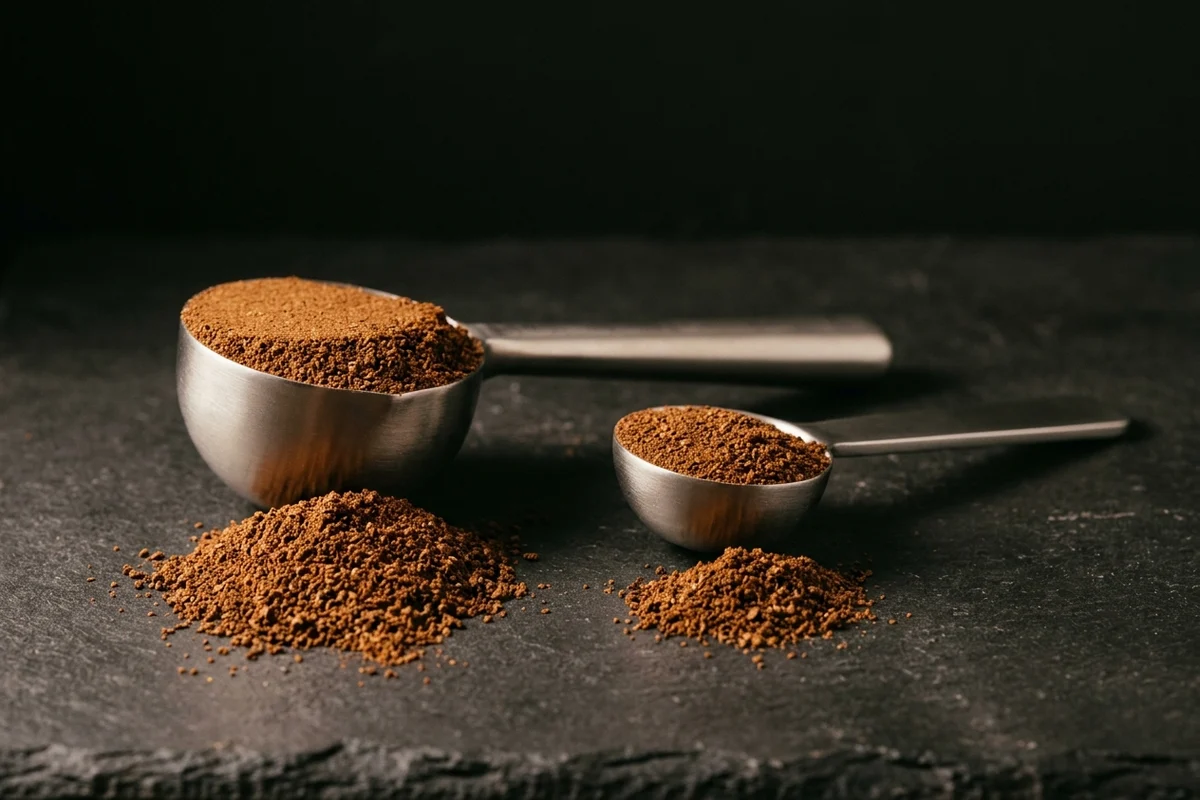
None of which is an argument for precision for its own sake. It is an argument for weighing rather than scooping, which is a different and much lower bar.
What your manual tells you, and why
Here is where the certified and uncertified worlds separate, and the mechanism is written into the standard.
SCA Standard 310-2021, §6.7:
Proper brewing instructions shall be supplied with the brewer, specifically some recommendation of coffee grind, a coffee/water ratio of 55 g/kg (or its equivalent in other units) and cleaning instructions.
§7.8 then sends the auditor into the paperwork to find it. Certification is the mechanism that puts the ratio in a consumer’s hands — not a badge on the box, a requirement about the booklet.
And it works. The Mr. Coffee Perfect Brew’s guide states that the machine follows the Golden Cup coffee-to-water ratio recommended by the Specialty Coffee Association, then prints the doses:
| Brew size | Coffee scoops | Grams | 55 g/kg would need |
|---|---|---|---|
| 8 oz | 1 | 13 | 13.0 |
| 12 oz | 1.5 | 20 | 19.5 |
| 16 oz | 2 | 26 | 26.0 |
| 8-cup carafe (40 oz) | 5 | 66 | 64.9 |
Four rows, four matches within about a gram. The half-scoop at 12 oz is the manufacturer conceding the same rounding problem Moccamaster’s table has, and solving it.
Now the same exercise on a machine that carries no certification. The Cuisinart DCC-5 booklet tells you a cup is 5 oz and to add one level scoop — one tablespoon — per cup. At a medium roast that is about 1:30, which puts roughly 60% as much coffee into the water as 1:18.2 does.
More striking than the recommendation is the ceiling. The booklet also says the basket’s maximum is five scoops for this 25 oz, five-cup machine. Its reservoir holds 26 oz, which is about 767 g of water; brewing that at 55 g/kg would take 42 g of coffee, or nearly nine tablespoons. The machine is not merely pointed somewhere else — at full capacity it cannot be dosed to the specialty standard, because the manufacturer says that much grounds will overflow the basket.
I want to be careful about what that does and does not mean. The DCC-5 is not a certified brewer and does not claim to be. The finding is not that Cuisinart is wrong; it is that a consumer manual and a specialty standard are describing two different drinks, and neither of them tells you that. If your coffee has always tasted thin and you have always followed the booklet, that is the first place I would look — before the grinder.
The water you pour is not the coffee you get
Every ratio chart on the internet is written on water going in. What lands in the cup is less, because the spent bed keeps some.
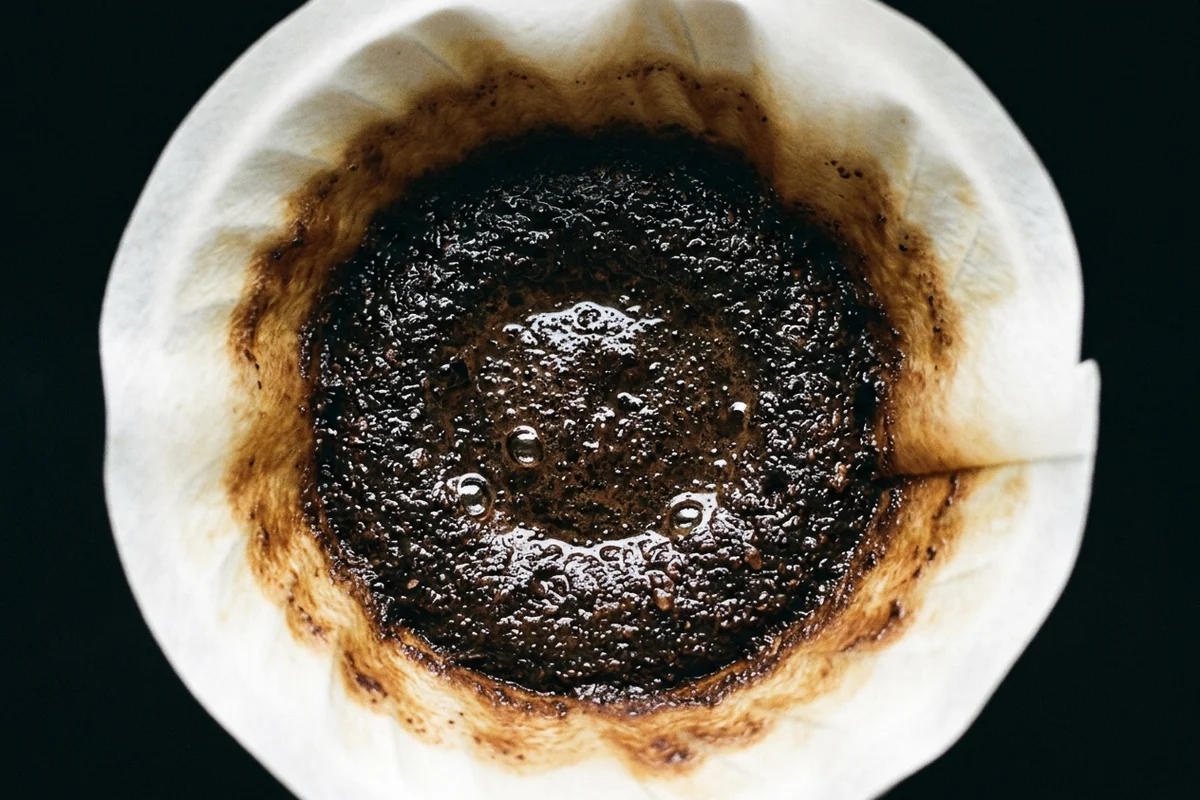
Measured liquid retention is about 2.1 g of water per gram of grounds. That turns a recipe into two lines of arithmetic. For a target of C grams in the cup at a ratio of r:
dose  = C ÷ (r − 2.1)
water = r × dose| Target in the cup | Ratio | Dose | Water to pour | Extra water |
|---|---|---|---|---|
| 240 g (one legal cup) | 1:18.2 | 14.9 g | 271 g | +13% |
| 240 g | 1:16 | 17.3 g | 276 g | +15% |
| 240 g | 1:15 | 18.6 g | 279 g | +16% |
| 350 g (a large mug) | 1:18.2 | 21.7 g | 395 g | +13% |
| 1000 g (a carafe) | 1:18.2 | 62.1 g | 1130 g | +13% |
It is also why a drip machine’s reservoir is larger than its carafe. Cuisinart’s own figures for the DCC-5 show it: a 26 oz reservoir feeding a 25 oz carafe. That gap is smaller than 2.1 g per gram would predict for the machine’s five-scoop dose, which is worth saying plainly rather than smoothing over — retention is an average across grind, bed depth and dwell time, not a constant, and the arithmetic above is a good estimate rather than a law.
The practical version: if you want a full mug, pour about 13% more water than the mug holds, and dose against the water rather than the mug.
Espresso measures something else entirely
The word “ratio” changes meaning when you move to espresso, and almost nobody says so.
| Recipe type | What the denominator is | Example |
|---|---|---|
| Filter ratio | the water you pour in | 55 g per 1000 g of water |
| Espresso ratio | the beverage that comes out | 18 g in, 36 g out — “1:2” |
A filter recipe counts water that will never reach the cup. An espresso recipe counts only what did. They are not comparable numbers, and lining “1:2” up against “1:16” as though espresso were eight times stronger mistakes a change of denominator for a change of drink.
There is a second reason to weigh espresso rather than eyeball it, and it comes from the two official definitions disagreeing about the unit. The Italian disciplinare specifies a dose of 7–9 g, 13–26 g in the cup, and a flow of 0.48–1.3 g/s: mass throughout. The World Barista Championship rulebook defines espresso as a beverage of around 1 fl. oz. / 30 ml: a volume. And part of that volume is crema, whose volume has been measured from 2.5 to 12 ml on carbon dioxide content alone. A line on a shot glass is partly measuring how long ago the beans were roasted.
So how many grams in a double shot?
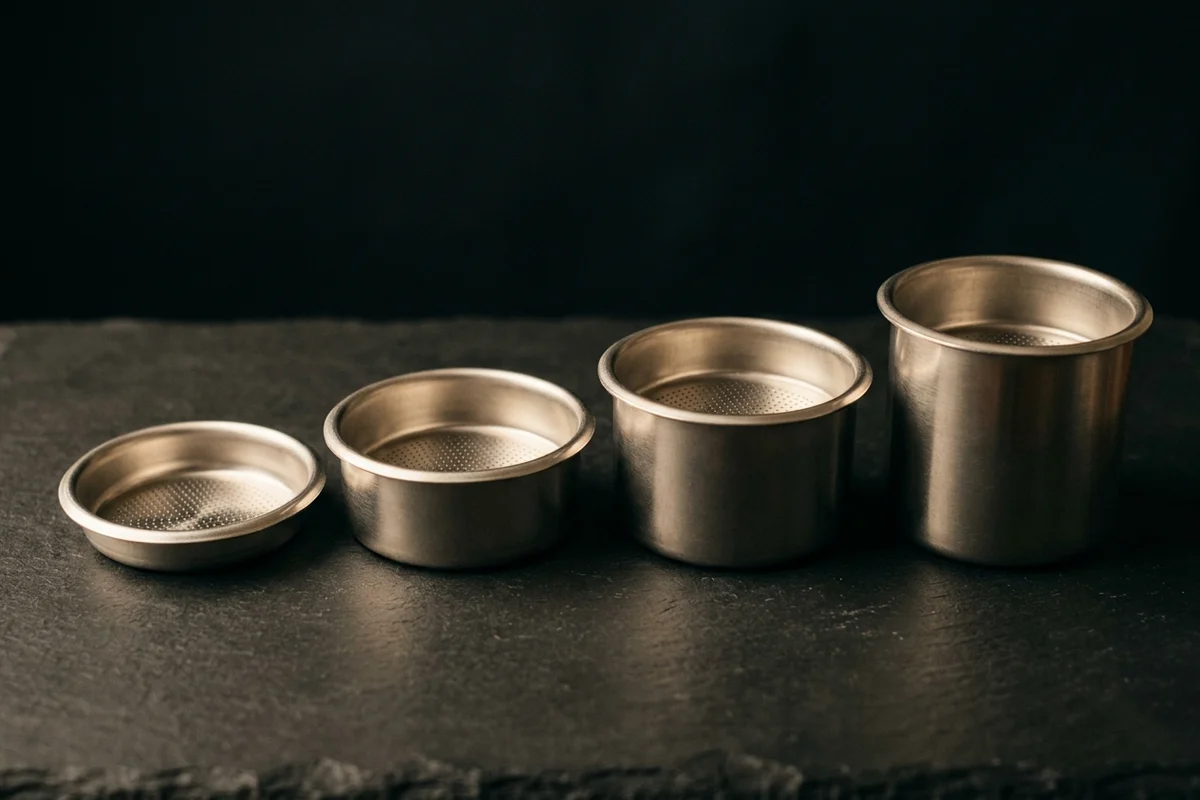
No standard says. That is the honest answer, and it is more useful than a number, because it tells you where the number actually comes from: the basket in your portafilter.
| Source | Dose | What it is |
|---|---|---|
| Italian disciplinare | 7–9 g (single) | An official document, in mass |
| WBC 2026 rulebook | not specified | Competition rules |
| VST 7 g single | 6–8 g | Hardware |
| VST 15 g double (EU) | 14–16 g | Hardware |
| VST 18 g double | 17–19 g | Hardware |
| VST 20 g competition | 19–21 g | Hardware |
| VST 22 g triple | 21–23 g | Hardware |
| Cameron et al. 2020 | 20.0 ± 0.5 g | Peer-reviewed experiment |
VST states a ±5% tolerance on the total open area of its baskets, and a rated dose window about a gram either side of the nominal size. That window is your answer: fill the basket you own to its rated dose.
And notice where the internet’s favourite range comes from. The disciplinare’s single is 7–9 g. Double it and you get 14–18 g — precisely the band repeated everywhere without attribution. The “18 g in, 36 g out” recipe is a widely used, perfectly sensible convention. It is not written in any standard.
How precise does any of this have to be?
Less precise than the tone of most brewing advice implies. Four published tolerances, from four unrelated sources:
| Source | Tolerance | On what | As a percentage |
|---|---|---|---|
| SCA Coffee Standards §3.1 | ± 0.25 g | 8.25 g cupping dose | ±3.0% |
| Cameron et al. 2020 | ± 0.5 g | 20 g espresso dose | ±2.5% |
| VST basket rating | ± 1 g | 18 g basket | ±5.6% |
| Moccamaster dosing table | ± 5 g | 55 g per litre | ±9.1% |
Three of the four sit in the low single digits of percent, and the loosest — a manufacturer’s own published figure — is still under ten. Which means the equipment question answers itself: a scale reading in tenths of a gram is comfortably finer than every tolerance anyone publishes, and the hundredths digit on an expensive one is decoration.
Getting your own number
Three steps, and only the first one is specific to you.
Find out what your machine means by a cup. Fill the carafe to a marked line, pour it onto a scale, divide. Or read the manual, which on a certified machine will simply tell you the ratio and save you the trouble. If your maker calls 40 oz eight cups, its cup is 5 oz — so a recipe written per 8 oz cup, applied one dose per machine cup, puts 60% more coffee into each ounce of water than its author intended.
Pick a ratio and stop converting it. 1:18.2 is the standard’s figure and a reasonable place to start; 1:16 is stronger and common in specialty cafés. Whichever you choose, keep it in grams per gram — it is the axis that strength and extraction yield both hang from, and the only one of the three you can set for free. Every conversion into scoops or spoons costs you up to a fifth of the number, as Moccamaster’s own table shows.
Dose against the water, not the cup, and add back what the grounds keep. Multiply the water by 0.055 for the standard ratio. If you want a specific amount in the cup rather than a specific amount of water, divide the target by (ratio − 2.1) to get the dose, and pour about 13% more water than the cup holds.
That is the whole method, and none of it requires equipment beyond something that reads grams. The only genuinely unanswerable part of the original question was its last word.
Sources
Every figure in this piece traces to one of these. Dates are when the source was read — lists and prices move.
- SCA Standard 310-2021: Home Coffee Brewers — Specifications and Test Methods Specialty Coffee Association Read via the public mirror on the Internet Archive. Source of the 55 g per 1.000 kg standard brew ratio, and of §6.7 and §7.8, which require a certified brewer's documentation to state that ratio and require the auditor to find it. Read 8 September 2026
- Coffee Standards (revised 2018) Specialty Coffee Association Read via the public mirror on the Internet Archive. §3.1 gives the cupping ratio as 8.25 g of whole bean ± 0.25 g, with the ratio stated as 0.055 g of coffee per 1 ml of water. §5.1, the Golden Cup Standard, defines strength and extraction yield and contains no brew ratio. The mirror drops a run of text inside §3.1 and §3.2, so the cupping vessel volume is not readable in it; the 150 ml figure quoted here is arithmetic from 8.25 ÷ 0.055, not a quotation. Read 8 September 2026
- SCA Certified Home Brewers Specialty Coffee Association The list of models certified between 2023 and 2026, used here only to establish that the Mr. Coffee Perfect Brew is on it. Read 8 September 2026
- Perfect Brew Hot & Cold Coffee & Tea Brewer User Guide, BVMC-IHCTM08SS Mr. Coffee (Newell Brands) The manufacturer's own PDF. Source of the dosing table (13, 20, 26 and 66 g), the statement that the machine follows the SCA's ratio, and of the two different cup sizes used in one document — brew sizes in 8 fl oz, the carafe as 8 cups of 40 oz. Read 8 September 2026
- DCC-5 Series 5-Cup Coffeemaker Instruction Booklet Cuisinart Read in full. States that a cup of coffee is 5 oz for this machine, recommends one level scoop of one tablespoon per cup, gives the reservoir as 26 oz and the carafe as 25 oz, and caps the basket at five scoops. Read 8 September 2026
- What formula of water to coffee does Moccamaster recommend? Moccamaster USA support Gives 55 grams per litre and a six-row dosing table in scoops and grams, with the doses printed as grams ± 5. The scoop column is the source of the 8.5–10.25 g spread derived here. Read 8 September 2026
- Moccamaster KB — product page Moccamaster USA Capacity given as 1.25 L / 40 oz / 10 cups, with no definition of a cup. Read 8 September 2026
- Drip coffee — how to brew National Coffee Association (aboutcoffee.org) Source of the NCA's Golden Ratio: one to two tablespoons of ground coffee for every six ounces of water. Read 8 September 2026
- 21 CFR § 101.9(b)(5)(viii) — Nutrition labeling of food US Code of Federal Regulations For nutrition labelling, a teaspoon means 5 ml, a tablespoon 15 ml, a cup 240 ml, one fluid ounce 30 ml and one ounce in weight 28 g. Read 8 September 2026
- VST Precision Filter Baskets VST Inc. The manufacturer's published rated dose ranges for each basket size, and the ±5% tolerance on total open area. Read 8 September 2026
- Systematically Improving Espresso: Insights from Mathematical Modeling and Experiment Cameron, Morisco, Hofstetter, Uman, Wilkinson, Kennedy, Fontenot, Lee, Hendon & Foster — Matter 2(3), 631–648 (2020) Source of the dose tolerance used in peer-reviewed espresso work: 20.0(5) g in, 40.0(5) g out. Read 7 September 2026
- Physical characterization of Arabica ground coffee with different roasting degrees Nakilcioğlu-Taş & Ötleş — Anais da Academia Brasileira de Ciências 91(2) (2019) Open access. Bulk density of the same Arabica at three roast levels — 0.39, 0.33 and 0.28 g/cm³ — with particle density statistically unchanged. Every tablespoon-to-gram conversion here rests on these figures. Read 7 September 2026
- A new Coffee Brewing Control Chart relating sensory properties and consumer liking to brew strength, extraction yield, and brew ratio Guinard, Ristenpart et al. — Journal of Food Science 88(4) (2023) Open access. Source of the liquid-retention figure of about 2.1 g of water per gram of grounds, which is what makes the water you pour different from the coffee you drink. Read 3 September 2026
- Disciplinare Caffè Espresso Italiano Tradizionale Consorzio di Tutela del Caffè Espresso Italiano Tradizionale, INEI and the Comitato Italiano del Caffè Defines a single espresso by mass: a 7–9 g dose, 13–26 g in the cup, and an average flow of 0.48 to 1.3 g/s. Read 5 September 2026
- 2026 World Barista Championship Rules and Regulations World Coffee Championships / Specialty Coffee Association Defines espresso as a beverage of around 1 fl. oz. / 30 ml and specifies no dose at all. Read 5 September 2026
- Thermophysical Properties of Fluid Systems: water NIST Chemistry WebBook, SRD 69 Density of liquid water at atmospheric pressure, used for every millilitre-to-gram conversion in this piece. Read 7 September 2026