
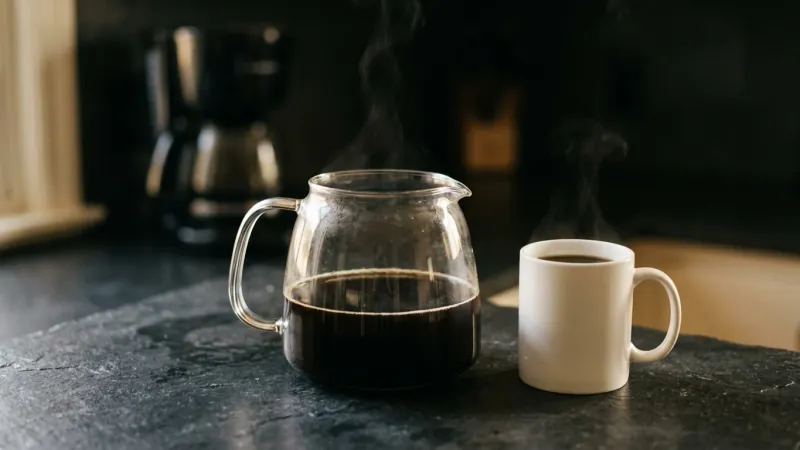
If your coffee maker’s coffee isn’t hot enough, the first question is which part is cold. The brewing temperature — the heat of the wet coffee in the basket — and the temperature of what you drink are different numbers — by the published figures, 15 °C or more apart within five minutes of a perfectly healthy brew — and they have different fixes. Descaling can help a brewer that runs cool; it does nothing for a cold mug.
Two findings frame the rest. The Specialty Coffee Association’s certification requires a heated carafe to hold coffee at 80–85 °C and never heat it above 85 °C — so the certified brewers recommended as the “hottest” are, by rule, not the hottest in the carafe. And when researchers at UC Davis brewed at 87, 90 and 93 °C and matched the extraction, a trained panel could not tell the coffees apart. Temperature matters through what it extracts. A thermometer in the basket tells you whether your problem is the machine at all.
Below: where the heat goes between the heater and your first sip, where the 195–205 °F figure comes from and what replaced it, what has actually been measured about temperature and taste, how hot coffee should be in the cup, why a brewer runs cool, what each maker says its machine does, and how to check yours with a thermometer in about ten minutes.
Affiliate links. Some links below go to Amazon. If you buy through one I earn a commission at no extra cost to you, and it never changes which product gets named or what the measurements say. Full disclosure.
Where the heat goes, from the heater to your first sip
Every temperature you will read about coffee makers belongs to a different point in the chain, and most of the numbers that rank for this search compare one point with another. Here is the chain, each figure from the document that publishes it:
| Point | Temperature | Source |
|---|---|---|
| Boiling point of water | 212 °F at sea level; about 198 °F at 7,500 ft | USDA |
| Water in the heater or tank | About 200 °F (BUNN Speed Brew); 192 °F (Keurig) | The makers |
| Water at the showerhead | 197.6–204.8 °F (92–96 °C) | KitchenAid, citing the SCAA — the SCA’s older rule |
| Wet coffee in the basket (the slurry) | 90–96 °C (194–205 °F), from a third of the way through | SCA Standard 310-2021 — the point the SCA measures |
| Coffee leaving the basket | About 192 °F (89 °C) on average | KitchenAid |
| Heated carafe, first 30 minutes | 80–85 °C (176–185 °F), never above 85 from the hotplate | SCA certification, 2017 and 2021 |
| Poured into a cup | 2–5 °C lower than the carafe | Abraham & Diller, measured across cup types |
| Insulated cup from a pod brewer | 180–185 °F | Keurig |
| An open cup after five minutes | 10–15 °C lower again | Abraham & Diller |
| First sip that no taster called too cold | 68–70 °C (154–158 °F) | UC Davis, 2022 |
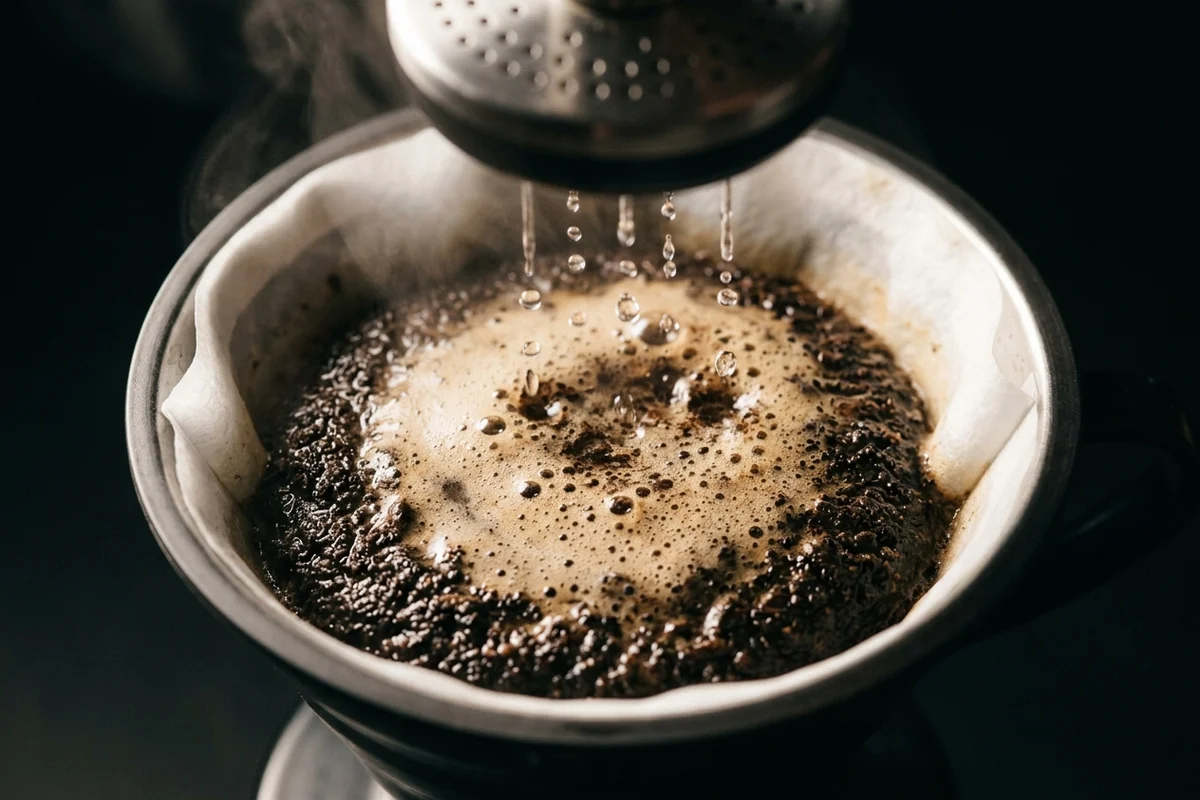
Two reviewers of hot-drink safety, John Abraham and Kenneth Diller, put the main steps together for a large insulated brewer: water at 200 °F, about 195 °F going into the carafe, 186–191 °F once poured. Add five minutes in an open mug and, by their figures, the coffee is roughly 15–23 °C cooler than when it was brewed. That sum is mine, but every part of it is theirs, and almost none of it happens inside the machine.
So when coffee tastes lukewarm, the brewer is one suspect of several, and it is the only one that needs a thermometer in the basket to clear.
What “hot enough” means, and where 195–205 °F comes from
The range nearly every page in this search quotes, 195–205 °F, is usually credited to the SCA. It came from the National Coffee Association, whose brewing page said, as archived in January 2023: “Your brewer should maintain a water temperature between 195 to 205 degrees Fahrenheit for optimal extraction.” That page now redirects to the association’s new site, where the pour-over guide gives 93 ± 3 °C instead.
The SCA’s own figures have changed twice, and they measure a different thing:
| Document | What is measured | Requirement | Time |
|---|---|---|---|
| SCA Coffee Standards, 2018 — cupping | Water poured on the grounds for cupping | 200 °F ± 2 °F (92.2–94.4 °C) | — |
| SCA Golden Cup Standard, 2018 | — | No temperature at all; strength and extraction only | — |
| SCA Certified Home Brewer requirements, 2017 | Water where it meets the grounds, by a sensor at the top centre of the bed | 92 °C within the first minute, at least 92 °C after that, never above 96 °C | Contact time over 4 and under 8 minutes |
| SCA Standard 310-2021 (current) | The slurry, by three thermocouples floating at the top centre of the bed | 90–96 °C once 33% of the water has been sprayed, held to the end | No time limit |
Three things changed in 2021. The floor dropped from 92 to 90 °C (from 197.6 to 194 °F). The clock moved from “the first minute” to “a third of the water,” which accepts that the start of a brew is cooler while the water heats the basket and the grounds. And the four-to-eight-minute window disappeared. The standard’s preface says it was “updated to include recent findings about coffee brewing”; its expert group includes William Ristenpart of UC Davis, a co-author of the temperature study below, published a year earlier. The standard does not say which findings it means, and I am not claiming one caused the other.
The older rule has outlived its replacement on the makers’ pages. OXO describes its certified 8-Cup as brewing at “SCA-specified 197.6 to 204.8°F,” and KitchenAid quotes the same figures for its showerheads — the 92–96 °C of 2017.
One more limit worth knowing: Standard 310 covers only electric filter brewers. Pod machines, espresso machines and pour-over are outside it, so for a Keurig or a Nespresso there is no SCA number, only the maker’s.
Does a cooler brew taste worse? What UC Davis measured
The claim on almost every page is that water below 195 °F makes coffee sour, weak and flat. The one controlled study of drip brewing temperature points somewhere more useful.
In 2020, Mackenzie Batali, William Ristenpart and Jean-Xavier Guinard of the UC Davis Coffee Center brewed the same Honduran coffee at 87, 90 and 93 °C on a programmable commercial brewer — 270 brews across nine combinations of strength and extraction. At each temperature they adjusted the grind, the ratio and the pulsed flow of water until the strength and extraction hit the same targets. A trained panel then scored 31 flavour and texture attributes. Strength and extraction changed the coffee a great deal. Temperature, in the authors’ words, “had no appreciable impact”: the multivariate analysis found no significant effect of temperature, alone or in combination with the other two, and the only attribute that moved with temperature by itself, “nutty,” moved by one point out of a hundred.
What that does and does not say:
- It does not say temperature is irrelevant. The cooler coffees only matched because something else was changed to compensate. Hotter water extracts faster; hold everything else fixed and a cooler brew extracts less, which you can taste — that is the extraction argument, and it is the real reason a cool brewer can make a thin cup.
- It does say the target is the extraction, not the degree. The authors went further and suggested that brewer certification “might focus more on precise control of flow rate over a wider range of temperatures.”
- Its limits are narrow and stated. One coffee, one medium roast, one commercial brewer, 87 to 93 °C and nothing below. It is filter coffee; the authors expect espresso to be “much more sensitive.” The panel described flavour; it did not rate liking. The study was funded by the SCA and underwritten by Breville.
At home you cannot reprogramme the flow, but you can change the grind. If a brewer genuinely runs a few degrees cool and the coffee tastes thin, grinding finer is the lever that did the compensating at UC Davis. That is my reading of the method rather than something the study tested on a home machine; the grind-size chart covers how far to move.
The study also found a side benefit: coffee brewed at 87 °C came out 4–5 °C cooler straight after brewing, which the authors note is safer against scalds.
How hot coffee should be in the cup
This is where most “not hot enough” complaints actually live, and it has been measured more often than brewing temperature.
- About 60 °C (140 °F) was the average when 300 consumers mixed hot and cooler coffee until it was how they liked it (Lee and O’Mahony, 2002). Black-coffee drinkers chose slightly hotter.
- 58–66 °C (about 136–151 °F) gave the highest acceptance in a 2022 UC Davis analysis of more than 3,000 tastings. But across 56–68 °C, 6–12% of tasters called the coffee too cold, and only at 68–70 °C (154–158 °F) did nobody — the authors’ “minimum temperature range at which no consumers will assess black coffee as too cold.” Their reasoning for serving at least that hot is practical: people can wait for coffee to cool, but they cannot heat it up.
- About 136 °F (57.8 °C) is the optimum two engineers calculated by setting burn risk against preference (Brown and Diller, 2008). A later review by Abraham and Diller recommends serving at 130–160 °F.
- Above 65 °C (149 °F) is what the International Agency for Research on Cancer calls “very hot.” In 2016 it classed drinking very hot beverages as probably carcinogenic, a cause of oesophageal cancer, while moving coffee itself out of its “possibly carcinogenic” group: “it is the temperature, rather than the drinks themselves, that appears to be responsible.” The evidence is rated limited, and it comes mostly from tea and maté drunk at about 70 °C.
There is a real tension in those numbers: the temperature at which nobody complains sits just above the one the cancer agency flags. Both are consistent with serving hot and drinking after a minute or two. A brewer that delivers 185 °F into the carafe has done its part; how hot the first sip is depends mainly on the cup and the wait.
Why your coffee maker brews cooler than it should
If the thermometer says the brew itself is cool, these are the documented causes, roughly in order of how often they are the answer.
Mineral scale. Three makers put it in writing. Breville’s manuals: hard water causes build-up “reducing the brewing flow, brewing temperature, power of the machine, and taste of the coffee.” Philips: limescale can “decrease the temperature of your coffee.” Nespresso: not descaling “could also affect the brewing temperature.” Ninja’s manual adds a symptom: a full carafe should take about 12–15 minutes, and a slower one calls for a clean cycle. None of them says how many degrees scale costs, and the “5–10 degrees” quoted on repair sites has no source I could find. Measure before and after; the difference is your answer. Scale comes from your water’s hardness, which the SCA water standard piece shows how to measure.
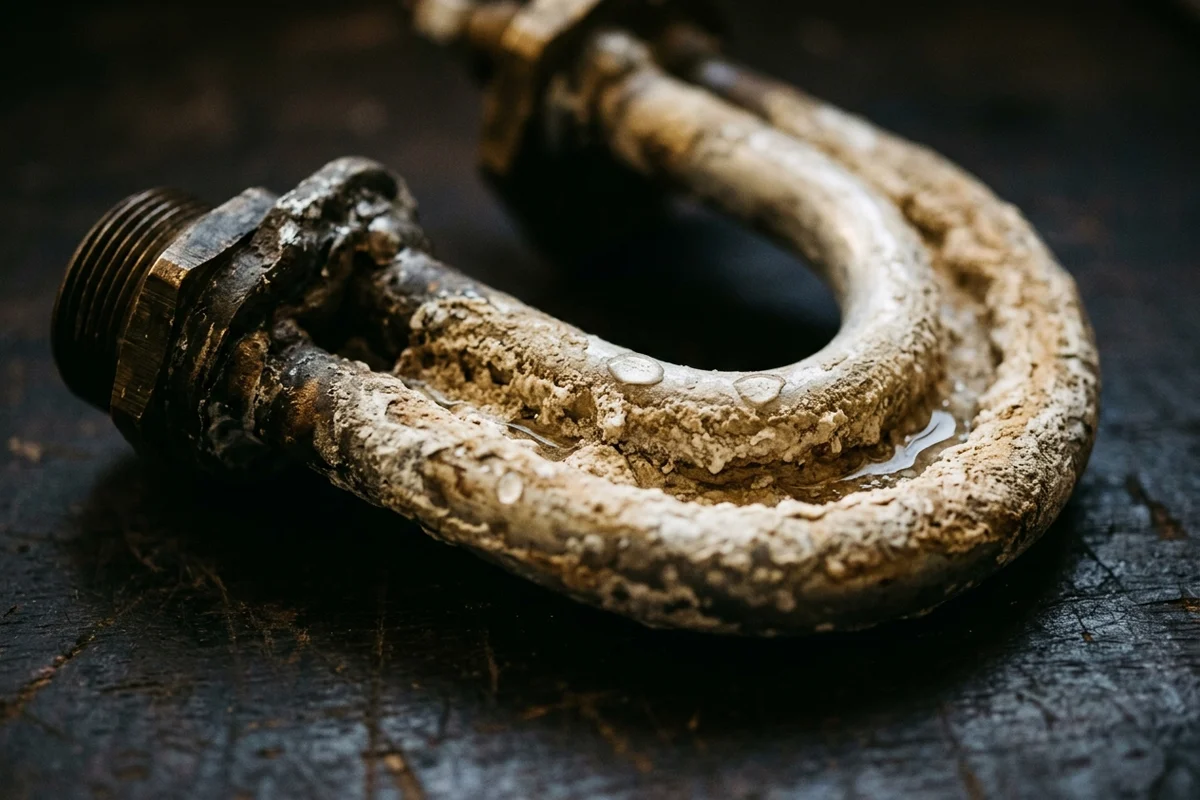
The first brew, and the start of every brew. Keurig says the first brew after switching on or after a long idle “can be a couple degrees cooler” and recommends a small water-only brew first, which warms both the brewer and the mug. KitchenAid says temperature is lower at the start of each cycle “as the water brings the coffee grounds and brew-basket insert up to temperature.” The SCA’s own standard starts its clock a third of the way in for the same reason. A water-only cycle before the real one is the cheapest fix there is.
Small batches. Several makers build a separate mode for them — Ninja’s Small Batch setting for four cups or fewer, Moccamaster’s half-carafe switch — and the SCA tests large brewers at a 1 kg batch as well as full capacity. I found no published measurement of how much cooler a half pot runs, so treat this as something to check with the thermometer rather than a known number.
Altitude. Water cannot get hotter than its boiling point, and that falls as you climb: about 208 °F at 2,000 feet and about 198 °F at 7,500 feet, according to the USDA, which gives the rule as just under 1 °F per 500 feet. By that rule Denver, at 5,280 feet, boils at about 202 °F (my arithmetic). KitchenAid notes its brew temperature drops with elevation, and Keurig’s K-Elite has a high-altitude mode in which the temperature can no longer be adjusted. The SCA tests certified brewers at 0–300 m above sea level, “to avoid high-altitude effects” — so the certificate says nothing about a mountain kitchen. Up high, grinding finer is the compensation that is left.
A warming plate that was never meant to be hotter. On a certified brewer, 80–85 °C in the carafe is the specification, not a fault. With a glass carafe the coffee usually sits on a hotplate; the UC Davis paper notes, citing earlier work, that coffee held in an open carafe on a hot plate changes in flavour over time. An insulated carafe and a preheated mug do more for the cup than a hotter plate would.
What the makers say their machines do
The figures below are each maker’s own, and they are taken at different points, which is why they cannot be lined up against each other:
| Maker / machine | What it says | Measured where | Source |
|---|---|---|---|
| Keurig | 192 °F | Water inside the brewer | Keurig support |
| Keurig | 180–185 °F | In an insulated cup | Keurig support |
| Keurig K-Elite | Adjustable 187–192° | Brewer setting | K-Elite guide |
| KitchenAid drip | 197.6–204.8 °F | Showerhead | KitchenAid support |
| KitchenAid drip | About 192 °F (89 °C) | Coffee leaving the basket | KitchenAid support |
| Moccamaster KBGV | 196–205 °F | “Brewing temperature” | Moccamaster USA |
| OXO Brew 8-Cup | 197.6–204.8 °F | “Water temperature” | OXO, SCA awards entry |
| BUNN Speed Brew | About 200 °F | Water in the internal tank | BUNN |
| Nespresso Original | 83–86 °C (181–187 °F) | Brewing temperature | Nespresso support |
| Nespresso Vertuo | 73–83 °C (163–181 °F) | Brewing temperature | Nespresso support |
| De’Longhi | 70–80 °C (158–176 °F) | Coffee leaving the spouts | De’Longhi support |
| Ninja CE251 | No figure — “calibrated temperature” | — | Owner’s guide |
| Cuisinart DCC-3200 | No figure — “hotter coffee” | — | Cuisinart |
Cuisinart sells its “PerfecTemp” brewer on “hotter coffee” and Ninja describes a “calibrated temperature,” but neither publishes a figure. Nespresso says outright that its coffee is cooler than filter coffee by design, so that it can be drunk straight away, and De’Longhi gives the same reason for its 70–80 °C.
Some figures you will see attributed to these brands do not appear in their documents. One widely ranked page says Keurig’s support documentation puts its coffee at 170–190 °F; Keurig’s article says 192 °F inside and 180–185 °F in an insulated cup. Another lists a drip brewer’s maximum as 294 °F, 82 °F above the boiling point of water.
Which coffee maker makes the hottest coffee?
The honest answer has three parts.
In the basket, no drip machine can beat boiling, and the good ones aim below it. A certified brewer holds the slurry between 90 and 96 °C. Tank machines such as BUNN’s keep water at about 200 °F all the time, so the first cup does not wait for a cold heater.
In the carafe, certified brewers are capped on purpose. The SCA requires a heated carafe to stay at 80–85 °C for the first half hour and never be heated above 85 °C. Pages that answer “which coffee maker makes the hottest coffee” with a list of SCA-certified brewers are recommending machines that are built not to. The SCA’s list, on 8 October 2026, ran to 28 home brewers — Moccamaster, Bonavita, OXO, Breville’s Luxe Brewer and Fellow’s Aiden among them — and, despite one ranking page’s claim that most certified brewers are BUNNs, no BUNN model at all.
In the cup, the vessel decides. Keurig’s own numbers show it: the same 192 °F water arrives at 180–185 °F in an insulated cup and “significantly” cooler in a cold ceramic mug. Preheating the mug and keeping coffee in a vacuum-insulated carafe rather than on a plate will raise the first sip more than switching machines.
If the measurement in the basket says your brewer is genuinely cold after descaling, a certified machine is a reasonable replacement, because its temperature has been tested by a laboratory rather than described by a marketing page — just not because it will make the hottest cup.
How to check your coffee maker’s temperature
The SCA measures with three thermocouples floating at the top of the coffee bed, logging every second. An instant-read thermometer gives you a home version of the same reading in about ten minutes:
- Mark the reservoir. Fill it to your usual full batch and put a strip of tape at two-thirds of that level. When the water drops to the tape, a third of it has been sprayed — the moment the SCA’s standard starts counting. (This is the standard’s own method for finding that point.)
- Brew your normal recipe, full batch, at room temperature — not straight after another brew. The SCA lets a brewer cool for ten minutes between tests.
- When the water reaches the tape, open the lid or swing out the basket and put the probe into the top centimetre or two of the wet coffee, in the centre. Wait three seconds and read.
- Read again near the end of the brew, in the same place.
- Then read the carafe and your mug, so you can see where any loss happens.
On a pod or capsule machine there is no basket to reach; read the stream as it comes out, then the cup.
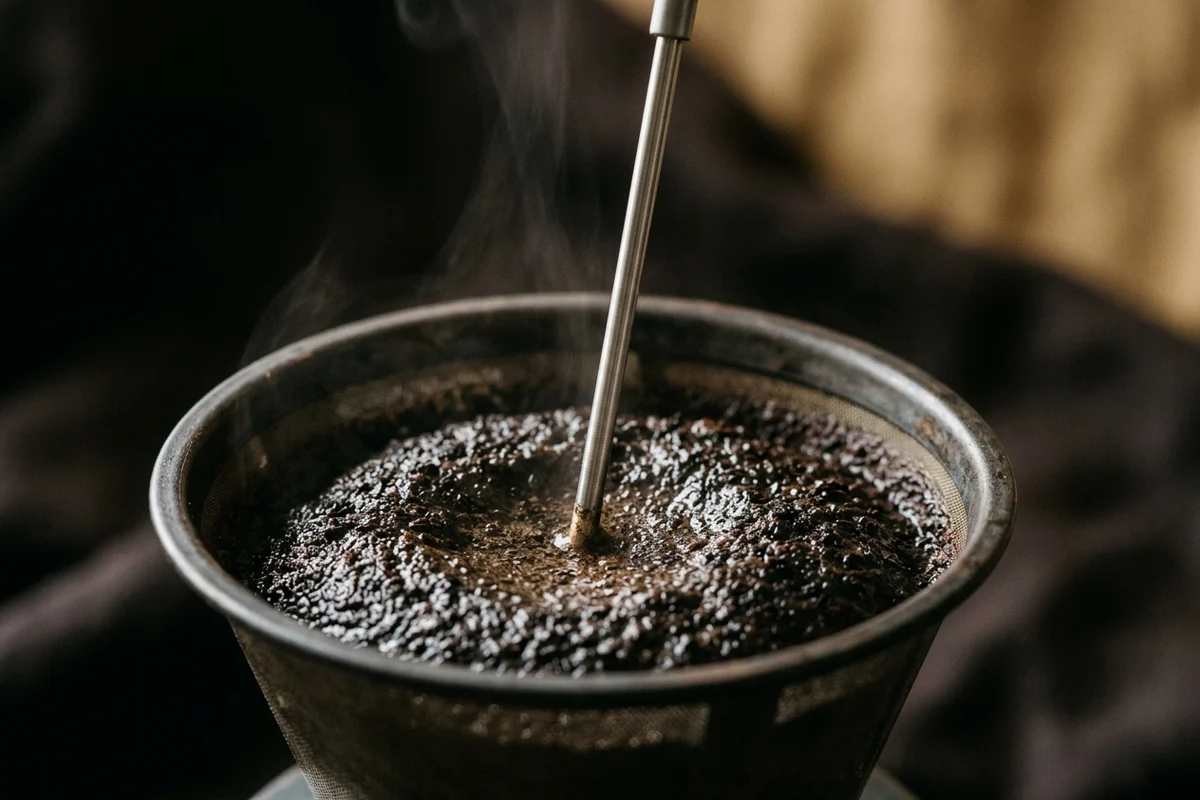
Reading the result.
- 90–96 °C (194–205 °F) in the basket: the brewer is doing what a certified one does. If the coffee in your mug still disappoints, the heat is being lost after the basket: warm the mug with hot water, use an insulated carafe, and do not leave the pot on the plate for an hour.
- A few degrees under 90 °C: run a water-only cycle first and measure again; then descale and measure again. If it stays cool and the coffee tastes thin, grind finer.
- Well under 90 °C after descaling: the heater or its thermostat is the problem, and repair or replacement is the honest answer.
- The carafe reads 80–85 °C on a certified brewer: that is the specification.
The thermometer does not need to be precise to the tenth. The difference between a healthy brew and a cool one is the difference between 93 and 87 °C — six degrees, the very range UC Davis tested. I would use ThermoWorks’ ThermoPop 2: the maker rates it to ±1 °F between 14 and 208 °F, it reads in two to three seconds with the 4.5-inch probe, and it comes with a NIST-traceable calibration certificate. ThermoWorks sold it for $24.00 on sale, against a $39.00 list price, on 8 October 2026. Two cautions from the maker’s own instructions apply here: the whole thermometer should not be exposed to more than 190 °F, so hold the body above the steam and take the probe out once you have your reading; and in Fahrenheit it shows whole degrees above 99.9, while in Celsius a brewing reading shows tenths.
Buyers rate it 4.6 out of 5 on Amazon, and the complaints are specific. One owner likes the speed but notes there is “no way to calibrate manually.” Another thinks cheaper probes “work just as well” — fair, for a job this coarse. The repeated warning is durability: a handful report units that broke or died within months.
What I would actually do
Measure the basket before changing anything. Ten minutes and a thermometer separate “the machine is cold” from “the cup is cold,” and they have nothing in common as fixes.
If the cup is the problem, fix the cup. Rinse the mug with hot water, pour from an insulated carafe or straight after brewing, and drink within a few minutes. That alone recovers more heat than any brewer upgrade.
If the brew is cool, work through it in order: a water-only cycle first, then descale, then grind finer. Re-measure after each step so you know which one worked.
Replace the brewer only when the basket stays well under 90 °C after descaling, and if you do, choose on tested numbers — a certified brewer’s slurry has been measured at 90–96 °C at sea level — rather than a box that says “hotter.”
The 195–205 °F that every page repeats is a fair target for the water. What decides whether your coffee is hot enough is a different number, taken in a different place: the one in your cup.
Sources
Every figure in this piece traces to one of these. Dates are when the source was read — lists and prices move.
- SCA Standard 310-2021 — Home Coffee Brewers: Specifications and Test Methods Specialty Coffee Association, © 2022 (Internet Archive copy) §6.2: slurry at 90–96 °C by the time 33% of the water has been sprayed, held to the end of the cycle; §7.3: three K-type thermocouples floating at the top centre of the bed, logged every second; §6.6: a heated carafe at 80–85 °C for 30 minutes, never above 85 °C from a heating element; §7.1: tests at 0–300 m above sea level; §7.1.7: the 33% point found by marking the reservoir at two-thirds. Scope excludes pod, espresso and manual brewers. Expert group includes William Ristenpart of UC Davis. Read 8 October 2026
- Certified Home Brewer Program — Minimum Certification Requirements Specialty Coffee Association, 2017 (Internet Archive copy) The rule 310-2021 replaced: water at the point of contact reaching 92 °C within the first minute, at least 92 °C for the rest of the cycle and never above 96 °C; contact time of more than 4 and less than 8 minutes; carafe no lower than 80 °C and no higher than 85 °C for 30 minutes. Read 8 October 2026
- Coffee Standards, revised 2018 — §3.3 Cupping Water Temperature and §5.1 Golden Cup Standard Specialty Coffee Association (Internet Archive copy) Cupping water at 200 °F ± 2 °F (92.2–94.4 °C) when poured on grounds. The Golden Cup Standard itself specifies brew strength and extraction only, no temperature. Read 8 October 2026
- SCA Certified Home Equipment Specialty Coffee Association 28 certified home brewers on this date, including eight Moccamaster models listed as certified in 2026; no BUNN model. Testing at the European Coffee Brewing Centre. Read 8 October 2026
- How to Brew Coffee National Coffee Association USA (Internet Archive copy, 7 January 2023) 'Your brewer should maintain a water temperature between 195 to 205 degrees Fahrenheit for optimal extraction', and 'coffee drinkers typically drink their coffee at 140 degrees Fahrenheit or below.' The address now redirects to aboutcoffee.org, whose pour-over page gives 93 ± 3 °C. Read 8 October 2026
- Brew temperature, at fixed brew strength and extraction, has little impact on the sensory profile of drip brew coffee Batali, Ristenpart & Guinard — Scientific Reports 10, 16450 (2020); author correction 11, 2676 (2021) Open access, read in full. 87, 90 and 93 °C on a programmable commercial brewer, nine strength-and-extraction targets, 270 brews, a trained descriptive panel of 31 attributes; grind, ratio and pulse flow were adjusted to hold strength and extraction constant. No significant multivariate effect of temperature; coffee brewed at 87 °C was 4–5 °C cooler straight after brewing. Funded by the SCA, underwritten by Breville. The correction concerns the units of the water recipe only. Read 8 October 2026
- Impact of beverage temperature on consumer preferences for black coffee Ristenpart, Cotter & Guinard — Scientific Reports 12 (2022) Open access, read in full. More than 3,000 tastings between 56 and 71 °C: 6–12% judged coffee too cold from 56 to 68 °C, none at 68–70 °C; 58–66 °C maximised acceptance; above 70 °C a majority called it too hot. Read 8 October 2026
- At What Temperatures Do Consumers Like to Drink Coffee?: Mixing Methods Lee & O'Mahony — Journal of Food Science 67(7), 2774–2777 (2002) Abstract read. 300 consumers mixed hot and cooler coffee to their preferred drinking temperature; the mean was about 60 °C (140 °F), slightly higher for black coffee. Read 8 October 2026
- Calculating the optimum temperature for serving hot beverages Brown & Diller — Burns 34(5), 648–654 (2008) Abstract read via PubMed. Hot drinks commonly served at 160–185 °F; a burn model balanced against preference gives an optimum near 136 °F (57.8 °C). Read 8 October 2026
- A Review of Hot Beverage Temperatures — Satisfying Consumer Preference and Safety Abraham & Diller — Journal of Food Science 84(8) (2019) Read in full. Typical stages for a large insulated system brewing at 200 °F: about 195 °F into the carafe, 186–191 °F in the cup; pouring into a cup costs about 2–5 °C across cup types; an uncovered drink loses roughly 10–15 °C in five minutes, and a lid about doubles the time. Recommends serving at 130–160 °F. Read 8 October 2026
- IARC Monographs evaluate drinking coffee, maté, and very hot beverages — Press release No. 244 International Agency for Research on Cancer, 15 June 2016 (summary in Loomis et al., The Lancet Oncology 17(7), 877–878) Drinking very hot beverages, defined as above 65 °C, classified as probably carcinogenic to humans (Group 2A) on limited evidence, mostly from tea and maté drunk at about 70 °C; coffee itself not classifiable (Group 3). Read 8 October 2026
- High Altitude Cooking USDA Food Safety and Inspection Service — last updated 13 August 2024 Water boils at 212 °F at sea level, 208 °F at 2,000 feet and about 198 °F at 7,500 feet, falling just under 1 °F per 500 feet. The Denver figure in this piece is derived from that rule. Read 8 October 2026
- How hot is the water in the brewer? · K-Elite Use & Care Guide Keurig support, published 28 June 2017 (Internet Archive copy, May 2021; the live article returns an authorisation error) · Keurig 192 °F internal water temperature; 180–185 °F typical in an insulated cup; a cold ceramic mug cools the coffee significantly; the first brew after switch-on or idling can be a couple of degrees cooler. The K-Elite guide (dam.keurig.com) gives an adjustable 187–192° and a high-altitude mode in which temperature cannot be adjusted. Read 8 October 2026
- Brew Times and Temperatures — Automatic Coffee Maker KitchenAid Product Help Showerhead water at 197.6–204.8 °F (92–96 °C), attributed to the SCAA; coffee leaving the brew basket at about 192 °F (89 °C) on average; lower at the start of the cycle and at higher elevation. Read 8 October 2026
- the Precision Brewer Thermal Instruction Book (BDC450) · the Luxe Brewer Instruction Book Breville 'After regular use, hard water can cause mineral build up in internal components, reducing the brewing flow, brewing temperature, power of the machine, and taste of the coffee.' Read 8 October 2026
- Coffee temperature of my Philips Espresso Machine is not warm enough Philips support Limescale 'could … decrease the temperature of your coffee'; cold cups and cold milk lower it; the first cup after a quick start may be cooler. Read 8 October 2026
- My coffee does not get hot enough Nespresso support (Australia) Brewing temperature about 83–86 °C on Original machines and 73–83 °C on Vertuo; not descaling 'could also affect the brewing temperature'; preheat the cup. Read 8 October 2026
- The coffee is not hot enough De'Longhi support (Spanish-language page) Coffee should leave the spouts at 70–80 °C (translated from the Spanish). Read 8 October 2026
- Moccamaster KBGV Coffee Maker Moccamaster USA 'A consistent brewing temperature between 196°F - 205°F'; glass-carafe models keep coffee on a hotplate with its own heating element. Read 8 October 2026
- OXO Brew 8-Cup Coffee Maker SCA Best New Product Awards entry Controls water temperature at 'SCA-specified 197.6 to 204.8°F' — the 92–96 °C of the 2017 rule. Read 8 October 2026
- BUNN Brews Differently BUNN The Speed Brew's internal tank holds 70 oz of water at approximately 200 °F; the owner's manual allows 15 minutes for the tank to reach brewing temperature. Read 8 October 2026
- CE251 Owner's Guide Ninja (copy hosted by P.C. Richard & Son) No temperature figure ('calibrated temperature'); a Small Batch setting for four cups or fewer; a full carafe takes about 12–15 minutes, and a slower brew calls for a clean cycle. Read 8 October 2026
- PerfecTemp 14-Cup Programmable Coffee Maker (DCC-3200) Cuisinart 'Hotter coffee temperature without sacrificing flavor or quality' — no figure given. Read 8 October 2026
- ThermoPop 2 — specifications and operating instructions ThermoWorks ±1 °F from 14 to 208 °F; 2–3 seconds with the 4.5-inch probe; NIST-traceable calibration certificate; 'Do not expose the entire thermometer to temperatures over 190°F (88°C)'. $24.00 on sale, $39.00 list, on this date. Read 8 October 2026