
Search for wdt tool and you get shopping. Eight of the first ten results are either a marketplace or a listicle counting down the seven, ten or fifteen best ones for this year. Search for espresso puck prep and the picture improves slightly: one retailer’s page says it ran a test.
I read that page carefully, because a test is exactly what this subject is missing. It compares six preparation methods. It uses the word measurable four times. It reports no dose, no machine, no grinder, no shot count, no extraction yield, no shot time, no standard deviation — not one number of any kind — and it closes by inviting you to talk to the team that sells all six of the things it just evaluated.
That is worth naming as a category of failure, because it is easy to miss. A page with no citations at least announces that you are being asked to take it on trust. A page that claims a measured difference and publishes no measurement is borrowing the authority of an experiment without doing one.
So here is the honest position, stated up front. Three tools are sold for puck preparation — a needle tool, a distribution leveler, and a tamper — and not one of them has a published controlled trial supporting the claim printed on its box. But that does not leave nothing. It leaves quite a lot, and most of it points somewhere other than the marketing.
What the tamp is actually for
Start with the sentence that reframes the whole subject. It comes from the 2020 Matter paper that built the first real mathematical model of espresso extraction, in the middle of its methods section, stated as an aside:
“Coffee must be tamped to level the granular bed. We explored a range of tamp pressures but did not observe an appreciable variation in shot time or EY, and so we standardized our tamping procedure using an automated device that pressed the bed at 98 N (see the Supplemental Information). Flavor differences, however, were noted but not quantified.”
Read the first clause again. The stated purpose of tamping, in the peer-reviewed espresso literature, is to level the bed. Not to compress it, not to build resistance, not to set the density. To make it flat.
Then read the last sentence, because I am not going to hide it: they noticed flavour differences and did not measure them. That is a real loose end, and it appears again below. But the two measured outcomes — shot time and extraction yield — did not move across the range they tried, and they settled on 98 N. That is 10.0 kgf, or 22.0 lbf, applied by a Puqpress accurate to within ±3 N.
The pump tamps harder than you do
There is an arithmetic here that nobody seems to do, and it explains the result above better than any amount of argument.
A standard espresso basket has an internal diameter of 58 mm, which the 2026 Physics of Fluids study records as an area of 2.64 × 10³ mm². Espresso is brewed at around 9 bar. Multiply those together and you get the force the water is pressing down on your coffee bed with for the entire shot.
| What is pressing on the puck | As a force | As a pressure over the 58 mm bed | Compared with 9 bar |
|---|---|---|---|
| Brew water at 9 bar | ≈ 2,378 N — about 242 kg, or 535 lb | 9 bar | — |
| A 30 lb tamp | 134 N | 0.51 bar | brew pressure is ≈ 18× larger |
| A 20 kg tamp — the top of the tested range | 196 N | 0.74 bar | ≈ 12× |
| The 98 N used in the Matter study | 98 N | 0.37 bar | ≈ 24× |
Derived here, not in any standard: force = pressure × area, using the 58 mm basket area published in the 2026 study and 9 bar brew pressure.
Whatever you do with your wrist, the pump then does something between twelve and twenty-four times harder, and holds it for thirty seconds. You are not the thing compressing the puck. The only lasting contribution your tamp makes is geometry: whether the bed the water arrives at is flat.
What actually resists the water
The reason the tamp matters so little to density is that the bed’s resistance is mostly created after the water arrives, not before.
The 2026 study measured this directly, then did the control experiment that settles it. Take the typical grind diameter of 200 µm, put it into Darcy’s law with the standard Carman–Kozeny closure, and the predicted flow rate is around 2,000 g/s — off by a factor of a thousand. So they packed the basket with an equivalent volume of 200 µm glass beads, which “at typical brewing pressures give virtually no resistance to flow compared to coffee grounds of similar size.”
Same particle size, no resistance. The resistance is not geometric packing. It is what happens when hot water hits roasted coffee:
“A 1000-fold decrease in permeability can be explained by a 30-fold decrease in effective pore diameter, which leads to estimated pore sizes of the order 6 µm.”
The puck is not a sieve of 200 µm gaps. Within a second or two of wetting it becomes something closer to a 6 µm sponge, because the grounds swell and the confined bed has nowhere to put the extra volume. That swelling — not your tamp — is what makes espresso slow. It is also why the spent puck stays wet: a measured 20-odd grams of water sits in pore space thirty times finer than the grounds themselves, and no amount of dialling gets it out.
And because the bed is elastic rather than rigid, pushing harder stops helping. Below about 5 bar, flow rises with pressure the way Darcy’s law says it should. Around 9 bar it saturates. The authors put it plainly, confirming something the older literature had already noticed:
“the authors state that the flow during espresso brewing does not linearly depend on pressure for pressures around 9 bar, and that an increase in pressure actually causes a decrease in the average flow, despite Darcy’s law suggesting otherwise — we corroborate these findings”
That is the same mechanism as the tamp, at a larger scale. Squeeze the bed and it closes up. It closes up under 9 bar of water whether you leaned on it or not.
Forty shots, four pressures, one answer
If you would rather have this tested directly, it has been. In 2015 a group ran the experiment properly and published the statistics, which is more than the retailer’s showdown managed eleven years later.
The setup: a blend rested eleven days, a Victoria Arduino Mythos One grinder, a 20 g VST basket in a La Marzocco GS/3 fitted with a 0.6 mm restrictor, 9 bar verified with a Scace device, 92.5 °C. Twenty grams in, forty grams out, with time to target weight recorded. Four tamping pressures — 5, 10, 15 and 20 kg, or 12, 22, 32 and 42 lb — applied by a mechanical tamper whose accuracy was checked on a scale. Ten shots per condition, forty in total, each measured on two different refractometers, with the sample order randomised.
“a mixed model ANOVA was then performed, yielding no significant difference between the Atago and VST measurements (p = 0.70), no significant difference between pressure conditions (p = 0.40), and no significant interaction between device and pressure condition (p = 0.70).”
Shot time did not move either — p = 0.30. What did move total dissolved solids was beverage weight, and only beverage weight: it was the single significant predictor in their model, which explained 18% of the variance.
Two limits belong with that result, and both come from the authors:
- The floor was not tested. Their tamper’s lowest setting was 5 kg, so nothing below 12 lb was measured. Their own caveat is that pressures outside the tested range might behave differently.
- They measured how much was extracted, not what. They note it is possible that tamping pressure affects “characteristics of particular compound extraction such as lipids” that refractometry cannot see.
Put that next to the Matter team’s unquantified flavour differences and you have a consistent, slightly unsatisfying picture: two independent groups found no effect on the numbers, and one of them thought it could taste something anyway. I would rather hand you that than a clean answer that is missing half the evidence.
If levelness is the job, one common habit works against it
The best-known specialty training curriculum arrives at the same place these experiments do — its advanced espresso course opens the tamping lesson by saying that “with pressure effectively removed as a variable, the barista is free to focus on the most important aspect — tamping flat.” It then adds a mechanical warning I have not seen anywhere else, and which cuts against a technique many guides teach:
“Correcting the angle after partially compressing the coffee is akin to nutation: changing the angle of force on the coffee allows particles to rearrange themselves so they can pack together more tightly. This creates areas of higher density, and thus uneven flow.”
In other words, noticing your tamp is crooked and straightening it mid-press does not fix the tilt — it bakes a density gradient into the puck. The same lesson advises removing the tamper slowly so suction does not lift the bed, not spinning it, and not knocking the portafilter against anything afterwards.
Two things to keep in mind about that source. It publishes no data behind these claims, so this is a training authority’s stated mechanism rather than a measurement. And it sells a tamper of its own, which the same paragraph mentions by name. I am passing on the mechanism because it is specific, falsifiable and consistent with the physics above — not because a curriculum asserted it.
The one cost of tamping hard that has been measured
Here is the part of this subject that no espresso page seems to know exists. The question how hard should I tamp has a rigorous, quantitative literature — it is just not in food science. It is in occupational ergonomics, where tamping is a repetitive high-force task performed by people at work.
In 2014, a team at Wilfrid Laurier University surveyed 59 baristas and video-recorded ten of them making espresso drinks for biomechanical analysis of cumulative and peak low-back loads and shoulder moments. Seventy-three per cent reported having experienced low back pain, and half attributed it to the job. Sixty-eight per cent reported shoulder pain, and again half attributed it to the job. Those who reported low back pain had higher peak low-back compression; those with shoulder pain generally had higher moments about their dominant shoulder.
A follow-up in 2018 measured the tamp itself. Ten experienced baristas each performed twenty tamps in randomised order — ten with a conventional vertical-handled tamper, ten with a flat handle-less one — with three-dimensional thoracic and lumbar posture captured by electromagnetic sensors on the spine, applied force captured on a force plate, and injury risk scored with RULA and the Strain Index. The flat design produced more neutral spine posture, lower applied force, and lower scores on both risk instruments. Their framing of the task is the sentence worth keeping:
“Tamping has been identified as one of the most strenuous tasks performed by baristas due to relatively high force and repetition as well as awkward spine and upper limb postures.”
Two honest qualifications. First, this is a workplace study: a café barista tamps hundreds of times a shift, and you probably tamp once. The risk does not transfer to your kitchen at anything like the same magnitude. Second, one company sells a tamper on the strength of this work, saying it is “the only espresso tamper developed with and tested by independent ergonomics experts” and naming the researcher — while publishing no figure from the study and disclosing no relationship. I am citing the research, not the product.
But the shape of the evidence is hard to argue with. On the extraction side, a twelve-to-forty-two-pound range produced no measurable difference. On the injury side, force itself is a measured risk factor. Advice to tamp harder is asking you to pay a documented cost for an unmeasured benefit.
The distribution tool was measured, and it lost
The leveler — the spinning, ramped disc you press into the basket to flatten the grounds — is the one puck prep tool that has actually been through a controlled comparison. The result is not what the category’s marketing suggests.
The same group that ran the tamping study ran this one: an Ethiopia–Brazil blend rested seven days, a La Marzocco Linea with a 0.6 mm restrictor, a 20 g VST basket, 9 bar verified with a Scace device, 94 °C, 20 g in and 40 g out, and — importantly — a depth-limited tamper, so every puck was compressed to the same height regardless of hand pressure. Three different grinders were used, so the finding would not be an artefact of one of them. Data were analysed blind, under generic labels, and matched to conditions only afterwards. The team stated that they had no vested interest and bought every product themselves.
“Results showed a significant reduction in TDS/extraction yield using the OCD (p < 0.01), a significant difference in TDS depending on grinder used (p < 0.01), and a significant interaction of OCD x grinder (p < 0.01)”
A second round tested the successor model and a rival distributor. The successor also lowered extraction significantly. The rival did not differ from doing nothing at all.
Then they checked the other claim — the consistency one:
“Did the OCD lead to more consistent extractions? Given our data, this does not appear to be true… The amount of variability did not vary between OCD and non-OCD conditions.”
Their guess at the mechanism is worth repeating because it is the useful part: a tamp applies compression, while a spinning ramped disc applies “a significant amount of shear force.” Those are not the same operation on a granular bed, and there is no reason to expect them to leave the same structure behind.
And their caveats, which I will not skip: they collected no sensory data, and note that a drinker might well prefer the lower-extraction shots, or that the mix of extracted compounds might differ in ways refractometry cannot resolve.
A small bonus result: tapping the portafilter
Because their two conditions differed in whether the portafilter got a gentle tap, they ran a separate study on just that.
“No significant difference was found between tap and no tap.”
That is the only published test of a habit that appears in nearly every puck prep guide. It appears to cost nothing and buy nothing.
The case for WDT is real — and it is circumstantial
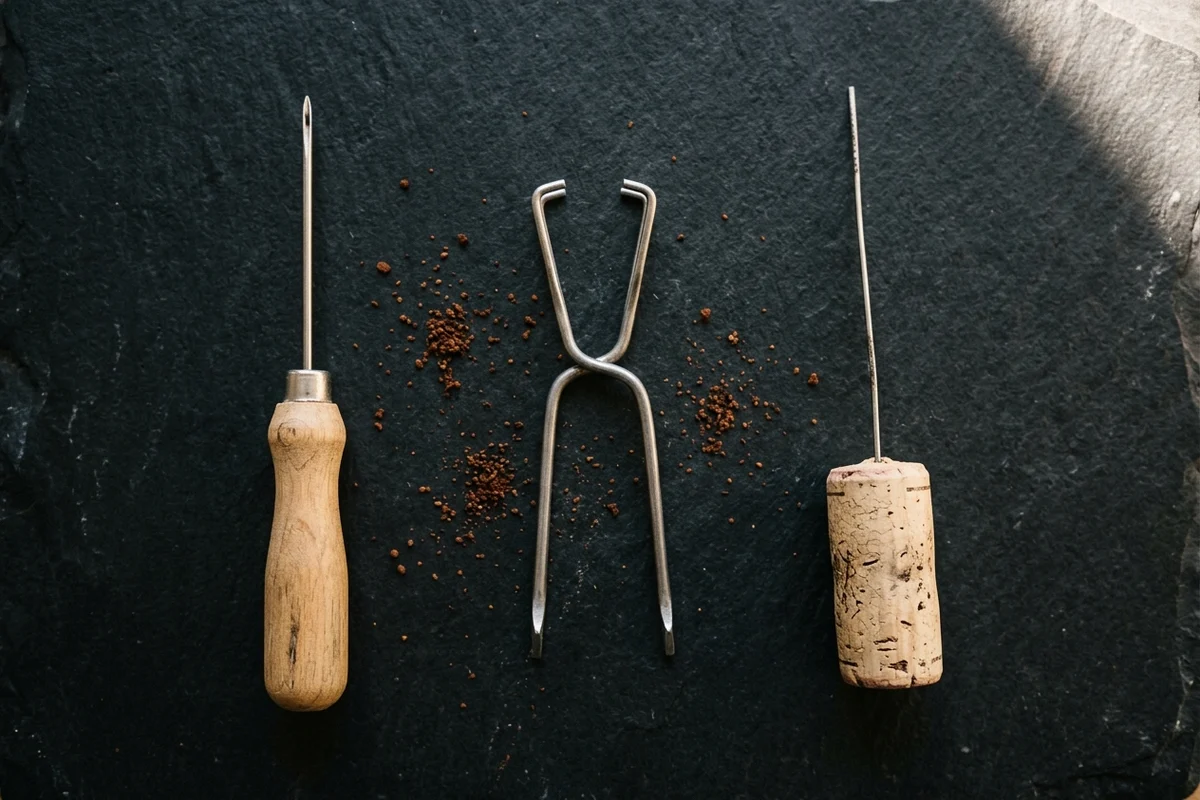
That leaves the needle tool, which is the odd one out. It has never been through a controlled trial. I searched the literature indexes three different ways and found no published study that treats the Weiss Distribution Technique as an independent variable.
What it has instead is the strongest circumstantial case of the three, and it is worth laying out precisely, because the labs use it is a different kind of claim from it was tested.
The 2026 Physics of Fluids team built a purpose-made rig — a two-group Sanremo machine instrumented with a pressure sensor and a scale logging at 10 Hz, laser diffraction for particle sizing, X-ray micro-tomography at 20 µm resolution to photograph the puck before and after. In the caption of their very first figure, describing the preparation sequence, they write that clumps are removed with a needle tool and add, in parentheses, “necessary for good reproducibility.”
That is a peer-reviewed statement about de-clumping, made by people whose entire experiment depended on shots behaving the same way twice. It is not a measurement of the technique. It is what a lab does so that its measurements work.
But now the honest complication. Their protocol also puts the grounds through a blind shaker for ten seconds before the needles ever touch them — and the second espresso lab in this piece, the Zurich group who published on fines in 2024, used a blind shaker and no needle tool at all.
| Warsaw, 2026 | Zurich, 2024 | |
|---|---|---|
| Dose | 18.50 ± 0.05 g | 20 g |
| Grinder | Fiorenzato F64 EVO, setting 1.9 | Vertical 63 |
| Distribution step | Blind shaker, 10 s, then a 3D-printed needle tool with acupuncture needles, on the upper layer | Blind shaker only |
| Tamp | Automatic tamper, 20 kg | 20 kgF |
| Basket | IMS Competizione, 58 mm, 26.5 mm deep, filled to 14 mm | 20 g VST |
| Pressure | 1–12 bar, calibrated at the basket | 9 bar |
What the two labs share is not the needles. It is the refusal to brew the grinder’s output as it falls. Both break the clumps up; they disagree about how. If you take one practical thing from this piece, take that: the step is de-clumping, and the tool is negotiable.
There is a way to have fewer clumps in the first place
The needle tool exists because grinders deliver clumps. A 2024 Matter paper went after the cause, and it is the best-measured thing in this entire article.
Grinding electrifies coffee — fracturing and rubbing leave the particles carrying static charge, which is why fines cling to boulders and to the grinder. The team measured charge-to-mass ratios across a range of coffees and found that charging falls systematically as water is added to the whole beans before grinding. As the added water approaches 20 µL per gram of coffee, the charge approaches zero.
That is a smaller quantity than it sounds. For an 18 g dose it is about 0.36 mL — a third of a millilitre, a few drops, applied to the beans with a pipette and shaken in a closed container. Baristas call this the Ross Droplet Technique, and the paper notes in passing that it too “was posited to have been originally presented on an online message board.” Two of the three things that actually work here came out of forums.
Three details from their results are worth carrying:
- Minerals make no difference. They tested sodium chloride solutions at 0.5 and 1.0 M against plain reverse-osmosis water and found the salt contributed nothing to charge suppression. It is the water.
- Humidity is not a substitute. Charging only began to drop above roughly 60% relative humidity; every measurement was made between 25% and 45% RH.
- Grinder retention collapsed. They report “near-zero grounds being retained by the grinder” — an aside in their paper, and a genuinely useful result if you single-dose.
Then they brewed it. Eighteen grams to 45.0 g on a Victoria Arduino Black Eagle at 7 bar static pressure and 94 °C, tamped by a machine at 196 N, three shots averaged per condition:
| Ground dry | Ground with water added | |
|---|---|---|
| Shot time | baseline | ~50% longer |
| First drops in the cup | ~10 s | ~10 s |
| Cup concentration | 8.2% TDS | 8.9% TDS |
| Rate the bed reaches equilibrium flow | ~2× faster | slower |
Their reading of that last row is the important one: a bed that races to equilibrium flow is a bed with open pathways through it. Dry-ground coffee “is producing a bed with markedly more porous pathways,” while the wet-ground version gives “less space within the compacted bed and likely more homogeneous contact with water over the duration of the shot.”
The caveats are mine, not theirs: this is three shots per condition on one coffee, with no statistical test reported and no tasting panel. But it is the only place in this subject where someone changed one variable, published the numbers, and got a result that points the same way from three different measurements at once.
And note what it implies about the rest of this article. The static that makes clumps happens inside the grinder. Everything else here — needles, discs, tampers — is repair work.
The protocol’s own source is a video
One more detail from the 2026 paper, and I think it is the single most revealing fact in this article. Asked to justify its puck preparation method, the paper cites this:
“The espresso preparation method followed the approach devised by Lance Hedrick with the help of Samo Smrke and Jonathan Gagné in [36, 37].”
References 36 and 37 are two YouTube videos. A third reference, for the universality of the bimodal grind distribution, is a book published by a coffee press. The paper calls the video protocol “the current standard within espresso brewing.”
It is not a criticism of the authors — they cited what exists, transparently, which is exactly right. It is a statement about the field. When a physics journal needs a citation for how to prepare an espresso puck, the best available source is a barista’s video, because there is no peer-reviewed standard to point at. Every confident instruction you have read about puck prep sits on top of that same absence.
What the one WDT study actually compared
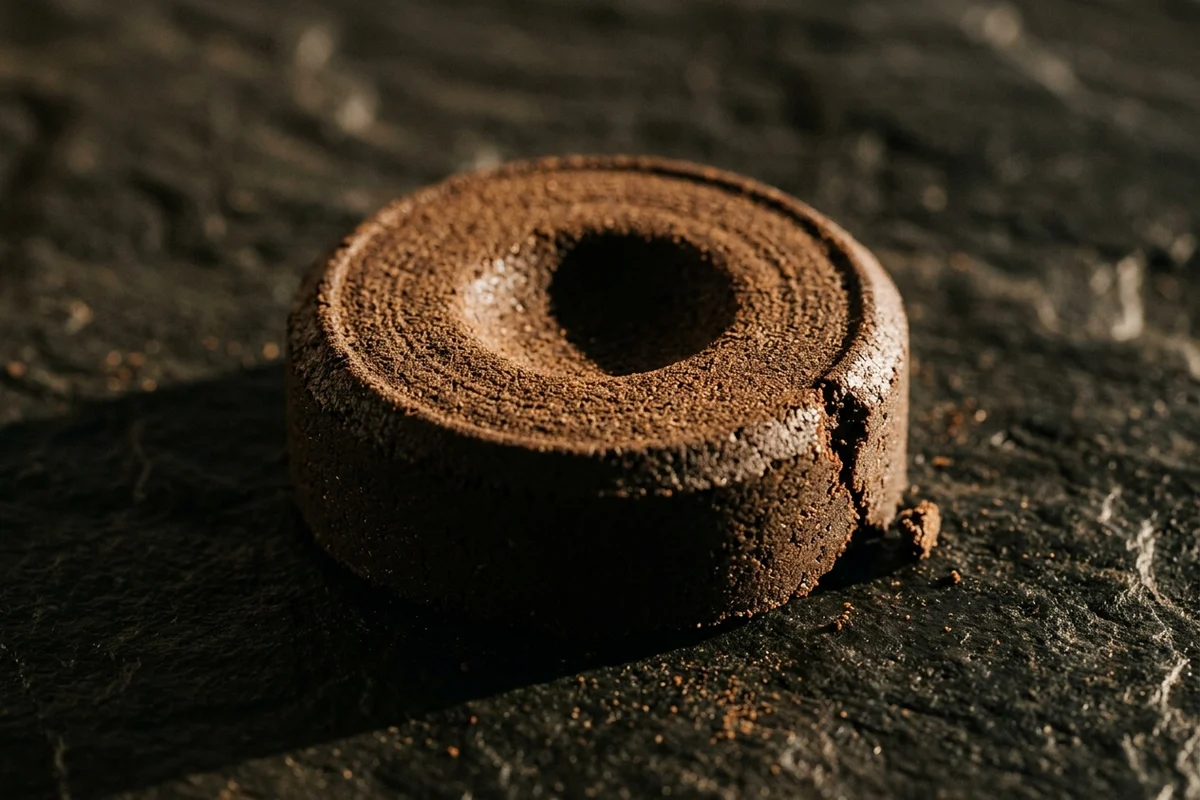
The experiment that gets linked whenever anyone asks for evidence is a 2021 home study on a Decent machine: 18.0 g ground directly into the portafilter from a Niche Zero at setting 14.0, an eight-needle tool, a self-levelling tamper, 24 shots with the first three discarded as dial-in, and puck resistance computed from the machine’s own pressure and flow data.
It found real things. Working only the top third of the bed produced roughly a 40% spread in peak puck resistance between shots; going in at full depth narrowed that spread. A dry paper filter laid on top raised overall resistance by about 7%. By the end of the shot, resistance varied by about 5% between shots — which the author notes is “comparable to the kind of resistance change one would expect from adding or removing 1 gram from a 18.0 grams dose.” And the observation that ought to humble everyone in this conversation:
“All the spent pucks from today’s experiment had a slight hollow near the center, indicating that water flowed unevenly”
Every puck. With deep needle work, a self-levelling tamper, and a machine that controls its own pressure profile.
But note what the four conditions were: surface needles, deep needles, surface needles plus paper, deep needles plus paper. All four arms used the technique. The most-cited WDT study does not compare WDT against no WDT — it compares shallow against deep. Which is useful, and is not the thing people cite it for.
If you do adopt the practice, that study is the reason to go in at full depth rather than skimming the surface. It is not a reason to believe the headline claim.
The needle-thickness question has no answer
Somewhere in every buying guide is a passage about needle diameter: 0.25 mm, 0.3 mm, 0.35 mm, 0.4 mm, each with a confident rationale.
No published comparison exists. And when I tried to verify the specifications themselves, they turned out not to be stable within a single product line.
| Where | Model | Stated needle diameter | Stated needle length |
|---|---|---|---|
| The manufacturer’s own product page | V2.1 | 0.25 mm | 50 mm |
| The manufacturer’s URL for that same page | — | 0.23 mm | — |
| Amazon listing, model number V2.1 | V2.1 | 0.23 mm | 46 mm |
| A second Amazon listing from the same brand | V2.1 | 0.25 mm | — |
One brand, one model designation, two diameters and two lengths — with the page’s own web address contradicting its own title. That is not a scandal; it is a rounding difference and a product revision. But it does dispose of the question. You cannot choose between 0.23 and 0.25 mm on evidence when the manufacturer cannot reliably tell you which one is in the box, and when nobody has measured whether the difference does anything.
Which returns the question to the person who named the technique. Asked in 2022 what he uses, John Weiss said:
“These days I’m mostly using an inexpensive four-needle keycap puller that I found on Amazon.”
Where the technique came from
The history is usually given as a single line — John Weiss, 2005 — with no link. The live forum where it happened now sits behind a bot check, so I read it from the Internet Archive instead, and the record is better than the summary.
Affiliate links. Some product names below link to Amazon. If you buy through one I earn a commission at no extra cost to you, and it never changes which product gets named or what the measurements say. Full disclosure.
Weiss had made himself a bottomless portafilter, which is how the problem found him. His own account:
“Initial struggles with channeling led me to the conclusion that good grinds distribution in the basket was a critical factor in pretty extractions.”
His apparatus was “a dissecting needle to stir grinds, with a cut-down yogurt cup as a funnel/shot collar to contain the mess” — chosen, he says, because it was the closest thin object to hand.
The dated record begins on 18 March 2006, in a thread titled The Weiss Distribution Technique is NOT a ‘cheat’!, split off by a moderator from an argument about something else. It opens by quoting the site’s own founder:
“Pros may eschew this technique, but John Weiss’ (RapidCoffee) and my own experience support the assertion that the extra stir action does enhance the evenness of an extraction, especially for grinders that tend to clump. I bet newbies who are still working on their distribution technique will also see better results with this ‘cheat.’”
Eight days later, on 26 March 2006, Weiss published the tutorial. Its opening is worth reading against the claims made for the technique today:
“If you’ve tried a naked portafilter, you may have observed channeling, spritzies, rim shots, and other evidence of uneven extraction… Learn a simple new dosing and distribution technique dubbed the WDT that attacks uneven distribution and helps cure many extraction flaws.”
The original claim is narrow and mechanical: it attacks uneven distribution. Not higher extraction yield, not more sweetness, not a percentage. Everything above that line was added later by people selling something.
Weiss added the rest himself, in 2022: “I don’t have an entrepreneurial bone in my body, and never seriously considered commercialization.” And: “I’m surprised that nobody suggested it sooner, and surprised that it generated so much controversy over the years. Now it’s mainstream. Go figure.”
(One correction to the usual account: the technique is generally said to have first appeared on CoffeeGeek in December 2005. I could not find that post in any archive. Weiss dates his experiments to around 2004; the earliest record I can actually produce is March 2006.)
Puck screens
The metal disc that sits on top of the tamped puck has two claims attached to it. One is not in dispute: it keeps the group head’s shower screen cleaner, which is a maintenance benefit you can verify by taking the screen off after a month.
The other claim — that it evens out the water arriving at the puck and improves extraction — has not been tested in anything published. The manufacturer of one describes it as evening out the flow of water “while helping to hold the puck solidly together to prevent channeling and spurts.” That is a product description, not a result.
The closest thing to a measurement is the paper filter in the 2021 study above: laid dry on top of the puck, it raised total resistance by about 7%, and the experimenter finished the experiment still undecided about whether to keep using it.
But the screen does have the same kind of circumstantial support the needle tool has, and I only noticed it in a methods section. The 2024 grinding study above states that for every espresso it pulled, “a normcore 58.5-mm diffusing screen was added to the top of the compacted bed.” So a peer-reviewed espresso protocol includes a puck screen by default — for the same reason it includes de-clumping, which is that the team wanted the shots to behave the same way twice.
That is worth exactly as much as it sounds like, and no more. It was not the variable. Nobody brewed the same coffee with and without one and reported what happened. It belongs in the same box as WDT: something the people who measure espresso do, which has never itself been measured.
Buy one to keep your machine clean — that claim is sound, and the labs’ habit is a mild point in its favour. The extraction claim is still untested, and the page telling you otherwise did not test it either.
The uncomfortable result
Everything so far assumes that a uniform bed is the goal. There is a peer-reviewed, open-access paper that makes a puck deliberately non-uniform and gets a better result.
A group in Florence built pucks in three 5 g layers: coarse at the bottom, standard in the middle, fine at the top — the layers produced by nudging the grinder one notch either side of its normal setting. Fifteen grams total, dynamometric tamper, La Marzocco GS3, 92 °C, 9 bar, target 30 g in 30 s, instantaneous flow logged on a 0.01 g scale. Three trials, 300 extractions.
| Measure | Conventional puck | Layered puck |
|---|---|---|
| Flow variation at end of shot | 11% | 6% |
| Batch-to-batch variation across five batches of one brand | Higher in four of five (p < 0.05); grinder had to be readjusted once | Lower; no readjustment needed |
| Flow change when the brand was swapped without regrinding | +25% and +35% — both outside the ±15% tolerance | −1% and +7% — both inside |
| Tolerance for wrongly ground coffee | — | Up to 40% of the dose could be the wrong size with no effect on flow |
And the detail that gives the result its teeth — they tried it upside down:
“The inverse stratification (coarse particles on the top and fine on the bottom) was also tested. However, extraction was clearly a problem, probably due to the migration of the large particles and data are not reported.”
So the effect has a direction, which means it has a mechanism, which means it is not noise.
Three things have to be said about this before anyone reaches for a spoon. It measures flow stability, not extraction yield and not taste. The layering is produced by the grinder, under a patent — I checked the number, WO2020148258A1, filed by an espresso machine manufacturer with the paper’s authors as inventors — and not by hand. And a needle tool run through that puck would destroy the structure entirely.
It does not show that you should stop de-clumping. It shows something more disorienting: the assumption underneath every puck prep product — that the ideal bed is identical everywhere — is not a settled result. The one team that tested the opposite got a more repeatable shot.
One more thing the pump does
A last finding from the 2026 study, because it has an immediate consequence and it is nowhere on the first page of any of these searches.
They photographed pucks with X-ray micro-tomography before and after brewing. The post-brew images show the grounds swollen, but also something structural: horizontal delamination, and the bed partly lifted off the bottom filter mesh with a layer of air in between.
To find out where that came from, they brewed at 8 bar for about 75 seconds and then cycled the pump on and off repeatedly.
“Upon repeated brewing, we witness a significant increase of the flow rate without additional dissolution, which suggests that a reconfiguration of the sample takes place each time the pressure is applied.”
Flow went up; extraction did not. That is the signature of a channel. Their conclusion, in their own careful wording:
“any brewing process that involves a temporary pause or repeated application of pressure might be prone to channelling and therefore should be avoided.”
The mechanism is the three-way valve that every modern espresso machine has: when pressure drops, it pulls water back off the top of the puck, and the bed moves.
I want to keep their hedge intact. They showed this on their rig, over long brews, with deliberate on-off cycling. They did not test commercial pre-infusion profiles, and neither will I claim they did. But if you have perfected your puck preparation and your shots still channel, the profile is a place to look that nobody is pointing at.
Nothing in any standard says how to do this
For completeness, since this site spends a lot of time reading standards: the only in-force third-party certification for espresso is the Italian one, and its parameter table fixes the dose at 7 g ± 0.5, water temperature at 88 °C ± 2, cup temperature, inlet pressure at 9 bar ± 1, percolation time at 25 s ± 5, volume in the cup at 25 ml ± 2.5, plus viscosity, fat and caffeine.
It contains no parameter for tamping, distribution, or puck preparation of any kind.
Meanwhile, when the Specialty Coffee Association surveyed 275 working baristas in 2017, tamping clustered at 20–30 lb — but 22% answered “other”, meaning they did not measure it, used a machine, or, in one answer the magazine reproduced, tamped “until the puck was evenly dense.”
Roughly one barista in five, asked how hard they tamp, does not have a number. Given everything above, they are not the ones with a problem.
What I would actually do
Ordered by how much published support sits behind each step, which is not the order the accessory market would give you.
| Step | What the evidence says | Worth doing? |
|---|---|---|
| Wet the beans before grinding — about 20 µL per gram | The best-measured step here. Charge falls to near zero, grinder retention to near zero, and the brewed bed came out denser and more concentrated (8.2% → 8.9% TDS) | Yes. It removes the cause instead of repairing the symptom |
| Break up the clumps before tamping | No controlled trial. But both published espresso labs do it, and one calls de-clumping necessary for reproducibility | Yes. Cheap, and the best-supported of the three tools |
| Tamp level | Peer-reviewed purpose of the tamp is to level the bed; every spent puck in a careful home study still had a central hollow | Yes — and levelness is the whole job |
| Straighten a crooked tamp mid-press | Changing the angle under load lets particles repack tighter on one side, creating the density gradient you were trying to avoid | No. Start straight, or start over |
| Tamp hard | No effect on shot time or extraction yield from 12 to 42 lb, in two independent experiments; force itself is a measured injury risk | No. Firm and flat, then stop |
| Go in at full depth rather than skimming the top | Surface-only work left roughly a 40% spread in peak puck resistance; deep work narrowed it | Yes, on the strength of one home study |
| Tap the portafilter on the counter | Directly tested. No significant difference | Harmless ritual |
| Use a distribution leveler | Directly tested. Significantly lower extraction yield (p < 0.01); no improvement in consistency | No |
| Add a puck screen | Keeps the shower screen clean, which is real. One lab uses one by default; nobody has tested what it does to extraction | For cleaning, yes. Not yet for flavour |
| Buy thinner needles | No published comparison; the specification is not stable within one model | Irrelevant |
The one tool I would actually spend money on is a WDT tool, and the reason is not that it has been proven — it has not. It is that the labs which measure espresso for a living will not brew a shot without doing what it does, and it costs less than a bag of coffee. Weiss himself uses a keycap puller.
Though if you only change one thing after reading this, make it the water. A third of a millilitre on the beans costs nothing, needs no tool at all, and is the only step in this article that arrived with its numbers attached.
Everything else in this category is being sold to you on the strength of the word measurable, by people who have not published a measurement.
The honest summary is short. Your tamp is not compressing the puck; the pump is, twelve to twenty-four times harder. The resistance you are trying to build with your hand is built instead by swelling coffee closing its own pores by a factor of a thousand. What you control is one thing only — whether the bed the water arrives at is even. That is worth doing carefully, with needles rather than a ramped disc, and then it is worth stopping.
If the shot still channels after that, the puck may not be the problem, and the taste will usually tell you which failure you have before any number does. Everything upstream of the puck — the grind, the dose, the ratio — moves extraction more than any accessory in this article, and what “extraction” even means is worth having straight before you start buying tools to improve it.
Sources
Every figure in this piece traces to one of these. Dates are when the source was read — lists and prices move.
- Under pressure: poroelastic regulation of flow in espresso brewing Waszkiewicz, Myck, Białas, Puciata-Mroczyńska, Dzikowski, Szymczak & Lisicki — Physics of Fluids 38, 063113 (2026); arXiv:2512.21528v2, CC BY 4.0 Full preprint text read. Source of the figure caption describing clump removal with a needle tool as necessary for good reproducibility, the complete puck-prep protocol (18.50 g, blind shaker, 3D-printed needle tool, 20 kg automatic tamp, 58 mm IMS basket, 14 mm dry bed), the thousand-fold permeability drop on wetting, the flow saturation above roughly 5 bar, the micro-CT delamination images and the repeated-pressure channelling result. Read 11 September 2026
- Systematically Improving Espresso: Insights from Mathematical Modeling and Experiment Cameron, Morisco, Hofstetter, Uman, Wilkinson, Kennedy, Fontenot, Lee, Hendon & Foster — Matter 2(3), 631–648 (2020) Full text read. Source of the statement that coffee must be tamped to level the granular bed, of the finding that a range of tamp pressures produced no appreciable variation in shot time or extraction yield, of the 98 N standardised tamp, and of the authors' own note that flavour differences were observed but not quantified. Read 11 September 2026
- Test of an innovative method to prepare coffee powder puck, improving espresso extraction reliability Angeloni, Guerrini, Masella, Dionisio, Gatti & Parenti — European Food Research and Technology 248(1), 163–170 (2022) Open-access full text read. Three trials, 300 extractions. Source of the stratified-puck result — coarse at the bottom, fine at the top — the drop in end-of-shot flow variation from 11% to 6%, the brand-to-brand flow differences of 25% and 35% under the conventional method, and the failure of the inverse stratification. Read 11 September 2026
- Coffee grinding machine configured to provide a dose of stratified ground coffee and associated method (WO2020148258A1) Marzocco SRL — WIPO, published 23 July 2020, priority 15 January 2019 Patent record read directly to confirm the number, title, applicant, dates and inventors cited by the stratified-puck paper. The inventors are that paper's authors and the applicant is an espresso machine manufacturer. Read 11 September 2026
- The Impact of Tamping Pressure on Espresso Extraction Socratic Coffee, 15 July 2015 Full write-up read, including method, statistics and the authors' stated limitations. Four tamping pressures of 5, 10, 15 and 20 kg, ten shots each, 20 g VST basket, La Marzocco GS/3 at 9 bar and 92.5 °C, measured on two refractometers. Read 11 September 2026
- Examining the Impact of the OCD (and OCD 2) on Total Dissolved Solids Extraction Socratic Coffee, 15 December 2016 (updated 22 March 2017) Full write-up read. Three grinders, 20 g VST basket, 9 bar, depth-limited tamper, blind analysis, and an explicit disclosure that the team bought the products themselves. Source of the significant reduction in extraction yield with the distribution tool, of the finding that shot-to-shot variability did not improve, and of the separate tap versus no-tap control. Read 11 September 2026
- Prevalence of occupation-related pain among baristas and an examination of low back and shoulder demand during the preparation of espresso-based beverages Dainty, Alcorn, Ferguson & Gregory — Ergonomics 57(8), 1192–1200 (2014) Abstract read in full via PubMed (PMID 24837283). Fifty-nine baristas surveyed and ten video-recorded for biomechanical analysis; 73% reported low back pain and 68% shoulder pain, with half in each case attributing it to the job. Read 11 September 2026
- Can the use of an alternatively designed tamper alter spine posture and risk of upper limb injury while tamping espresso? Gregory & Romero — International Journal of Industrial Ergonomics 65, 103–109 (2018) Abstract read in full. Ten experienced baristas performed twenty tamps each, order randomised, with three-dimensional spine posture measured by electromagnetic sensors, applied force by force plate, and injury risk by RULA and the Strain Index. Source of the description of tamping as one of the most strenuous tasks baristas perform. Read 11 September 2026
- The role of fines in espresso extraction dynamics Smrke, Eiermann & Yeretzian — Scientific Reports 14 (2024) Open-access full text read via PubMed Central. Source of the second laboratory's puck protocol — grounds homogenised in a blind shaker, 20 g VST basket, tamped at 20 kgF, extracted at 9 bar — and of the finding that a rising share of fines lowers bed permeability and lengthens extraction. Read 11 September 2026
- Banish Uneven Extractions with Weiss Distribution Technique John Weiss (RapidCoffee) — Home-Barista.com, 26 March 2006 Read from the Internet Archive because the live site is behind a bot check. The dated primary record for the technique, including the author's own description of what it was meant to fix. Read 11 September 2026
- The Weiss Distribution Technique is NOT a 'cheat'! Home-Barista.com, 18 March 2006 Read from the Internet Archive. The eight-day-earlier thread in which the technique is defended against the charge of being a shortcut, quoting the site founder's own description of it as a cheat. Read 11 September 2026
- What is WDT in Espresso? We Talked to Its Creator, John Weiss Howard Bryman — Daily Coffee News, 14 December 2022 Read in full. Source of Weiss's own account of the dissecting needle and cut-down yogurt cup, of his surprise at the controversy, and of what he uses today. Read 11 September 2026
- A Study of Espresso Puck Resistance and How Puck Preparation Affects it Jonathan Gagné — Coffee ad Astra, 16 January 2021 Read in full. Twenty-four shots at 18.0 g on a Decent DE1, comparing surface against deep needle work with and without a paper filter on top. Source of the roughly 40% spread in peak puck resistance, the roughly 7% resistance increase from a top paper filter, and the observation that every spent puck had a slight hollow near the centre. Read 11 September 2026
- B1 1.03 — Tamping, and Æ 3.06 — Tamping and Brewing Technique Barista Hustle Education Both lessons read in full. Source of the statement that with pressure removed as a variable the priority is tamping flat, and of the mechanism by which correcting a tamper's angle mid-press lets particles repack into higher density. Neither lesson contains the percentage figure widely attributed to this curriculum, and neither publishes data behind its claims; the same page names the publisher's own tamper. Read 11 September 2026
- Analysing extraction uniformity from porous coffee beds using mathematical modelling and computational fluid dynamics approaches Moroney, O'Connell, Meikle-Janney, O'Brien, Walker & Lee — PLOS ONE 14(7), e0219906 (2019) Open-access full text read. A 59 mm cylindrical bed holding 60 g of coffee at a constant 250 ml/min, with modelled pressure drops matching experiment to two decimal places. Cited here only for the mechanism that extraction varies with depth inside a single bed; its numbers are filter-scale, not espresso-scale. Read 11 September 2026
- Moisture-controlled triboelectrification during coffee grinding Méndez Harper, McDonald, Rheingold, Wehn, Bumbaugh, Cope, Lindberg, Pham, Kim, Dufek & Hendon — Matter 7(1), 266–283 (2024) Full text read. Source of the 20 µL per gram of water at which charging approaches zero, of the finding that dissolved minerals add nothing to that effect, of the near-zero grinder retention, and of the brewing comparison — 18 g to 45.0 g at 7 bar and 94 °C, tamped by machine at 196 N, three shots averaged per condition — that produced a roughly 50% longer shot and a rise from 8.2% to 8.9% TDS. Also the source of the detail that its protocol placed a 58.5 mm puck screen on every bed. Read 11 September 2026
- The Certified Italian Espresso and Cappuccino Istituto Nazionale Espresso Italiano The institute's own booklet, read in full for an earlier piece. Its certification table fixes dose, water temperature, cup temperature, inlet pressure, percolation time, cup volume, viscosity, fat and caffeine — and contains no parameter for tamping or distribution. Read 10 September 2026
- Defining the Ever-Changing Espresso Dan Fasman — 25 Magazine Issue 3, Specialty Coffee Association, 1 February 2018 Read from an archive mirror for an earlier piece. Source of the 2017 survey of 275 baristas, in which tamping clustered at 20–30 lb but 22% answered other — meaning they did not measure it, used a machine, or tamped until the puck felt evenly dense. Read 10 September 2026