
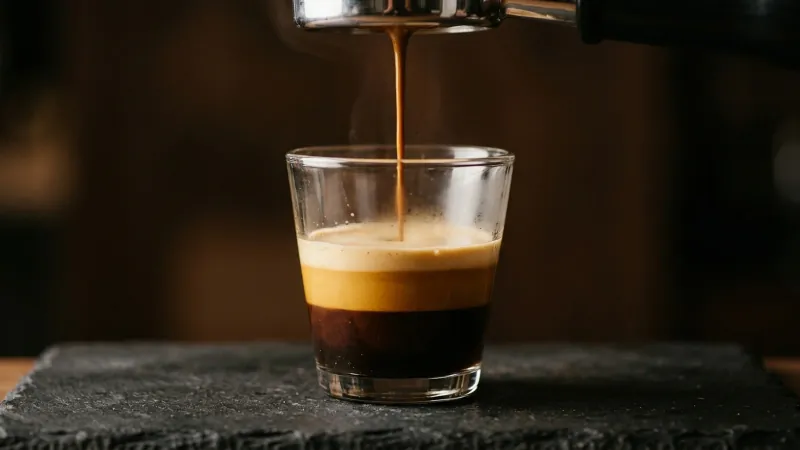
Coffee extraction is the fraction of the dry coffee, by mass, that dissolves into the water during brewing. It is written as a percentage of the grounds you started with: grind 18 grams, dissolve 3.6 of them, and you extracted 20%. Not the flavour, not the brewing time, not how strong the cup tastes — those are consequences, and two of them are separate measurements entirely.
The definition really is that simple. Almost everything built on top of it in the popular explanations — the order flavours come out in, the thirty-second bloom, the twenty-five-second shot — turns out to be either unmeasured or measured and contradicted. What follows is the definition, the arithmetic that goes with it, and then the four places the received wisdom parts company with the research.
The ceiling: only about 30% of coffee can dissolve
A roasted bean is mostly structure. Cellulose and other insoluble plant material make up the bulk of it and never leave the filter, which is why spent grounds still look like coffee. The soluble fraction — acids, caffeine, trigonelline, melanoidins, soluble carbohydrates and the rest — is roughly 30% of the dry mass.
Lee, Smith and Arshad put the working figure plainly in Physics of Fluids in 2023:
Usually up to around 30% of the coffee is removed during the extraction so there is scope for considerable variation in porosity and thus permeability.
Their own model predicts a maximum yield of 33.8%, which they compare against 30.3% calculated from an earlier dataset. Both are laboratory ceilings, not targets.
This matters for reading the famous window. 18–22% is not “most of what is there”. It is roughly two-thirds of what is chemically available, chosen because of how the rest tastes, not because the rest will not come out. There is a longer piece on where 18–22% comes from and what the SCA actually certifies; the short version is that the pairing dates to a 1957 study by Ernest Lockhart, and that the standard SCA certifies home brewers against today quotes a wider strength window than the box on the chart.
Strength and extraction are two different numbers
This is the most common confusion in the subject and it is worth thirty seconds.
Strength (TDS) is how much dissolved coffee is in the liquid, as a percentage of the liquid’s mass. It is what your tongue reads as strong or weak. Extraction yield is how much of the dry coffee you managed to dissolve, as a percentage of the grounds. It is what your tongue reads as sour and hollow, or harsh and drying.
They move independently, which is why one number cannot stand in for the other. A weak cup can be perfectly extracted. A very strong cup can be badly under-extracted. The formula connecting them is the whole method:
Extraction yield (%) = TDS (%) × beverage mass (g) ÷ dry dose (g)
Weigh the dose. Brew. Weigh the liquid that actually reached the cup — not the water you poured, because a meaningful fraction stays behind in the wet bed. Read the strength. Multiply and divide.
For a full-immersion brew — French press, cupping bowl, Clever dripper — you can use the total water instead of the beverage mass, since there is no separate retained bed to account for. For percolation brews there is, and ignoring it inflates the answer.
Espresso sits at the other end of the strength scale entirely. The Italian traditional-espresso specification asks for a dry residue of at least 5% in the cup. Filter coffee lives near 1.2–1.4%. Same measurement, four times the concentration.
Flavours do not come out in the order you were told
Search for what extraction means and you will read some version of this: the acids dissolve first, then the sugars, then the bitter compounds last, so a short brew is sour and a long one is bitter. It is repeated by roasters, machine manufacturers and training material. It is a tidy story and it does not survive contact with a sensory panel.
In 2020, Batali, Frost, Lebrilla, Ristenpart and Guinard did the direct experiment. They brewed standard drip coffee and swapped in an empty carafe every 30 seconds, splitting one brew into a series of fractions, then handed the fractions to a trained descriptive panel and ran the monosaccharide content through mass spectrometry. From their results:
…the earlier fractions were systematically more bitter and more sour than later fractions. Surprisingly, however, several flavor and taste attributes increased in time; for example, later fractions were systematically sweeter and more floral than earlier fractions. Since later fractions had lower TDS, these results indicate that perceived sweetness in drip brew coffee is negatively correlated with TDS. Mass spectrometry measurements of the monosaccharide content in the brews showed that none of the fractions had perceptible concentrations of any monosaccharide.
Three claims fall at once.
| The usual story | What was measured |
|---|---|
| Bitter compounds come out last | The earliest fractions were the most bitter |
| Acids come out first, so under-extraction is sour | The earliest fractions were both more sour and more bitter — it is concentration, not sequence |
| Sugars extract in the middle, giving the sweet spot | No fraction had a perceptible concentration of any monosaccharide. Sweetness rose as strength fell |
A second study points the same way. Liang and colleagues, brewing full-immersion at 4, 22 and 92 °C and tracking the sensory profile across five extraction stages, found that “the intensity of sweetness was negatively correlated with TDS, and 19 other attribute intensities were positively correlated with TDS.”
Compounds genuinely do extract at different rates — that part is not invented. Schmieder and colleagues tracked four markers across espresso shots on a flow-controlled machine and reported that “the fastest decrease was observed for trigonelline and Total Dissolved Solids (TDS), followed by 5-caffeoylquinic acid (5-CQA) and caffeine.” But look at what that ordering actually says: trigonelline is bitter and depletes fastest; caffeine is bitter and depletes slowest. Bitterness is at both ends of the shot. There is no window in the middle where only the nice things are coming out.
So what is over-extraction, if not late-arriving bitter compounds? It is total. Push the yield up and you dissolve more of everything, including the fraction of the bean that is harsh and drying, and you dissolve it out of a bed that has already given up its best. The thing that changes is the ratio of what is in the cup, not the arrival order of a queue. That distinction is the whole subject of why an espresso tastes sour or bitter, and it is the reason “brew it shorter” and “grind it finer” are not interchangeable advice.
One honest note on the sweetness finding: it is a correlation across fractions of one brew, and perceived sweetness in coffee appears to come from masking effects and sweet-associated aromas rather than from sugar. It does not mean weak coffee is sweet coffee. It means the sugar in your mental model is not there.
Every yield is an average over a bed that never extracts evenly
When you write down 20%, you are describing the bed as a whole. No part of it was actually at 20%.
Cameron and colleagues found the first hard evidence of this in espresso: their model, assuming water flows evenly through the puck, predicted yield rising steadily as the grind got finer. Real shots did not. Yield peaked at an intermediate setting and fell off at both ends.
Lee, Smith and Arshad built a two-pathway model to explain why, and their conclusion is stronger than the anomaly it was built for:
…the model suggests that uneven flow between pathways is always present and that the peak in extraction yield is due to dissolution of all soluble coffee from one part of the coffee bed.
Read that carefully. Uneven flow is not a fault that appears when something goes wrong; it is the normal condition, and small differences in porosity get amplified because the paths that flow more also dissolve more, which opens them further. The peak in yield is the point where one region has been completely exhausted — locally 100% extracted — while another region is still under-extracted. Two shots at the same measured 20% can be built from entirely different distributions and taste nothing alike.
This is the physical basis of channelling, and it is why puck preparation earns its reputation. It is also the honest limit on the number: extraction yield is a real measurement of a real quantity, and it is an average that conceals its own spread.
Coffee blooming: a convention, not a finding
Blooming is wetting the grounds with a small amount of water — commonly about twice the coffee’s weight — and waiting before the main pour. The foam is carbon dioxide, formed during roasting and trapped in the bean’s pore structure, escaping as water displaces it.
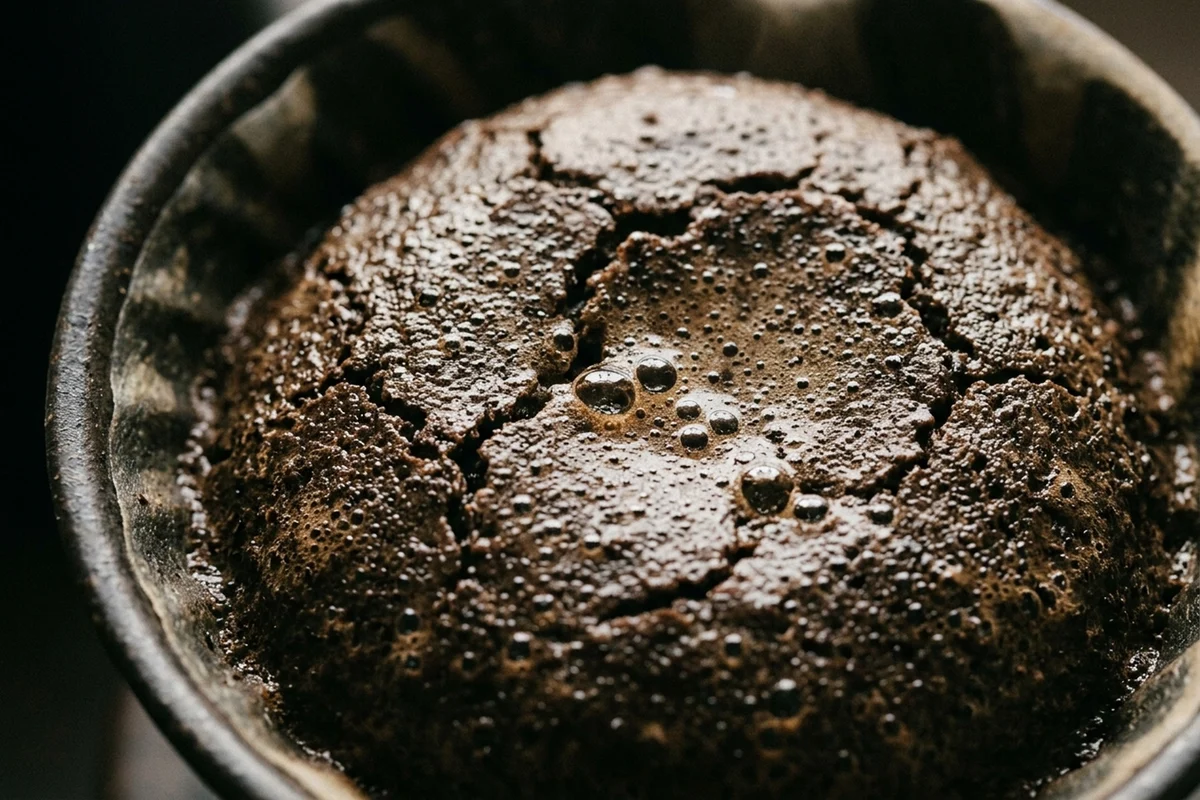
The gas is real and it has been measured properly. From Smrke and colleagues’ gravimetric study and the work it summarises:
| Quantity | Measured value |
|---|---|
| Total CO₂ trapped in roasted beans | 6.5–14 mg/g over 30 days; up to 16 mg/g residual |
| Released during and immediately after grinding | Up to 75% of the trapped gas, within 90 seconds |
| Grinding loss by grind size (residual-CO₂ method) | 26–30% coarse · 33–38% medium · 45–59% fine |
| Still releasing from ground coffee afterwards | Up to 3.0 mg/g (arabica), 3.9 mg/g (robusta) |
| Internal bean pressure reported in the literature | 4.4 atm, 8 bar and 25 atm across different studies |
The grinding figure is the one worth keeping. By the time you pour bloom water, most of the gas has already gone — you released it at the grinder, seconds after the burrs, and the finer you ground the more of it left. The bloom is working on the remainder.
Which brings the awkward part. Every source that tells you to bloom for 30 to 45 seconds presents it as settled. On 4 September 2026 I searched Europe PMC — which indexes PubMed, PMC and Agricola — and Crossref for peer-reviewed work measuring the bloom’s effect on extraction yield or sensory outcome. There is none. What comes back is degassing kinetics: how much CO₂ there is, how fast it leaves, how roast and grind change that. Nobody appears to have published the experiment where you brew the same coffee with and without a bloom and measure what changed.
Affiliate links. Some product names below link to Amazon. If you buy through one I earn a commission at no extra cost to you, and it never changes which product gets named or what the measurements say. Full disclosure.
The closest thing I found is an independent measurement by Nasko Panov, who brewed on an AeroPress with and without a 40-second bloom, four replicates each, and ran the results through a total organic carbon analyser: bloomed 666 arbitrary units of inorganic carbon against 716 unbloomed, a difference he puts at about 0.047% of the total extracted carbon. Detectable by laboratory instrument, and not the sort of gap a palate finds. That is one small non-peer-reviewed test and should be read as one.
So should you bloom? Yes, and for the reason that survives the evidence: the wait wets the bed evenly before flow starts. Given that uneven flow amplifies itself from the first seconds, starting with a uniformly saturated bed is a defensible thing to do regardless of what the gas is doing. Roughly twice the dose in water, 30 to 45 seconds, longer for very fresh coffee and shorter for coffee more than a couple of weeks off roast. Just hold it as a sensible default rather than a law, because that is what it is. On an espresso machine the same idea is called pre-infusion, and the same caution applies.
Espresso shot time: no two authorities agree, and one times it differently
“Espresso shot time range” gets asked constantly, and gets answered with 25–30 seconds as though it were written somewhere authoritative. Here is what is actually written down.
The World Barista Championship sets no time range at all. I read the 2026 Official Rules and Regulations in full. Espresso is defined in §3.1 as:
Espresso is a beverage (around 1 fl. oz. / 30 ml) made from ground coffee, poured from 1 side of a double portafilter in 1 continuous extraction.
Brew temperature is set between 90.5 and 96 °C, pressure between 8.5 and 9.5 bar. The only rule touching time is a consistency rule: extraction times between the two pairs of shots “must be within a 3.0 second variance”, or the competitor is marked down. The words brew ratio, extraction yield and TDS do not appear in the document at all, and neither does any instruction to measure the shot. The most visible espresso competition in the world scores whether you can repeat a time, not whether you hit one.
The Italian specification does give a range — and measures it differently. The Disciplinare Caffè Espresso Italiano Tradizionale, published by the protection consortium together with INEI and the Italian Coffee Committee, is a formal parameter table:
| Parameter | Lower | Upper |
|---|---|---|
| Extraction pressure | ≥ 8 bar | — |
| Mean extraction flow | 0.48 g/s | 1.3 g/s |
| Extraction temperature | 90 °C | 96 °C |
| Coffee dose | 7 g | 9 g |
| Dry residue (TDS) | ≥ 5% | — |
| Quantity in cup | 13 g | 26 g |
| Crema persistence | complete coverage ≥ 120 s | — |
| Extraction time | 20 s | 27 s |
And then the definition underneath it, which is the sentence most people have never read: tempo di erogazione della dose di bevanda monitorato dalla prima goccia — extraction time is timed from the first drop.
Almost everyone at home times from the button. On a machine with any pre-infusion at all, first drop can arrive six to fifteen seconds in, so a “25-second shot” by the Italian definition and a “25-second shot” by yours are not the same event, and can differ by half the shot. If you take one thing from this section, take that one.
| Where the number comes from | What it says | How time is measured |
|---|---|---|
| 2026 WBC rules | No range. Shots within 3.0 s of each other | From activating the brew cycle |
| Disciplinare (2018 text) | 20–27 s | From the first drop |
| INEI’s 2003 definition | 25 s ± 2.5 s, 7 g ± 0.5, 25 ml ± 2.5 | Historical; single Italian basket |
| SCA Standard 310-2021 | Nothing — espresso machines are explicitly out of scope | — |
| Popular advice | 25–30 s | Usually unstated |
And the deeper reason not to chase the clock: shot time is not a setting. It is what the puck does to the water. Smrke, Eiermann and Yeretzian showed that the share of fines under 100 µm is a primary control on it — “an increase of share of fines decreases coffee bed permeability, leads to reduced flow rates and longer extraction times” — and a 2026 Physics of Fluids paper adds that the puck deforms elastically under pressure as it dissolves, so permeability changes during the shot.
Time is a symptom. It is a genuinely useful symptom: if today’s shot runs ten seconds longer than yesterday’s on the same recipe, something changed and you should find out what. But dialling for a time and letting the ratio fall where it may is aiming at the thermometer instead of the room.
What actually moves the number
Three inputs do most of the work, and one famous one does less than its reputation.
- Brew ratio. Free, and it sets the diagonal that strength and yield both hang from. Fix the dose and the beverage mass and you have removed the largest source of variance in your brewing before touching anything else.
- Grind size — up to a point, and then not. This is the Cameron result: finer means more surface area right until it means more channelling, after which yield falls. There is no setting fine enough to force an even extraction.
- Agitation and bed geometry. How evenly the water meets the coffee decides how wide the spread around your average is, which the average itself will never show you.
- Temperature, less than you think. Schmieder and colleagues found the extraction kinetics for their markers “nearly identical for the temperature lower and upper boundary settings” across 80 to 98 °C, with overlapping confidence bands throughout. Batali, Ristenpart and Guinard compared drip at 87, 90 and 93 °C while holding strength and extraction fixed, and reported that “the brew temperature had no appreciable impact”. Neither result says temperature is irrelevant — both held something else constant, and temperature changes the rate you get there. They do say that a two-degree obsession is misplaced next to a ratio you are not weighing.
Filter choice belongs on this list too, though it changes what dissolves rather than how much: paper retains oils and the diterpenes carried in them, metal does not, which is a separate question about taste, sediment and cholesterol.
So what is extraction for?
It is a coordinate, not a grade.
The number tells you where a cup sits, so you can find your way back to it or away from it deliberately. It does not tell you whether the cup is good — the 2023 revision of the brewing chart makes that point in the most direct way available, by keeping the familiar rectangle and relabelling it from ideal to “classic standard”, on the stated grounds that it was unclear which drinkers ever found those conditions ideal.
Practically:
- Learn the definition before buying the instrument. Knowing that strength and yield are different numbers fixes more cups than owning a refractometer does, because it stops you solving a weakness problem with a grind change.
- Weigh two things. Dose in, beverage out. That is the ratio, and it is the input the whole chart is built on.
- Treat time as a reading, not a target. Especially on espresso, and especially if you are comparing your number to someone else’s without knowing where they started the clock.
- Bloom, but hold it loosely. The gas mostly left at the grinder, the evidence for the ritual is thin, and the good reason — even saturation before flow — is a reason to be careful rather than a reason to count to forty.
- Remember the average conceals a spread. Every measured yield is a bed that extracted unevenly. That is not a failure of technique; it is the physics, and it is why two identical numbers can be two different drinks.
Crema is the next thing people read as evidence, and it is the clearest case on the espresso side of a signal that looks like proof and is not — there is a separate piece on what crema does and does not tell you.
Sources
Every figure in this piece traces to one of these. Dates are when the source was read — lists and prices move.
- Sensory and monosaccharide analysis of drip brew coffee fractions versus brewing time Batali, Frost, Lebrilla, Ristenpart & Guinard — Journal of the Science of Food and Agriculture 100, 2953–2962 (2020) Drip brews fractionated every 30 seconds and put in front of a trained panel. Source of the finding that early fractions are both more bitter and more sour, that later fractions are sweeter, and that no fraction contained a perceptible concentration of any monosaccharide. DOI checked against Crossref. Read 4 September 2026
- Sensory analysis of the flavor profile of full immersion hot, room temperature, and cold brewed coffee over time Liang, Batali, Routt, Ristenpart & Guinard — Scientific Reports 14, 19298 (2024) Open access. Sweetness negatively correlated with TDS; brew time had smaller effects than expected once TDS plateaued. Read 4 September 2026
- Influence of Flow Rate, Particle Size, and Temperature on Espresso Extraction Kinetics Schmieder, Pannusch, Vannieuwenhuyse, Briesen & Minceva — Foods 12(15), 2871 (2023) Open access. Compound-by-compound extraction rates across a shot, and the finding that 80 °C and 98 °C produced near-identical kinetics at fixed flow and grind. Read 4 September 2026
- Uneven extraction in coffee brewing Lee, Smith & Arshad — Physics of Fluids 35 (2023) Preprint openly available as arXiv:2206.12373. Source of the ~30% soluble ceiling and of the two-pathway model showing that uneven flow is always present. Read 4 September 2026
- Time-Resolved Gravimetric Method To Assess Degassing of Roasted Coffee Smrke, Wellinger, Suzuki, Balsiger, Opitz & Yeretzian — Journal of Agricultural and Food Chemistry 66(21), 5293–5300 (2018) Every CO₂ figure in the bloom section, including the finding that up to 75% of the trapped gas leaves during and immediately after grinding. Also the route to the Wang & Lim degassing numbers, which are quoted here at second hand. Read 4 September 2026
- The role of fines in espresso extraction dynamics Smrke, Eiermann & Yeretzian — Scientific Reports 14, 5612 (2024) Open access. Fines lower bed permeability, which lowers flow rate, which lengthens the shot — the mechanism behind treating time as an output. Read 4 September 2026
- 2026 World Barista Championship Official Rules and Regulations Specialty Coffee Association / World Coffee Championships Read in full. Source of the espresso definition, the temperature and pressure bands, and the 3.0-second variance rule — and of the absence of any extraction time range. Read 4 September 2026
- Disciplinare Caffè Espresso Italiano Tradizionale Consorzio di Tutela del Caffè Espresso Italiano Tradizionale, with INEI and the Comitato Italiano del Caffè (2018 text) The parameter table quoted here: 20–27 seconds, 7–9 g, 13–26 g in the cup, ≥ 5% dry residue — and the definition of extraction time as running from the first drop. Read 4 September 2026
- A new Coffee Brewing Control Chart relating sensory properties and consumer liking to brew strength, extraction yield, and brew ratio Guinard, Frost, Batali, Cotter, Lim & Ristenpart — Journal of Food Science 88(5), 2168–2177 (2023) Open access. The relabelling of the chart's ideal box as the 'classic standard', and the liquid-retention ratio used in the arithmetic here. Read 4 September 2026
- Brew temperature, at fixed brew strength and extraction, has little impact on the sensory profile of drip brew coffee Batali, Ristenpart & Guinard — Scientific Reports 10, 16450 (2020) Open access. 87, 90 and 93 °C compared at matched TDS and extraction. Read 4 September 2026