
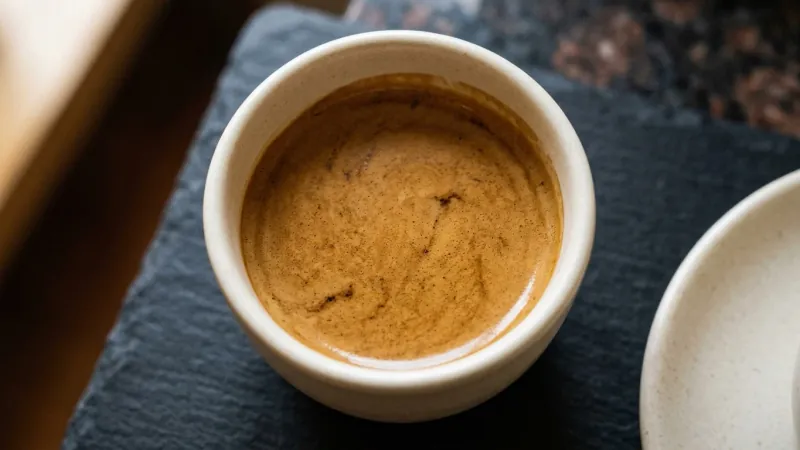
Crema is the layer of foam on top of an espresso, and the bubbles in it are mostly carbon dioxide made during roasting. The gas is trapped inside the bean, dissolves into water under nine bars of pressure, and comes out of solution the moment the pressure drops at the spout. That is the whole mechanism, and it explains both why crema is worth understanding and why it is a poor witness to almost everything it gets called as evidence for.
It is the single most-read signal in espresso. It is also the one with the widest gap between what people believe it measures and what has actually been measured about it. So: what crema is, what moves it, what the only two official standards in existence require of it, and what to make of a shot that arrives without any.
What crema actually is
The definitive review of the subject is Illy and Navarini’s 2011 paper in Food Biophysics, which is open access and remains the only serious survey of espresso foam. Their description:
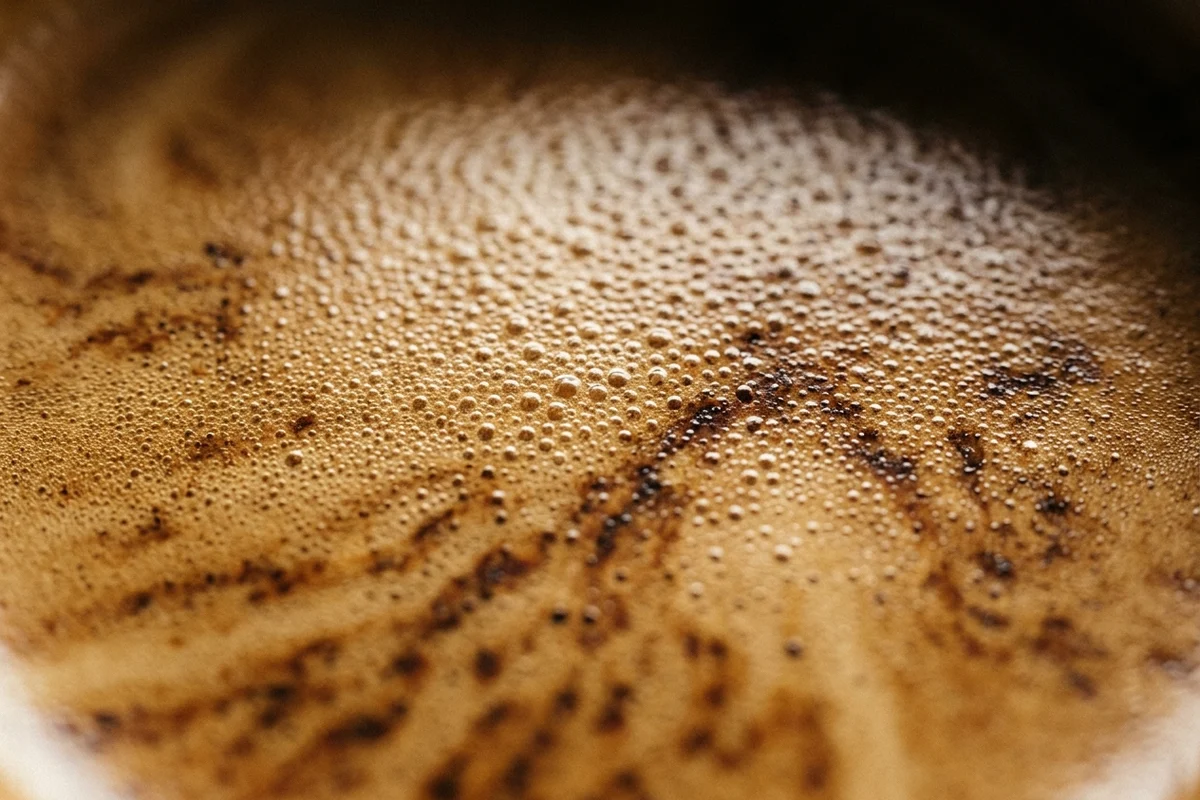
the gas phase is mainly the carbon dioxide generated during coffee roasting and entrapped within the cell structure
Underneath the bubbles, the liquid is an oil-in-water emulsion — droplets of coffee oil, 90% of them under 10 µm, in a solution of sugars, acids, protein-like material and caffeine, carrying suspended cell-wall fragments of 2–5 µm. So crema is gas foam sitting on an emulsion, not the emulsion itself. That distinction matters more than it sounds, and I will come back to it.
| Quantity | Measured value |
|---|---|
| Bubble diameter, pure arabica espresso | 10–150 µm |
| Crema as a share of a 25–30 ml serving | at least 10% (“foam index”) |
| Distance a bubble rises in the cup | 1.5–2 cm |
| Reported persistence, laboratory conditions | 6–40 minutes |
The formation mechanism is straightforward physics. At nine bars and near 100 °C the water holds far more CO₂ than it can at cup pressure and temperature, so the beverage arrives supersaturated; the suspended solid particles act as nucleation sites; and the bubbles have only a centimetre or two to rise before they reach the surface. Navarini and colleagues worked the arithmetic for a normal café dose and found roughly 7.6 ml of CO₂ available per cup at standard temperature and pressure — squarely inside the range of foam volumes people actually measure.
Where the gas comes from, and how fast it leaves
Roasting makes the gas. How much depends on how far you take the roast, and Xiuju Wang measured it directly in a University of Guelph doctoral thesis that is freely available:
| Roast degree | Residual CO₂ (mg per gram) |
|---|---|
| Light | 6.29–6.70 |
| Medium | 11.04–11.51 |
| Dark | 15.36–15.62 |
| Very dark | 15.11–15.97 — no further gain |
Two things follow. A dark roast starts with roughly two and a half times the gas of a light roast, which is most of the answer to why a light roast gives a thinner crema — not a fault, an inventory. And the plateau at very dark matches what Foschia observed in the cup: a very dark roast produced less foam than a dark one, presumably because the precursors are spent and the second crack has already vented much of what was made.
The same thesis found something less expected: residual CO₂ depends on the degree of roast, not the roasting temperature that got you there. Two roast curves to the same colour left statistically indistinguishable amounts of gas in the bean.
Then the gas starts leaving, on two very different clocks.
- Whole beans are slow. In the thesis, a dark roast took more than 800 hours — about 33 days — to release roughly 90% of its residual CO₂, and a slower-roasted equivalent still held 42% of it after the same period.
- Ground coffee is fast. Grinding alone costs 26–30% of the residual gas at a coarse setting, 33–38% at medium and 45–59% at fine. Smrke and colleagues put the immediate loss at up to 75% of the trapped gas during and within 90 seconds of grinding. In the thesis, finely ground coffee had essentially finished degassing within 50 hours.
That is the practical shape of it: your beans hold gas for weeks and your grounds hold it for hours. Illy and Navarini’s recommendation, that the interval between grinding and brewing should not exceed 30 minutes, is a foam recommendation before it is a flavour one. There is more on where that gas goes during brewing in the piece on what coffee extraction actually means.
What holds the bubbles up (it is not the oil)
Here is the most repeated sentence about crema on the internet, in one form or another: crema is emulsified coffee oils. It is backwards.
Nunes and colleagues measured foamability and foam stability across roast degrees alongside the brew’s composition, and found a high correlation between foamability and protein content, a relationship between stability and high-molecular-weight polysaccharides — galactomannans and arabinogalactans, largely as Maillard-reaction complexes — and, in the other direction, a strong negative correlation between fat and foamability. Illy and Navarini place this alongside beer, where free fatty acids are a well-documented foam killer: they weaken the adsorbed protein film around each bubble and make coalescence more likely.
Work on the isolated fractions sharpens it further. The foam-active material separates into one high-molecular-weight fraction, about 80% mannan, that governs stability, and a lower-weight melanoidin-and-protein fraction that governs formation. When D’Agostina and colleagues put both in front of a panel, the stabilising fraction was essentially tasteless, and the foam-forming one was intensely aromatic with a persistent bitter taste.
So the foam is built by proteins and melanoidins, held together by polysaccharides, undermined by lipids — and the molecule that makes it is bitter. Everything anyone tells you about the buttery richness of crema is happening in spite of its chemistry, not because of it.
The thickest crema is the first to collapse
If crema graded espresso, more of it would be better. It does not work that way, and the cleanest demonstration comes from an experiment that changed nothing about the coffee at all.
Angeloni and colleagues brewed one batch of 100% arabica, on one machine, with one grinder and one water — and varied only the gas fed into the brewing chamber.
| Gas | Foam index at 30 s | Foam index at 2 min | Persistence |
|---|---|---|---|
| Air | 60.4% | 32.2% | over 8 hours |
| Argon | 50.2% | 34.0% | over 8 hours |
| Nitrogen | 40.2% | 28.2% | over 8 hours |
| CO₂/N₂ 70:30 | 88.8% | 13.3% | 15–18 min |
| Nitrous oxide | 78.8% | none detected | under 2 min |
| Carbon dioxide | 76.1% | none detected | under 2 min |
Their summary of the pattern:
Measurements of the foam index after 30 s found a negative linear correlation (R = −0.8) with persistence. Persistence was highest when the foam index was lowest.
The gas that produced the most spectacular foam at 30 seconds had lost most of it by two minutes. The thin nitrogen foam was still there eight hours later. And the two cups with the highest dissolved solids — 4.76% and 4.21%, against 2.62% for nitrogen — were the two whose crema vanished fastest. Strength and crema were not merely uncorrelated in this experiment; they ran in opposite directions.
One caveat, because it matters: this was not a standard nine-bar machine. Caffè Firenze is a sealed-chamber method running around 15–20 bar with a gas feed, chosen precisely because you can swap the gas. What it demonstrates is the principle — the foam belongs to the gas, and the gas can be changed without touching the coffee — not a set of numbers to expect from your own machine.
The same inversion shows up in ordinary espresso. Illy and Navarini note that the factors which raise foam volume tend to lower persistence, and give the physical reason: CO₂ is poorly soluble in hot water, so an excess of it destabilises the foam it just made, while a cooler, less gassy foam is held up by a continuous phase whose viscosity nearly triples as the cup cools. Nunes’ data adds the curve: persistence is not linear with roast, but peaks at a medium roast — 33.9 minutes for arabica, 48.6 for robusta — and falls away at darker roasts even as volume keeps rising.
What the only two official standards actually measure
Given how much weight crema carries in conversation, you would expect specifications for it. There are exactly two, and neither measures what people look at.
The Italian traditional-espresso specification — the Disciplinare Caffè Espresso Italiano Tradizionale, published by the protection consortium with INEI and the Italian Coffee Committee — sets it out in clause 7:
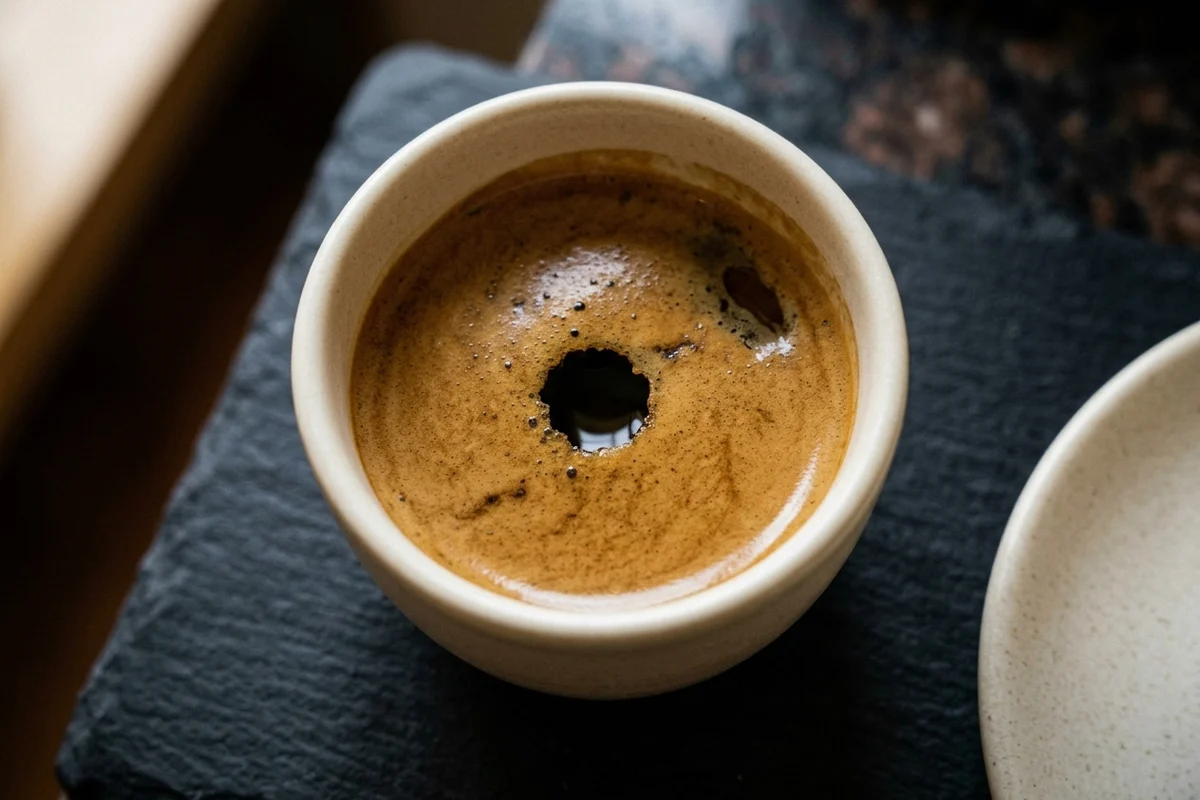
La crema deve essere uniforme e persistente per almeno 120 secondi dal termine di erogazione della bevanda non rimescolata. Nell’arco dei 120 secondi non deve apparire alcun foro sulla superficie che faccia intravedere il liquido sottostante.
The crema must be uniform and persist for at least 120 seconds after the pour ends, on an unstirred cup, and within those two minutes not a single hole may open on the surface to reveal the liquid beneath. Not a thickness. Not a colour. Coverage, and how long it holds.
The World Barista Championship is even blunter. I read the 2026 Official Rules and Regulations in full; crema appears twice. In §3.1: “Crema should be present when espresso is served, with no break in coverage.” And in the judging protocol, §15.1.1:
Judges will visually evaluate the appearance of the crema for presence in the vessel. To score a “yes” the crema must stretch across the entire surface of the espresso and not have any holes or broken spots.
A yes or a no. There is no score for thickness, colour, or tiger flecking anywhere in the document. And the instruction immediately before it, §15.1-B, tells the sensory judges to stir the espresso three times with a spoon before tasting.
Read those two together and the position of the world’s most visible espresso competition is unambiguous: crema being present is a sign that the drink was made properly, and the crema itself is removed before anyone judges how it tastes.
Does crema change the taste? Yes — twice, and not how you’d think
Through aroma, there is an optimum rather than a maximum. Barron and colleagues produced six espressos with different foam characteristics by varying extraction pressure and filtering the beverage, then tracked volatiles in the headspace and in the nose during drinking. Crema in its standard quantity gave the best release of pleasant high volatiles. Filtering it away lowered them. And raising crema volume by increasing extraction pressure “did not bring any added value” — more foam bought nothing. More crema did increase the dominance of roasted notes through the drink.
Through the eyes, the effect is larger and stranger. Labbe and colleagues served espressos with different amounts of crema in three conditions: looked at but not tasted, tasted blindfolded, and tasted normally.
Results showed that espresso coffee without crema was expected to be moderately liked, low in quality and weakly smooth as compared to espresso coffee with crema. Such expectations negatively impacted hedonic and sensory in-mouth experience through assimilation effect.
The expectation set by the look of the cup carried into the mouth and dragged the actual rating with it. Which is the honest resolution of the whole argument: crema is not evidence of quality, but believing it is makes it behave like evidence. A crema-less shot from good coffee will taste worse to you than the same liquid would have with a hat on. That is a real effect and worth knowing about, in the same way it is worth knowing which of your opinions came from the label.
Why your espresso has no crema
Ranked by how strongly the effect is actually supported, which is close to the reverse of the usual list.
| Cause | What the measurements show | Strength of evidence |
|---|---|---|
| Coffee is old, or was pre-ground | Grinding costs 26–59% of residual CO₂ immediately, up to 75% within 90 seconds; ground coffee is done degassing in ~50 hours | Strong — measured directly |
| Light roast | 6.3 mg/g of CO₂ against 15.4 for dark; foam volume rises with roast degree | Strong |
| Not enough pressure | Foam volume rose steadily from 5.1 to 6.9 ml across 7 → 11 atm | Strong |
| Basket and cup | Double and triple baskets gave more stable crema than a single; a warm cup matters | Moderate |
| Coffee species | Robusta gave more volume in one study, arabica more stability; another found no volume difference | Contested — see below |
| Brew temperature | 88–98 °C: no statistically significant difference in foam volume | Measured, and it is not a cause |
| Grind size, brew ratio | Both “less affected” crema volume and stability than variety and freshness | Weak as crema levers |
The last two rows are where this list departs most sharply from the standard advice, which usually opens with grind and temperature. Both matter enormously for how the shot tastes — see what actually moves extraction — but as controls on the foam they are secondary to how much gas is in the coffee and how hard the pump is pushing.
The species question deserves its own note, because the internet is certain about it and the literature is not. Wang and colleagues found larger crema volume from robusta and more stable crema from arabica, attributing the latter to arabica’s higher lipid content — which sits awkwardly beside the foam chemistry above, where lipids are the antagonist. Nunes found no significant difference in volume between the species at all. Illy and Navarini, reviewing the lot, conclude that the role of species “is not established and it cannot be considered a consolidated belief”. I am not going to resolve it here; I am going to note that a measurement and the explanation attached to it are two different claims, and this pair disagrees about both.
Affiliate links. Some product names below link to Amazon. If you buy through one I earn a commission at no extra cost to you, and it never changes which product gets named or what the measurements say. Full disclosure.
Two related appearances, since they get read as extraction readouts: the mottled “tiger skin” pattern on the surface is attributed to very fine particles and cell-wall fragments carried into the foam — it shows up in pure arabica crema and not in pure robusta, which instead leaves a beer-like lacing on the cup wall. That makes the pattern a signature of what the grinder produced and which species you used. Nobody has published a link between it and extraction. What does diagnose the flow through a puck is watching the underside of a bottomless portafilter, which is the subject of channelling.
Crema you can buy
If crema were proof of anything about the coffee, it should not be possible to manufacture it independently. It is, at three price points.
Pressurized (dual-wall) baskets. Breville’s own explanation is admirably direct: the basket “generates back pressure by forcing hot water through the small hole at the bottom of the outer wall (like a valve)”, which serves to “compensate for inconsistencies that can cause issues with extraction, such as uneven espresso tamping or the wrong espresso grind size”, giving “more consistent shots of espresso with rich crema at the top” — while conceding it “might not produce the same full-bodied flavor as a non-pressurized option”. A manufacturer describing a device that produces crema regardless of grind and tamp quality is the clearest possible statement that crema and technique have been decoupled.
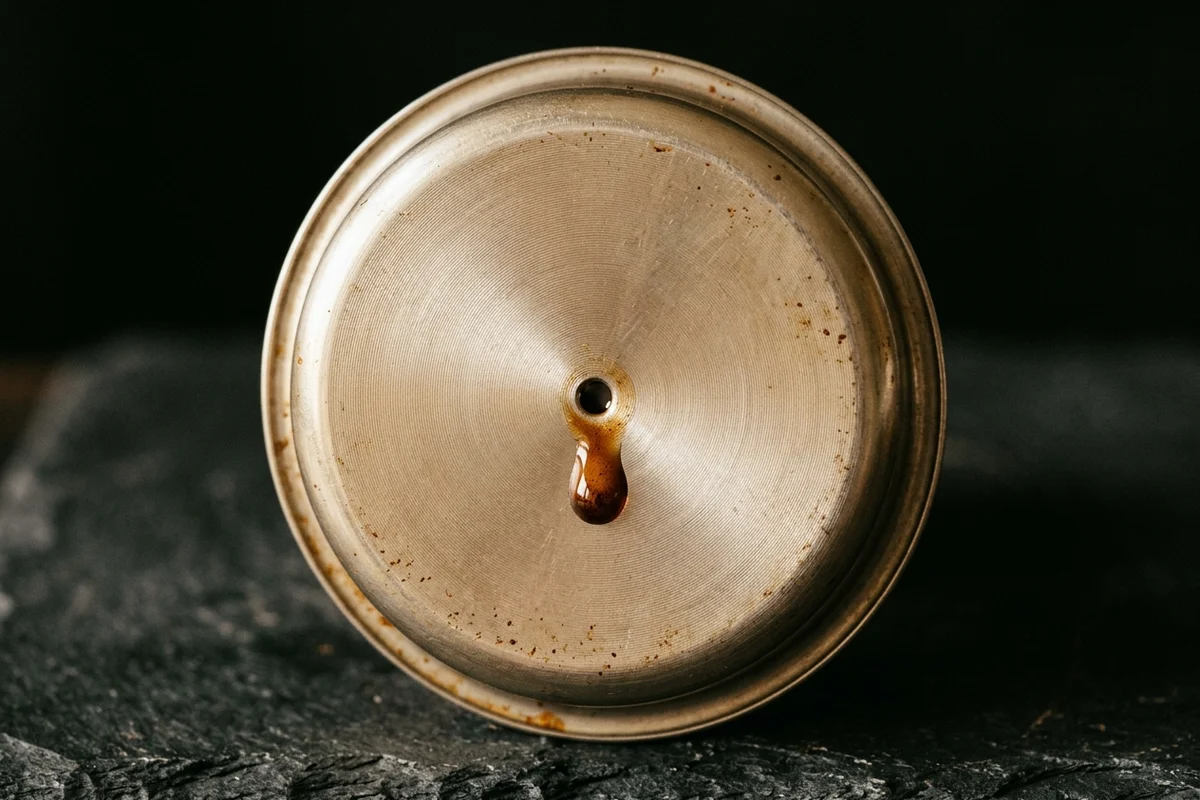
Gas injection. BSH — Bosch and Siemens’ appliance arm — holds US patent 8383181 B2, granted in 2013, for producing crema by running the coffee through a Venturi nozzle and briefly raising the volumetric flow, because “an increased flow rate or an increased volumetric flow of the fluid through the Venturi nozzle results in an increased intake of gas”. The point of the invention is to give machines working near one bar the fine-bubbled foam that nine-bar machines get from the coffee’s own CO₂.
And a slogan. Crema became a quality signal for a commercial reason before it was ever a technical one. Gaggia’s own company history records the 1938 patent behind its steam-free machine as producing coffee “characterized by a soft layer of ‘crema naturale’”, advertised in Milanese bars with the line “Crema caffè naturale — Funziona senza vapore”: natural coffee crema, works without steam. The foam was the visible proof that the machine was not the old steam boiler. It was, from the beginning, a demonstration you could see across a room.
What crema can honestly tell you
Not nothing. Read as a gas gauge, it is genuinely informative:
- Roughly how much CO₂ the coffee still had — which bundles roast degree, days since roasting, minutes since grinding, and how the bag was stored, without telling you which one is responsible.
- Whether the machine built pressure. No crema at all from fresh, properly roasted coffee points at the pump, the basket or a puck that offered no resistance.
- Whether something changed since yesterday. Like shot time, crema is a useful symptom precisely because it is sensitive; a sudden change on an unchanged recipe means go and look.
And what it cannot tell you: how well the coffee extracted, how strong the cup is, whether the beans are good, or whether you will like it. For the first two there are numbers, and they are the subject of the SCA’s brewing standard and how the measurement works.
What nobody has measured
Two absences worth stating plainly, both checked on 5 September 2026.
There is no published study correlating crema with extraction yield. I searched Europe PMC — which indexes PubMed, PMC and Agricola — for coffee papers touching crema alongside extraction yield or total dissolved solids, and ran the equivalent query through Crossref. Fifteen results, none of which tests the relationship. The one systematic study of crema even measured extraction yield and TDS in passing, and reports crema volume as driven by variety and freshness instead. The claim that a good crema means a good extraction is not contradicted by the literature; it is simply absent from it.
And the received numbers have no source. “Crema should be 2–4 mm thick” and “good crema lasts 2–3 minutes” appear across dozens of pages without attribution. The only quantified figures I can find in the literature are the foam index of at least 10% of the serving, the disciplinare’s 120 seconds of complete coverage, and laboratory persistence measurements spanning 6 to 40 minutes. If you have been measuring your crema against a millimetre figure, you have been measuring it against nothing.
So: pull the shot, look at the crema, and read it for what it is — a report on the gas your coffee had left and the pressure your machine applied. Then stir it in, the way the judges do, and taste the coffee.
Sources
Every figure in this piece traces to one of these. Dates are when the source was read — lists and prices move.
- Neglected Food Bubbles: The Espresso Coffee Foam Illy & Navarini — Food Biophysics 6(3), 335–348 (2011) Open access, read in full. The review this piece is built on: the gas phase, the emulsion, bubble sizes, the foam volume–CO₂ correlation, the inverse relationship between volume and persistence, and the conclusion that the role of coffee species in foam is not established. Also the route to the Dalla Rosa (1986), Severini (1997), Foschia (2008) and Navarini (2006) figures, which are quoted here at second hand. Read 5 September 2026
- Foamability, Foam Stability, and Chemical Composition of Espresso Coffee As Affected by the Degree of Roast Nunes, Coimbra, Duarte & Delgadillo — Journal of Agricultural and Food Chemistry 45(8), 3238–3243 (1997) Foamability correlates with protein content, stability with high-molecular-weight polysaccharides, and fat correlates negatively with foamability. Source of the persistence peak at medium roast. Read 5 September 2026
- Influence of polysaccharide composition in foam stability of espresso coffee Nunes & Coimbra — Carbohydrate Polymers 37, 283–285 (1998) The galactomannan and arabinogalactan fractions behind foam stability. Read 5 September 2026
- Physical and Chemical Effects of Different Working Gases in Coffee Brewing: A Case Study of Caffè Firenze Angeloni, Masella, Guerrini, Spadi, Bellumori, Innocenti & Parenti — Foods 9(12), 1825 (2020) Open access, read in full. One batch of coffee brewed with six different gases: the source of the foam index, persistence, sugar-test and TDS figures, and of the negative correlation (R = −0.8) between foam index at 30 seconds and persistence. Read 5 September 2026
- Investigation of the factors that affect the volume and stability of espresso crema Wang, Lim, Tan & Fu — Food Research International 116, 668–675 (2019) Paywalled; used at abstract level only. Crema volume driven mainly by variety and freshness, stability strongly by basket size, and less affected by particle size, brew ratio and temperature. Read 5 September 2026
- Understanding the Formation of CO₂ and Its Degassing Behaviours in Coffee Xiuju Wang — PhD thesis, University of Guelph (2014) Open access, read in full. Residual CO₂ by roast degree, the finding that roast degree rather than roast temperature sets it, the 26–59% lost at the grinder, and the whole-bean degassing curve that runs past 800 hours. Read 5 September 2026
- Time-Resolved Gravimetric Method To Assess Degassing of Roasted Coffee Smrke, Wellinger, Suzuki, Balsiger, Opitz & Yeretzian — Journal of Agricultural and Food Chemistry 66(21), 5293–5300 (2018) Up to 75% of the trapped gas leaves during and immediately after grinding, within 90 seconds. Read 5 September 2026
- Impact of crema on the aroma release and the in-mouth sensory perception of espresso coffee Barron, Pineau, Matthey-Doret, Ali, Sudre, Germain, Kolodziejczyk, Pollien, Labbe, Jarisch, Dugas, Hartmann & Folmer — Food & Function 3, 923–930 (2012) Six espressos with different foam characteristics. Standard crema gave the optimum release of pleasant high volatiles; adding crema by raising extraction pressure added nothing. Read 5 September 2026
- Impact of crema on expected and actual espresso coffee experience Labbe, Sudre, Dugas & Folmer — Food Research International 82, 53–58 (2016) Espresso rated in three conditions — visual only, blindfolded, and normal. Crema sets an expectation that carries into the tasting through an assimilation effect. Read 5 September 2026
- Investigations on the high molecular weight foaming fractions of espresso coffee D'Agostina, Boschin, Bacchini & Arnoldi — Journal of Agricultural and Food Chemistry 52, 7118–7125 (2004) The two foaming fractions put in front of a panel: the stabilising one essentially tasteless, the foam-forming one intensely aromatic and persistently bitter. Read 5 September 2026
- Influence of water pressure on the final quality of arabica espresso coffee. Application of multivariate analysis Andueza, Maeztu, Dean, de Peña, Bello & Cid — Journal of Agricultural and Food Chemistry 50, 7426–7431 (2002) 7, 9 and 11 atmospheres compared. Foam volume rose with pressure; the 9 atm cups carried the key odorants. Read 5 September 2026
- Influence of extraction temperature on the final quality of espresso coffee Andueza, Maeztu, Pascual, Ibáñez, de Peña & Cid — Journal of the Science of Food and Agriculture 83, 240–248 (2003) Water temperature across 88–98 °C, the range in which foam volume was not statistically different. Read 5 September 2026
- Multivariate methods for characterization and classification of espresso coffees from different botanical varieties and types of roast by foam, taste and mouthfeel Maetzu, Andueza, Ibañez, Paz de Peña, Bello & Cid — Journal of Agricultural and Food Chemistry 49, 4743–4747 (2001) Foam and taste parameters classify species and roast type — which is what crema appearance is actually good at. Read 5 September 2026
- Disciplinare Caffè Espresso Italiano Tradizionale Consorzio di Tutela del Caffè Espresso Italiano Tradizionale, with INEI and the Comitato Italiano del Caffè (2018 text) Read in full. Clause 7 requires uniform crema persisting at least 120 seconds on an unstirred cup, with no hole exposing the liquid beneath. Read 5 September 2026
- 2026 World Barista Championship Official Rules and Regulations Specialty Coffee Association / World Coffee Championships Read in full. §3.1-I and §15.1.1 make crema a yes/no on complete coverage; §15.1-B has judges stir the espresso three times before tasting. Read 5 September 2026
- Method and device for crema production based on volumetric flow (US 8383181 B2) BSH Hausgeräte GmbH — inventors Daburger, Gerl & Jerance Mitrovic; filed 2009, granted 26 February 2013 A Venturi nozzle drawing gas into the coffee stream so that machines working near 1 bar can produce fine-bubbled foam. Read 5 September 2026
- Pressurized vs. non-pressurized portafilter baskets Breville The manufacturer's own description of how a dual-wall basket generates back pressure to compensate for grind and tamping errors, and the flavour trade-off it acknowledges. Read 5 September 2026