
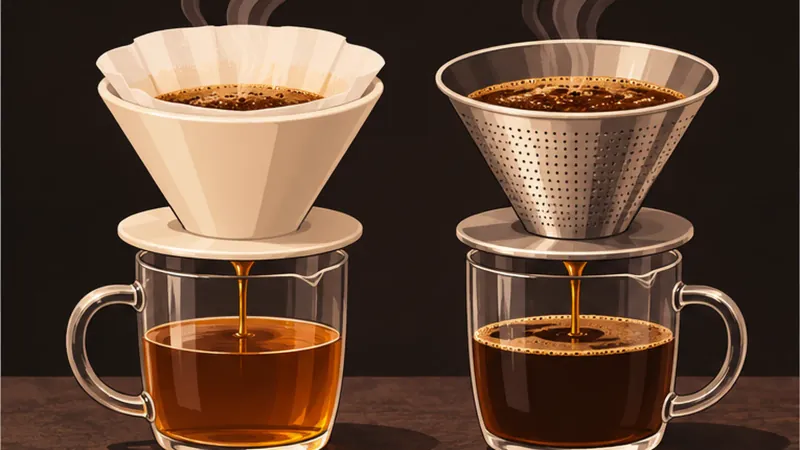
A paper filter leaves about 0.08 mg of cafestol — the coffee compound that raises cholesterol — in a small cup of coffee. A reusable nylon filter measured in the same 1995 Dutch study let through 0.64 mg: eight times as much. A French press in that study let through 2.8 mg, thirty-five times as much. In cholesterol terms, on the formula built from the controlled trials, five small cups a day through that nylon filter come to about 2 mg/dl of total cholesterol more than paper; through a French press, about 8 mg/dl.
Two things the pages that rank for this question get wrong are where the cafestol goes and what “metal” means. Paper does not soak up the oil so much as stop the last of it: in the one study that traced it, 87% of the cafestol never left the grounds. And “metal” covers filters that measured as clean as paper, as oily as espresso, and some that nobody has measured at all. The taste difference everyone describes — paper bright and clean, metal heavier — is real enough to be common knowledge and has never been tested by changing only the filter.
Below: where cafestol goes and what a filter actually stops, how much reaches the cup through each kind of filter, how large the cholesterol effect is and where it comes from, why “metal” is four different filters, why paper is not one thing either, what is and is not known about taste and sediment, and the chlorine and microplastics questions.
Affiliate links. Some links below go to Amazon. If you buy through one I earn a commission at no extra cost to you, and it never changes which product gets named or what the measurements say. Full disclosure.
Paper vs metal coffee filter: what each one actually stops
Cafestol and its close relative kahweol are diterpenes, fat-soluble compounds carried in the coffee bean’s oil. They make up “about 1% (wt:wt) of coffee beans,” in the words of the Dutch researchers who identified them as the cholesterol-raising factor in coffee, and they are “extracted by hot water but are retained by a paper filter.”
That last phrase is where most explanations stop, and it leaves out the larger part. Hot water extracts very little of the bean’s oil. A 2012 study at the University of Nottingham found that even the most generous method, a light roast in a French press, carried only 6.5% of the bean’s cafestol into the brew; a dark-roast moka pot, 2.42%. In 2017 a Brazilian team traced the cafestol in paper-filter brewing to where it ended up: 87.45% stayed in the spent grounds, 12.41% in the paper, 0.15% in the cup. “The greater part of the coffee cafestol is retained by the spent coffee,” they concluded, “due to the low extraction of the lipid fraction by the hot water.”
So the bed of grounds does most of the filtering. What a filter decides is the last few percent, and that last few percent travels partly as oil droplets and partly stuck to fine particles of coffee. The Swedish team behind a 2025 study of workplace machines put it that way: without a fine filter, more diterpenes “pass through, bound to coffee particles.” A paper filter stops both. A 1991 Dutch trial measured the oil itself: coffee boiled and then poured through a commercial paper filter carried 0.02 g of lipid per litre, against 1.0 g for the same coffee unfiltered. A second trial the same year found filtering “removed more than 80% of the lipid-soluble substance.”
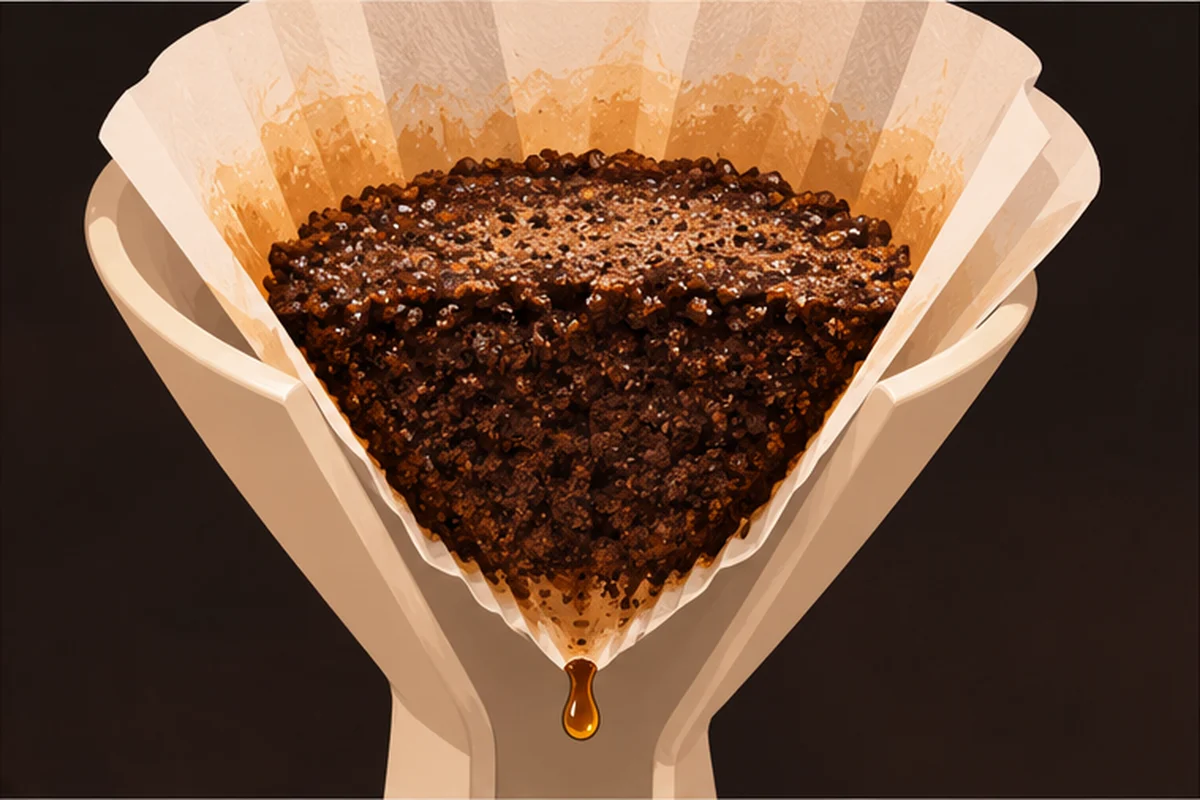
That is also why grind and the bed matter as much as the filter material. The Brazilian team’s 2018 follow-up named “the porosity of the paper filter and the particle size of the ground roasted coffee” as the deciding factors. A finer grind puts more small particles in the water; a filter with bigger holes lets more of them through. Grind is the half of this you control on every brew — the grind size chart covers where each method sits, and the piece on grind and flavour covers what fines do in the cup.
How much cafestol reaches the cup through each filter
The only study that measured a reusable filter alongside paper and a French press, with the same method, is the 1995 Dutch study by Rob Urgert and colleagues. I could not read the paper itself; its figures below are as Naidoo and colleagues tabulated them in 2011, scaled to a 120 ml cup, next to their own measurements of coffee from Singapore, India and Indonesia:
| Brew | Cafestol per 120 ml cup | Where it was measured |
|---|---|---|
| Paper filter | 0.08 mg | Europe (Urgert, 1995) |
| Reusable nylon filter | 0.64 mg | Europe (Urgert, 1995) |
| Instant | 0.2 mg | Europe (Urgert, 1995) |
| Scandinavian boiled | 2.4 mg | Europe (Urgert, 1995) |
| French press | 2.8 mg | Europe (Urgert, 1995) |
| Turkish or Greek | 3.12 mg | Europe (Urgert, 1995) |
| South Indian metal filter | 0.05 mg | India (Naidoo, 2011) |
| Cloth sock | 0.09 mg | Singapore (Naidoo, 2011) |
| Cloth sock | 0.85 mg | Indonesia (Naidoo, 2011) |
| Metal mesh | 0.98 mg | Indonesia (Naidoo, 2011) |
| No filter | 4.43 mg | Indonesia (Naidoo, 2011) |
Three things to keep in mind when reading it.
The cup is small. These figures are per 120 ml. A 12 oz mug holds about 355 ml, roughly three of these cups, so two mugs a day is about six cups on this table.
Compare within a study, not across studies. Absolute cafestol numbers do not agree well between laboratories. Paper-filtered coffee came out at roughly 0.7 mg per litre in the Dutch measurements, 1.6 to 3.0 mg per litre in the Brazilian 2018 study, and a median of 11.5 mg per litre in the Swedish 2025 one, whose authors note that their values run higher than older studies across the board. The ratios hold up better than the absolute values: in every study that measured both, paper is lowest and unfiltered coffee highest.
The metal and cloth samples are few. The nylon filter is three samples; the Indonesian metal mesh is one. They show the range, not a precise figure for any filter you can buy.
Does a metal filter raise cholesterol? The size of the effect
The cafestol story did not start in a laboratory. It started with Scandinavian boiled coffee and a run of randomized trials in the late 1980s and early 1990s. In the Netherlands, 107 young adults drank four to six cups a day of boiled coffee, filtered coffee or no coffee for nine weeks; boiled coffee raised total cholesterol by 0.48 mmol/l against filtered, and there was no significant difference between filtered coffee and no coffee at all. In the 1991 trial above, six cups a day of unfiltered boiled coffee for 79 days raised LDL by 0.41 mmol/l (16 mg/dl) compared with the same coffee poured through paper. A meta-analysis of 14 trials in 2001 summed it up: “Consumption of unfiltered, but not filtered, coffee increases serum levels of total and LDL cholesterol.”
The American Heart Association’s 2026 scientific statement on caffeine says the same, and is explicit about where the effect comes from: “Whereas no clear relationship between caffeine and blood lipids is evident, unfiltered coffee raises low-density lipoprotein cholesterol.” The effect comes from the filter, or its absence, not from the caffeine.
Trials with purified diterpenes turned this into a formula: each 10 mg of cafestol a day raises total cholesterol by about 0.13 mmol/l, about four-fifths of it as LDL. Naidoo and colleagues applied it to each brew in their table. For five 120 ml cups a day:
| Brew, five 120 ml cups a day | Predicted rise in total cholesterol | In mg/dl (derived here) |
|---|---|---|
| Paper filter | under 0.01 mmol/l | under 0.4 |
| Reusable nylon filter | 0.05 mmol/l | about 2 |
| Scandinavian boiled | 0.18 mmol/l | about 7 |
| French press | 0.21 mmol/l | about 8 |
| Turkish or Greek | 0.23 mmol/l | about 9 |
That is the honest size of the paper-versus-reusable question: on the one measurement there is, a couple of mg/dl at five small cups a day, a little more at two large mugs. The gap between paper and a French press is four times larger. If LDL is a number you already watch, those are the sizes of the levers; what they mean for any one person is a question for the person who reads your blood test, not for a coffee site.
Population studies point the same way, with the usual caution that they show associations, not causes. In Norway’s Tromsø Study of 21,083 adults, six or more cups a day of boiled or plunger coffee was associated with total cholesterol 0.23 to 0.30 mmol/l higher, and three to five espressos a day with 0.09 to 0.16 mmol/l higher; six or more cups of filtered coffee came with 0.11 mmol/l higher in women and no difference in men. A study that followed 508,747 Norwegians for about twenty years found that “Unfiltered brew was associated with higher mortality than filtered brew.”
One ranking page goes the other way and calls cafestol and kahweol “two of the most nutritious compounds in coffee,” recommending a steel filter to let “all that goodness through.” It cites nothing. The controlled trials above are the evidence on what cafestol does in people.
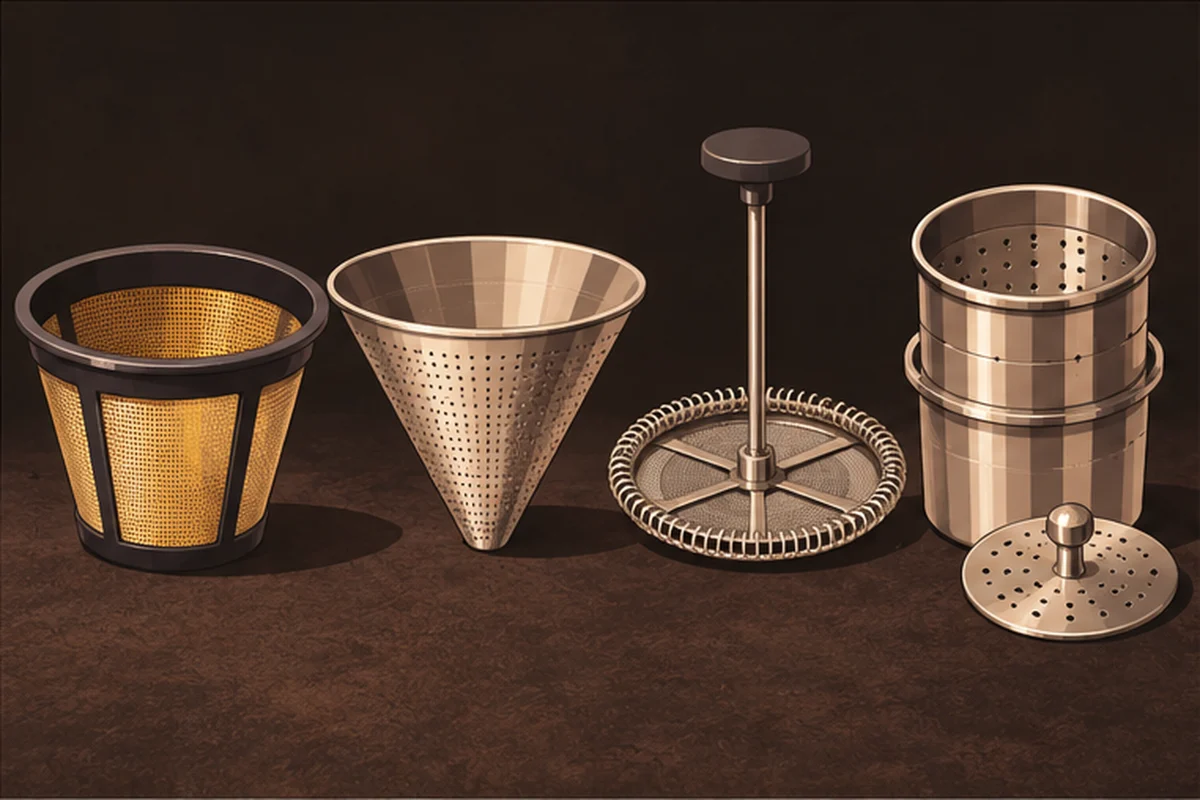
“Metal” is four different filters
Most pages treat “metal filter” as one thing and many put it level with a French press. The measurements do not:
| Filter | What it is | Cafestol measured? |
|---|---|---|
| Reusable mesh basket or cone | Fine mesh, often gold-coloured, sold with many 8–12 cup drip machines | Only in nylon, once: 0.64 mg per 120 ml cup (1995) — eight times paper, a quarter of a French press |
| Etched stainless-steel cone | A single sheet of steel with chemically etched holes, sold for pour-over | No published measurement found |
| French press screen | A coarse mesh disc on a plunger, with the grounds steeping in the water | Yes: 2.8 mg per 120 ml cup |
| South Indian filter | A perforated metal cup with a pressing disc, grounds packed tight, slow drip | Yes: 0.05 mg — as low as paper |
The Indian result is the most instructive. An Indonesian metal-mesh coffee in the same study let through twenty times as much, and the authors put the difference down to the filters’ porosity, how many times the coffee passed through, and “how compacted the grounds were.” A dense bed of grounds is a filter in its own right, which is why the Brazilian study found 87% of the cafestol there.
The etched stainless cones are the gap that matters most for pour-over drinkers, and I could not close it. Able Brewing, which makes one of the best known, the Able Kone, describes it as brewing “a full-bodied cup of coffee, rich with oils and flavors normally trapped by paper filtration” — which is the honest description of a filter that lets oil through, but not a measurement. Until someone measures one, the nylon figure is the closest evidence, and it is not the same kind of filter.
Two more metal filters sit in kitchens and offices. An espresso basket is metal too; the Tromsø figures above are what is known about espresso and cholesterol, and a shot is too small for the per-cup table to apply. And the bean-to-cup machines common in offices brew through a metal filter: in the Swedish 2025 study of 14 such machines in hospitals, the median cafestol was about 15 times that of paper-filtered coffee made in the same laboratory, and two samples from the same machine two or three weeks apart differed by 58% on average. The authors suggested cleaning schedules as one reason — “Paradoxically, cleaning a metal filter could hypothetically result in greater permeability” — and were careful to note that they measured coffee, not anyone’s cholesterol. Fully automatic home machines brew in a similar way; the piece on how long espresso machines last covers their other trade-offs.
Not every paper filter is the same either
Paper filters differ in thickness, porosity and, in some brands, deliberate perforations. The Brazilian 2018 study compared papers from six countries — Brazil, Japan, the US, Germany, France and the Netherlands — ranging from 50.46 to 67.48 g/m², and found the diterpene retention “similar” across countries. The exception was perforation: among same-size papers, “the highest cafestol and kahweol concentrations were obtained using paper filters with micro perforations.” The Swedish study tested the same question and found no significant difference: 9.7 mg per litre through ordinary paper, 13.2 through perforated, with a P value of 0.43.
It matters because the Melitta #4 natural brown cone — ranked second among disposable coffee filters on Amazon in the US on 2 November 2026 — carries “Microfine Flavor Enhancing perforations that allow the full coffee flavor to filter through.” On the evidence above, a perforated paper still sits in the paper range, far below the measured metal filters and a French press; it is just not the cleanest paper you can buy. Hario V60 paper filters, third in the same ranking, make no perforation claim; Hario describes them as designed “with limited flow restriction.”
Taste and sediment: what is measured, and what is not
Almost every page on this question says the same thing: paper gives a brighter, cleaner cup with more defined acidity, metal a heavier, rounder one with more body and some silt at the bottom. Nearly every coffee drinker who has tried both would agree. But I found no peer-reviewed tasting study that brewed the same coffee in the same brewer and changed only the filter.
The nearest is a 2023 study from the University of Camerino. One Kenyan coffee was brewed four ways — two through metal (a Victoria Arduino Pure Brew machine and a French press) and two through paper (a Hario cone dripper and an AeroPress) — and analysed for aroma compounds and on the SCA cupping form. The aroma profiles grouped by filter material: the paper-filtered cups had “higher percentages of caramel-, and flowery-related compounds,” the metal-filtered ones “more fruity and roasted.” But the four methods also used different grinds, ratios and brew times, so the filter is not the only thing that changed, and the study shares an address with the company that makes the Pure Brew machine, which scored highest.
One home brewer’s side-by-side is more direct, though it is one person and not blind. The author of the blog firefortysix dialled in a paper-filtered cone dripper, then switched to the metal cone and tried three grind settings to make the two cups match. They would not: “it was clear that it wasn’t going to happen.” With one of the two coffees the metal cup was the better one; with the metal filter, the fines that passed the steel made “the last few sips pretty much undrinkable.” The blog also works out that the Kone cost 550 times as much as one Cafec Abaca paper filter — about a year and a half of daily brewing to break even.
Owners say the same about sediment, and disagree about how much. Among Amazon reviews of the Kone that mention it, as many complain about sludge as praise how little there is: one finds “very little sediment, much less than a French press,” another “a lot of sludge at the bottom of the mug” without a paper filter. The practical advice that recurs is to grind coarser for metal. On the paper side, the complaint is paper taste, and Hario buyers repeat the usual fix: “no paper flavor if you rinse with water before using.”
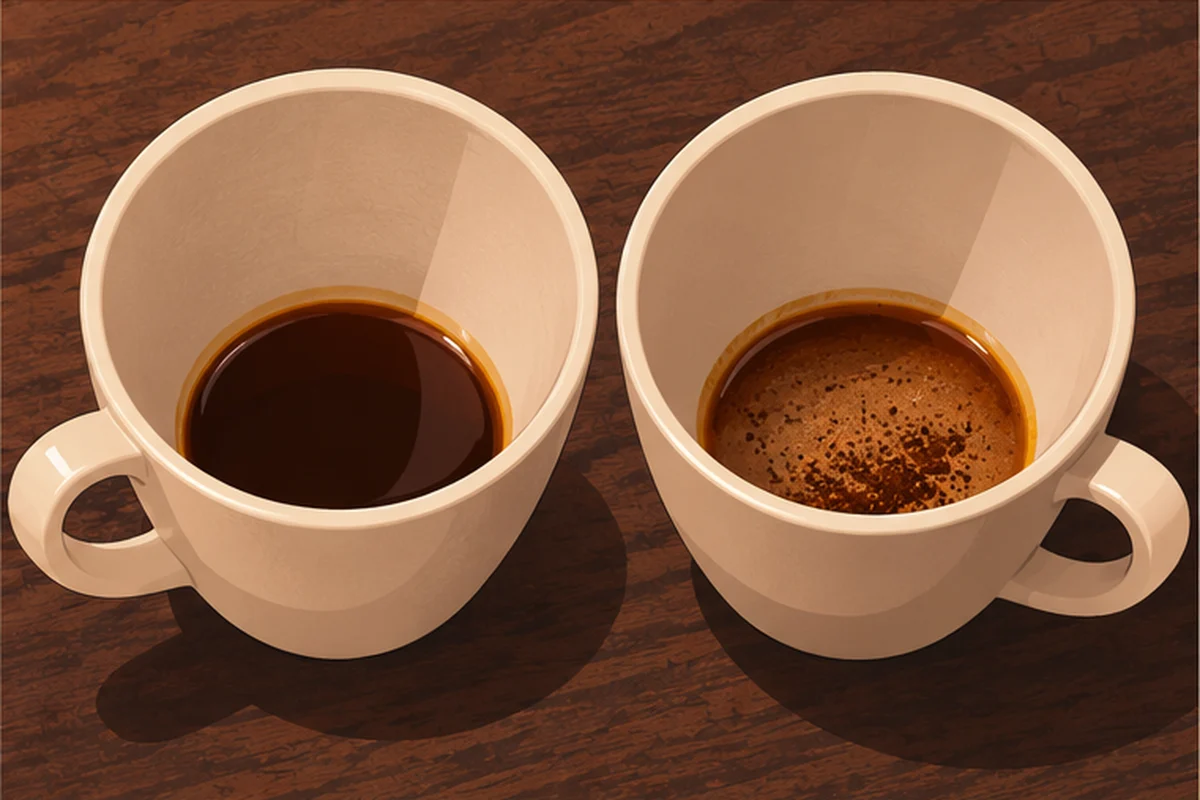
One measurement quirk is worth knowing if you measure brew strength. Oil and suspended particles bend light without being dissolved, so unfiltered samples read high — the piece on the SCA Golden Cup covers the comparison that showed it. A metal-filtered cup carries more of both, so part of its apparently higher strength can be a measurement artefact. Strength in the extraction sense counts only what dissolved; the piece on coffee extraction explains how that number is defined.
Bleach, chlorine and microplastics
Two worries about paper come up alongside this question. One ranking page says the chlorine used to whiten filters “stays in the paper” and may end up in the coffee. It gives no source, and I found none. The two best-selling filters I checked say otherwise on the box: Hario lists its white V60 paper filters as “100% oxygen-bleached paper pulp,” and Melitta’s natural brown filters are unbleached. I have not checked every brand, so this is not a claim about all white filters.
The microplastics question usually leads to a 2021 study from IIT Kharagpur that found about 25,000 micron-sized plastic particles released into 100 ml of hot water in fifteen minutes — but from disposable paper cups, which are lined with a plastic film. A paper coffee filter has no such lining, and I found no study that measured microplastics from one.
The filters, side by side
| Filter | What it is | Fits | What is measured | Price |
|---|---|---|---|---|
| Hario V60 paper filters, size 02 | White cone filters, 100 to a box; “oxygen-bleached,” “made without glue,” made in Japan | Size 02 cone drippers | Paper filter range: about 0.08 mg cafestol per 120 ml cup (Urgert) | Check price → |
| Melitta #4 natural brown | Unbleached cone filters with micro-perforations, 100 to a pack | 8–12 cup drip machines with a cone basket, most single-cup cones | Paper range; perforated papers passed the most cafestol among papers in one study, no significant difference in another | Check price → |
| Able Kone | Etched stainless-steel cone; $39.50 at Able on 2 November 2026 | Chemex 6, 8 and 10 cup; sits on a V60 | No published cafestol measurement; owners split on sediment | Check price → |
What I would actually do
Keep whatever filter you like for taste if you drink one or two small cups a day. At that volume the difference between paper and a reusable nylon filter is under 1 mg/dl on the only measurement there is.
If you drink several mugs a day through metal, or through a French press, and you already track LDL, change the filter before you change the coffee. It is the one variable the trials isolated, and paper in the brewer you already own is the cheapest version of that change. A paper filter inside a metal one works too.
Grind a little coarser for metal. Fewer fines means less sediment, and the fines carry cafestol with them.
Rinse paper before brewing if you taste it.
Do not trust a page — this one included — that gives a single number for “metal filters.” The measured ones range from as clean as paper to as oily as espresso, and the stainless cones most people mean have not been measured.
Paper filters work less by trapping oil than by catching the last of what the grounds let go. Whether that last trace is worth a paper filter every morning depends on how much you drink and what your numbers already are — and now you have the numbers.
Sources
Every figure in this piece traces to one of these. Dates are when the source was read — lists and prices move.
- Is cafestol retained on the paper filter in the preparation of filter coffee? Rendón, dos Santos Scholz and Bragagnolo, Food Research International 100:798–803, 2017 Read in the PubMed abstract (PMID 28873752). Source of the 87.45% (spent coffee), 12.41% (paper) and 0.15% (brew) split, and of 'the greater part of the coffee cafestol is retained by the spent coffee, due to the low extraction of the lipid fraction by the hot water.' Read 2 November 2026
- Physical characteristics of the paper filter and low cafestol content filter coffee brews Rendón, dos Santos Scholz and Bragagnolo, Food Research International 108:280–285, 2018 Read in the abstract. Paper filters from Brazil, Japan, the US, Germany, France and the Netherlands; grammage 50.46–67.48 g/m²; cafestol 1.62–2.98 mg/l; highest with micro-perforated papers; retention similar across countries; filter porosity and grind size 'determinant factors'. Read 2 November 2026
- Cholesterol-raising factor from boiled coffee does not pass a paper filter van Dusseldorp, Katan, van Vliet, Demacker and Stalenhoef, Arteriosclerosis and Thrombosis 11:586–593, 1991 Read in the abstract. Randomized trial, 64 volunteers, six cups a day for 79 days. Unfiltered boiled coffee 1.0 g lipid per litre, the same coffee through a paper filter 0.02 g; LDL +0.41 mmol/l (16 mg/dl; 95% CI 0.16–0.66) relative to filtered; no significant effect of the filtered coffee against no coffee. Read 2 November 2026
- The hypercholesterolaemic factor in boiled coffee is retained by a paper filter Ahola, Jauhiainen and Aro, Journal of Internal Medicine 230:293–297, 1991 Read in the abstract. Crossover trial, 20 volunteers, four weeks per period; filtering 'removed more than 80% of the lipid-soluble substance'. Read 2 November 2026
- The effect on serum cholesterol levels of coffee brewed by filtering or boiling Bak and Grobbee, New England Journal of Medicine 321:1432–1437, 1989 Read in the PubMed abstract (PMID 2811958). 107 adults, nine weeks, four to six cups a day. Boiled coffee: total cholesterol +0.48 mmol/l, LDL +0.39 mmol/l against filtered; no significant difference between filtered coffee and no coffee. Read 2 November 2026
- Cholesterol-raising diterpenes in types of coffee commonly consumed in Singapore, Indonesia and India and associations with blood lipids Naidoo, Chen, Rebello and others, Nutrition Journal 10:48, 2011 (open access, CC BY) Read in full. Asian measurements (sock 0.09 mg/cup in Singapore; Indian metal filter 0.05; Indonesian sock 0.85, metal mesh 0.98, unfiltered 4.43) and Table 2, which adapts Urgert and colleagues' 1995 European measurements to a 120 ml cup (paper 0.08, nylon 0.64, French press 2.8, Turkish 3.12, Scandinavian boiled 2.4, instant 0.2) with the predicted effect of five cups a day. Source of the 0.13 mmol/l per 10 mg cafestol formula, from Urgert and Katan (1997). Read 2 November 2026
- Levels of the cholesterol-elevating diterpenes cafestol and kahweol in various coffee brews Urgert, van der Weg, Kosmeijer-Schuil and others, Journal of Agricultural and Food Chemistry 43:2167–2172, 1995 The original measurements behind the paper, nylon and French press figures. I could not read the paper itself; the figures in this piece are as tabulated by Naidoo and colleagues (2011), on a 120 ml cup. Read 2 November 2026
- The cholesterol-raising factor from coffee beans Urgert and Katan, Annual Review of Nutrition 17:305–324, 1997 Read in the abstract: cafestol and kahweol 'make up about 1% (wt:wt) of coffee beans' and 'are extracted by hot water but are retained by a paper filter.' Read 2 November 2026
- Coffee consumption and serum lipids: a meta-analysis of randomized controlled clinical trials Jee, He, Appel and others, American Journal of Epidemiology 153:353–362, 2001 Read in the abstract. 14 trials; 'Consumption of unfiltered, but not filtered, coffee increases serum levels of total and LDL cholesterol.' Read 2 November 2026
- Caffeine and Cardiovascular Disease: A Scientific Statement From the American Heart Association Marcus and others, Circulation, 2026 Read in the abstract: 'Whereas no clear relationship between caffeine and blood lipids is evident, unfiltered coffee raises low-density lipoprotein cholesterol.' Read 2 November 2026
- Coffee consumption and mortality from cardiovascular diseases and total mortality: Does the brewing method matter? Tverdal, Selmer, Cohen and Thelle, European Journal of Preventive Cardiology 27:1986–1993, 2020 Read in the abstract. 508,747 Norwegians followed for about 20 years; observational. 'Unfiltered brew was associated with higher mortality than filtered brew.' Read 2 November 2026
- Association between espresso coffee and serum total cholesterol: the Tromsø Study 2015–2016 Svatun, Løchen, Thelle and Wilsgaard, Open Heart 9:e001946, 2022 Read in the abstract. 21,083 adults, cross-sectional. Three to five espressos a day: +0.09 mmol/l (women), +0.16 (men); six or more boiled or plunger coffees: +0.30 (women), +0.23 (men); six or more filtered: +0.11 in women, none in men. Read 2 November 2026
- Cafestol and kahweol concentrations in workplace machine coffee compared with conventional brewing methods Orrje, Fristedt, Iggman and others, Nutrition, Metabolism and Cardiovascular Diseases, 2025 Read in full (Chalmers repository copy). 14 workplace machines in Swedish hospitals. Brewing machines with a metal filter: median cafestol 175.7 mg/l; home paper-filtered drip 11.5 mg/l; ordinary vs perforated paper 9.7 vs 13.2 mg/l, not significant. The authors note their absolute values run higher than older studies. Read 2 November 2026
- Kahweol and cafestol in coffee brews: comparison of preparation methods Wuerges, Dias, Viegas and Benassi, Revista Ciência Agronômica 51, 2020 Read in full. Cloth- and paper-filtered brews similar per 50 ml dose (0.11–0.14 mg cafestol across brews); cloth higher per gram of solids — 'apparently less retention when using the cloth filter.' Read 2 November 2026
- Cafestol extraction yield from different coffee brew mechanisms Zhang, Linforth and Fisk, Food Research International 49:27–31, 2012 Read in the abstract. Highest cafestol extraction yield 6.5% (light roast, French press); lowest 2.42% (dark roast, moka pot). Read 2 November 2026
- Discrimination of Filter Coffee Extraction Methods of a Medium Roasted Specialty Coffee Based on Volatile Profiles and Sensorial Traits Santanatoglia, Alessandroni, Fioretti and others, Foods 12:3199, 2023 (open access, CC BY) Read in full. One Kenyan coffee through Pure Brew and French press (metal) and V60 and AeroPress (paper). Volatile profiles grouped by filter material. Grind, ratio and method also differed between brewers, so filter material is not isolated. Read 2 November 2026
- Microplastics and other harmful substances released from disposable paper cups into hot water Ranjan, Joseph and Goel, Journal of Hazardous Materials 404:124118, 2021 Read in the PubMed abstract. Plastic-lined paper cups, not coffee filters: about 25,000 micron-sized particles into 100 ml of hot water in 15 minutes. Read 2 November 2026
- Comparing paper and metal filters for V60 pour over coffee firefortysix (personal blog), 23 April 2022 One home brewer, two coffees, three grind settings on an Able Kone against paper; not blind. Source of the observation that grind changes could not make the two cups alike, and that fines made 'the last few sips pretty much undrinkable'. Read 2 November 2026
- V60 Paper Filter for 02 Size Dripper · Kone (Able Brewing) Hario USA; Able Brewing Hario: product numbers VCF-02-40M to VCF-02-100WK, 'Made without glue', 'FSC Certified', 'Made in Japan'. Able (ablebrewing.com/products/kone): $39.50; 'photo chemically etched stainless steel'; 'rich with oils and flavors normally trapped by paper filtration'. Read 2 November 2026