
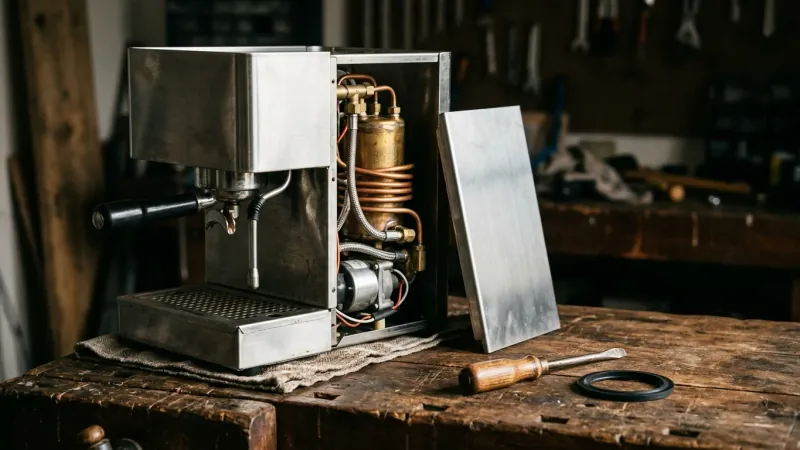
Breville, De’Longhi and Gaggia give no lifespan for their espresso machines in the US warranties and support pages I read. The few makers that have named a figure did so when a magazine asked, and most of them counted in brews rather than years. The independent figures that do exist land in the same place: about five years to the first serious repair. Germany’s consumer testers, Stiftung Warentest, found fully automatic machines breaking down after five years on average. At the repair cafés that pool their records in the Open Repair Alliance’s public dataset, the median coffee machine that comes in is five years old. Austrian households, surveyed for the Vienna Chamber of Labour, keep theirs for 4.9 years.
Whether a machine outlives those five years is decided by two things you can check before anything breaks: the water that goes into it, and whether anyone will still sell you its parts. Four warranties write scale, or skipped descaling, out of their cover, and La Marzocco calls water outside its specification “the most common reason for machine and parts failure.” At repair cafés, 44% of the coffee machines declared beyond repair, where the repairer wrote down why, were lost to a spare part that was missing or too expensive.
The pages that rank for this question print tables — three to five years for a cheap machine, ten to twenty for a good one, a percentage for how much descaling adds — with no source under them. There is a reason they cite nothing. In 2021 the European Commission’s own consultants wrote that “No current lifetime data detailed for the different coffee machine technologies is publicly available.” What is public is repair records, consumer surveys, makers’ figures counted in brews, and warranties that say what they will not pay for. This piece is built from those.
Below: the figures that exist and what each one measures, what makers promise and in which unit, what breaks and what it costs, when a repair is worth paying for, whether the parts will exist, how often a home machine actually needs a service, and why the warranty is the best document on what kills a machine.
Affiliate links. Some links below go to Amazon. If you buy through one I earn a commission at no extra cost to you, and it never changes which product gets named or what the measurements say. Full disclosure.
How long do espresso machines last? The figures that exist
Each of these measures something different, which is why they need reading side by side:
| Source | What it counts | Result |
|---|---|---|
| Stiftung Warentest, Germany, 2018 | Fully automatic machines, from a survey of readers and independent repair workshops | First breakdown after about 5 years on average; about three faults in ten years |
| Open Repair Alliance, records to July 2026 (my count) | 24,651 coffee machines brought to repair cafés and community repair events | Median age 5 years; the middle half between 3 and 9 |
| Vienna Chamber of Labour (AK Wien), 2015 | How long Austrian households keep a coffee machine | Used for 4.9 years; owners wanted 8.7 |
| Consumer NZ, 2026 | Its yardstick for a reliable appliance | “Fault-free for at least the first five years” |
| CHOICE, Australia, 2019 | 3,626 members’ machines bought 2011–2018 | 65% of espresso machine buyers never had a problem |
| EU ecodesign study (Lot 25), 2011 | An assumption for environmental accounting, not a measurement | Semi-automatic espresso 7 years, fully automatic 10; drip 6, pod and capsule 7 |
The Open Repair figures are my count of the alliance’s public dataset, and they come with limits worth stating. The 24,651 records are machines filed as coffee makers by repair groups, mostly in the Netherlands, Belgium, Germany, France, Denmark and the UK, between 2013 and July 2026. Espresso machines are not a separate category in the data. The age is what the owner said, and it was recorded for 9,688 of them. And these are machines whose owners chose to bring them to a free repair event, not a random sample of kitchens.
The three measured figures answer three different questions: when a machine first fails (Stiftung Warentest), how old it is when it comes in for repair (Open Repair), and how long people keep it (AK Wien). That they land within a few months of each other — three countries, three methods, three different years — is the strongest evidence there is. The EU’s seven and ten years are longer, but they are planning inputs, and an industry stakeholder quoted in the Commission’s 2021 study suggested seven years even for fully automatic machines.
I found no American survey that covers espresso machines. Consumer Reports’ reliability survey, the largest I found, counts 130,000 drip and pod coffee makers and no espresso machines. Nor could I find a measurement behind the fifteen or twenty years that ranking pages promise for a well-built machine. What supports that figure is the makers’ own targets, below, and owners’ stories: one British coffee blogger reports owning a 21-year-old Gaggia Classic.
Five years to the first fault is also not five years to the bin. In Stiftung Warentest’s own scenario a fully automatic machine fails three times in ten years and is repaired each time. How long it lasts after the first fault depends on whether it gets repaired, which is what most of this piece is about.
What the makers say — in drinks, not years
In 2018 Stiftung Warentest asked ten makers of fully automatic machines three questions: how long they keep spare parts, what lifespan they design for, and how long their warranty runs. Their answers, for the German market:
| Maker | Spare parts kept | Lifespan it calculates | Warranty |
|---|---|---|---|
| BSH (Bosch, Siemens) | 10 years | Would not say | 2 years |
| De’Longhi | 8–10 years | 7 years | 2 years |
| Electrolux (AEG) | 10 years | At least 10 years | 2 years |
| Groupe SEB (Krups, Rowenta) | 10 years | Would not say | 2 years |
| Jura | 10 years | 20,000 drinks | 25 months |
| Melitta | 5 years | At least 15,000 drinks | 2 years, at most 15,000 drinks |
| Miele | 15 years | 20 years, about 25,000 drinks | 2 years |
| Otto (Privileg) | 5 years | 5 years | 2 years |
| Panasonic | 7 years | Would not say | 2 years |
| Philips (Saeco) | Would not say | Would not say | 2 years |
Four of the ten would not give a lifespan. Of the six that did, three counted drinks — the more useful unit, because a machine that makes two coffees a day and one that makes eight do not age at the same rate. Turning those counts into years is simple division, and it shows why a single “X years” means little:
| Drinks a day (derived here, not by the makers) | Jura, 20,000 | Melitta, 15,000 | Miele, 25,000 |
|---|---|---|---|
| 2 | 27 years | 21 years | 34 years |
| 4 | 14 years | 10 years | 17 years |
| 6 | 9 years | 7 years | 11 years |
These are design targets the makers gave a magazine, not measurements, and they sit far above the five years to the first fault. My reading is that both numbers are right about different things: a design life assumes that worn parts are replaced along the way, and the five years is roughly when the first one goes.
In the US, the figure a maker actually commits to is its warranty, and none of them is long:
| Brand | US warranty |
|---|---|
| Breville | “Our espresso makers are backed by two-year warranties,” per its own blog; it also publishes a one-year text, so check the model’s page |
| De’Longhi | 2 years on fully automatic machines, 1 year on most other products; one more year for registering a coffee machine |
| Gaggia (North America) | 1 year, parts and labour |
| Rancilio (through its US importer) | 1 year, parts |
| Jura | “two years or up to 6,000 coffee brewings, whichever comes first” |
| La Marzocco Home | 12 months on the Linea Micra, 24 on the Linea Mini |
A warranty is not a lifespan; it is the period a maker is willing to pay for. Jura’s is the only one counted in use, and the arithmetic is telling: 6,000 drinks in two years is about eight a day, so a household machine will nearly always reach the two years first.
What breaks, and what it costs
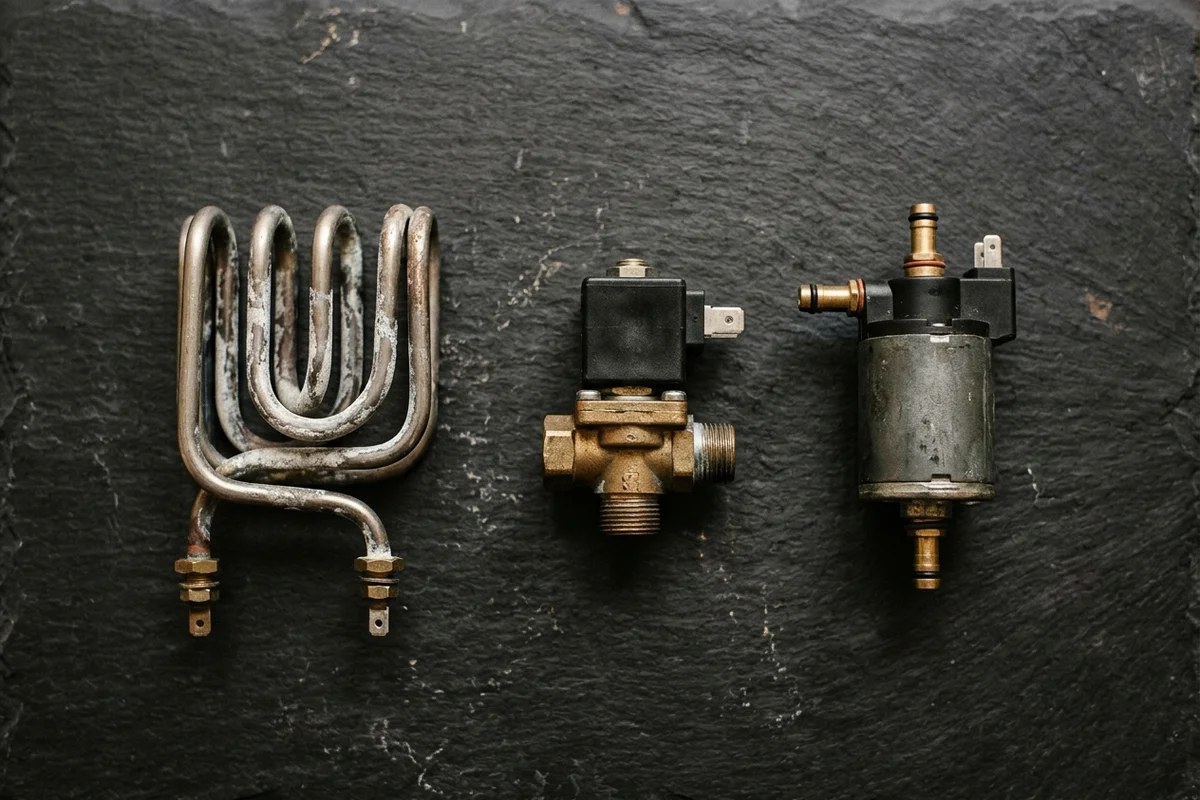
Stiftung Warentest asked independent workshops what they fix most on fully automatic machines. The heating element came first — “die größte Schwachstelle,” the biggest weak point — at an average repair cost of 145 euros. Next came worn valves, when the machine leaks (100 euros), and then the pump, when coffee barely runs or stops (110 euros). Britain’s Which?, surveying more than 4,000 owners of all kinds of coffee machine, saw the same shape from the owner’s side: 20% of faulty machines had trouble dispensing coffee, 19% leaked, and 8% had a cracked or damaged body.
The repairers’ notes in the Open Repair data show which faults get fixed. Counting fault words in five languages across the 20,088 records that describe the problem is rough — one note can name several faults, and a word is not a diagnosis — but the differences are large:
| Fault named in the repair note (my count) | Share of records | Of those, fixed |
|---|---|---|
| Leak | 17% | 42% |
| No water flow | 11% | 60% |
| Scale | 10% | 59% |
| No power | 8% | 47% |
| Not heating | 8% | 32% |
| Pump | 7% | 41% |
| Seal or gasket | 6% | 52% |
| Electronics or circuit board | 3% | 19% |
| All coffee machines | — | 49% |
Scale, blocked water paths and worn seals are usually fixed at a repair-café table. Circuit-board faults are fixed less than one time in five. That is the one place this data supports the old advice that simpler machines last longer — not by brand or by type, which the records cannot separate, but by fault.
A machine that has started brewing cooler is often scaled rather than broken. Three makers say in writing that scale lowers the brewing temperature, and the piece on coffee makers that run cool covers how to tell the difference.
Is it worth repairing an espresso machine?
Usually, if the part exists. Of the 24,651 coffee machines in the Open Repair data, 48.6% left fixed, 19.5% were judged repairable — they needed a part ordered or advice to finish the job at home — and 29.8% were declared beyond repair. Where the repairer recorded why, in 2,864 records, the reasons were:
| Why it could not be repaired (my count) | Share |
|---|---|
| Spare part too expensive | 22% |
| Spare part not available | 22% |
| No way to open the product | 20% |
| Repair information not available | 18% |
| Product too worn out | 16% |
| Lack of equipment | 3% |
Between them, parts account for 44%. The Restart Project’s figures for British repair events in 2023–24 are harsher: coffee makers were repaired 33% of the time, the second-lowest rate it lists. Professional workshops do better. Stiftung Warentest’s independent repairers fixed 84% of the fully automatic machines brought to them, and most of the rest were turned away on cost.
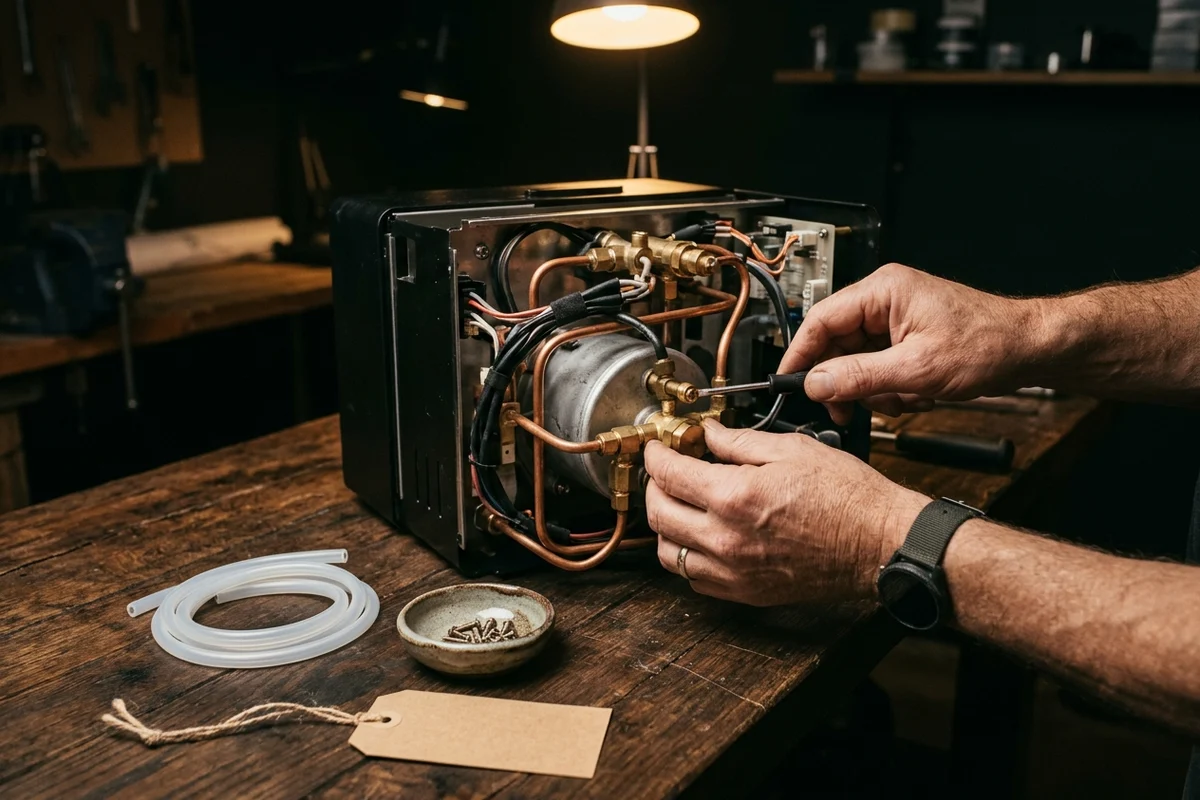
Where a repair is subsidised, coffee machines are what people bring. Austria’s repair bonus covers half the cost of a repair, up to 130 euros, and in the first weeks of its 2026 scheme coffee machines led the list: 10,461 vouchers between 12 January and 26 March, ahead of washing machines.
When the repair is worth paying for
The ranking pages give rules like “replace it if the repair costs more than 40% of a new one,” or 50%. None cites a source. Stiftung Warentest worked one out for fully automatic machines, and it depends on age: in the first four years, spend at most half the purchase price on a repair; the older the machine, the less; from the seventh year, at most 20%.
Its worked example: an 810-euro machine that fails three times in ten years, at an average of 118 euros a repair, costs less to repair each time than to replace at the first fault. By my arithmetic that is 1,164 euros over ten years against about 1,620 for two machines. The testers add that the environmental case is stronger still, because a fully automatic machine carries about 600 grams of electronics.
Will the parts exist?
This is the question to ask before you buy, because it is the one that ends machines. The makers Stiftung Warentest asked kept parts for five to ten years, Miele for fifteen, and when the testers went looking for important parts for a ten-year-old model, they found them for every brand but Melitta. Third-party parts can cost a fraction of the original: an AEG pump that cost about 182 euros from AEG was just under 19 euros from an online third-party seller.
Other commitments, where makers have written them down:
- De’Longhi France, in its 2026 warranty terms, keeps spare parts for “0 an, 2 ans ou 10 ans (selon la catégorie et le modèle)” — zero, two or ten years, depending on the category and the model. I found no published figure for De’Longhi in the US.
- Krups commits to spare parts for up to 15 years, according to Which?.
- Sage, Breville’s name in the UK, gives a two-year guarantee and, Which? reports, “does not offer repairs outside the guarantee period,” though it sells parts on its website. I could not find Breville’s out-of-warranty repair policy for the US.
- The law does not help yet. The EU’s 2024 right-to-repair directive obliges makers to repair after the legal guarantee only for the product groups in its Annex II — washing machines, dishwashers, fridges, vacuum cleaners, phones and a handful of others. Coffee machines are not on the list.
How often should you service an espresso machine?
Less often than the ranking pages say, if it is a home machine. The schedules that turn up in this search — a professional service every six months, a new group gasket every three — are café schedules, from a commercial service company and a 2015 guide to café maintenance, for machines that pull hundreds of shots a day. The makers of home machines write something different:
| Machine | What its maker schedules |
|---|---|
| La Marzocco Linea Micra | Every year: check or replace the group gasket, shower screen and baskets; check for leaks, brewing pressure, flow rate and the expansion valve. Every two years: vacuum breaker, solenoid and check valves, auto-fill probe, a steam-valve rebuild kit. Every four years: wiring; new safety and expansion valves; boilers taken out for descaling if needed |
| La Marzocco (Australia) | “You are required to service your machine every 12 months. This is vital to maintaining your factory warranty.” |
| ECM (E61, dual boiler) | Group cleaning with detergent every 90–140 cups; a scaled machine goes to a qualified technician |
| Breville | No interval for the group seal: “Over time, the silicone seal surrounding the shower screen will need to be replaced”; a new water filter every 2 months; cleaning and descaling when the machine asks |
| Gaggia | Replace the group gasket when wear makes it leak; no interval |
| Philips and Saeco (fully automatic) | Grease the brew group every 4 months at 1–5 coffees a day, every 2 months at 6–10, monthly above 10 |
| Jura (fully automatic) | A new filter “after 50 litres of water has passed through or after 2 months”; a new milk pipe every 3 months |
Two things stand out. La Marzocco’s list, the most detailed one I found from any maker of home machines, asks only for checks in the first year; the parts it replaces as a matter of course come at year four. And it starts with the water: the first line of the form is a sample “taken at inlet,” with its hardness, alkalinity, pH and chlorides written down before anything is opened.
The other is that most of the work belongs to the owner, weekly and monthly: the cleaning cycle or backflush, the filter, descaling where the maker asks for it. Which product, how and how often is covered in the piece on descaling an espresso machine.
Signs it needs a new seal or a technician
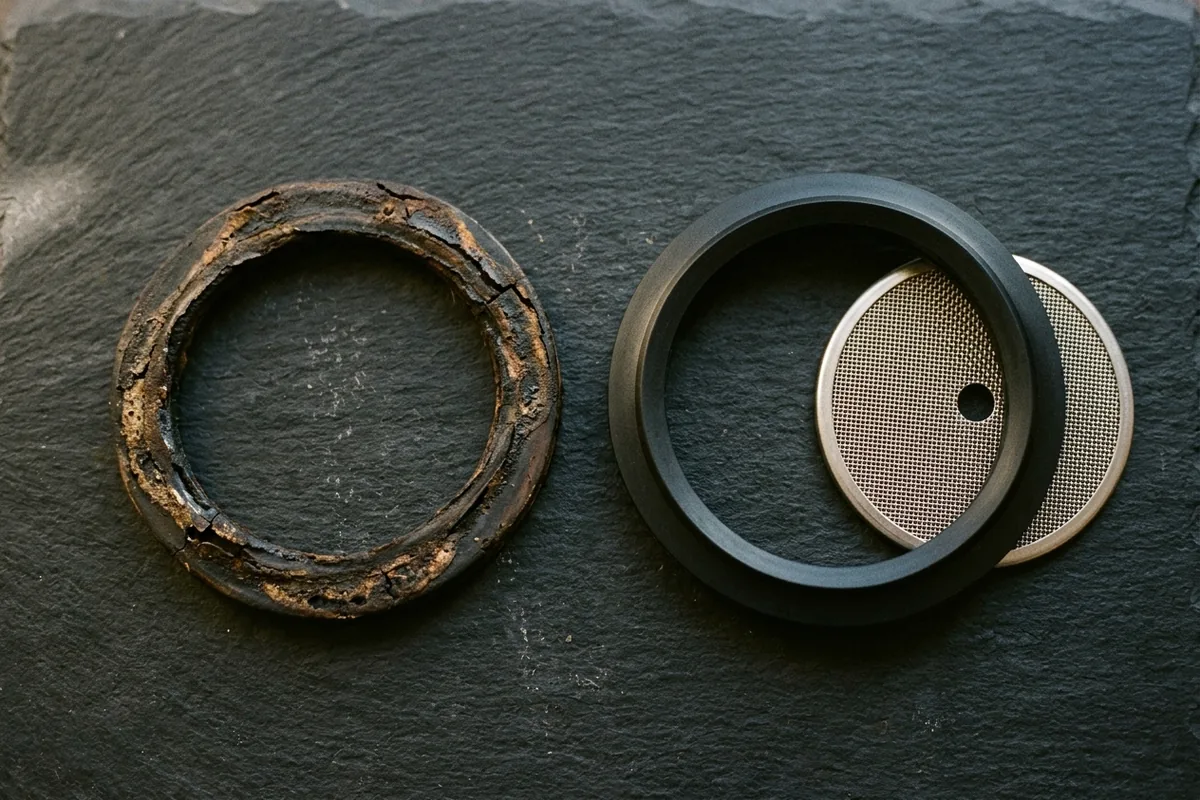
- Coffee runs out around the edge of the portafilter, or the handle locks further round than it used to. That is usually the group seal. Breville’s troubleshooting table lists, among the causes of espresso running round the edge, that “The silicone seal surrounding the shower screen needs to be replaced to ensure the portafilter is properly secured into the group head.” It is a cheap part, and Breville, Gaggia and ECM all print the steps for owners.
- The flow slows and shots run cooler. Usually scale. Descale on the manual’s terms before calling anyone.
- Nothing comes out. The most common fault in Which?’s survey. Clean a blocked basket or shower screen first; if that does not fix it, the pump is the usual suspect — it is what Stiftung Warentest’s workshops replace when coffee barely runs.
- Water under the machine. The second most common fault for Which?, and the fault most often named in the repair notes. Empty the drip tray before anything else: Which? points out that a full one can pass for a leak.
- It trips the breaker, smells of burning or gives you a tingle. Unplug it and stop using it. That one is not an owner’s job.
Water is written into the warranty
Several ranking pages say regular descaling extends a machine’s life by 50 to 100%, or that hard water halves it. I found no source for any of those percentages. What I did find is more useful: four warranties that name scale, or the descaling that prevents it, as something they will not pay for.
| Warranty | What it says |
|---|---|
| La Marzocco Home (US) | “Using water outside the La Marzocco specifications is the most common reason for machine and parts failure.” Excludes “Problems relating to water damage, poor water quality and scaling” |
| Rancilio’s US importer | “The warranty will not cover any repairs if our technicians find limescale in your machine.” |
| Jura (US) | Excludes “Damage caused by neglecting and omitting maintenance, cleaning and decalcifying cycles” |
| De’Longhi (France, 2026) | Excludes “Les pannes liées à l’entartrage ou à l’usage de produits détartrants non autorisés” — faults caused by scale, or by unauthorised descalers |
A warranty is the one document in which a maker puts its own money behind a claim about what kills its machines, and on this question they agree. Which?’s scientist Jacob Compton says the same from the repair side: “Repairing a coffee machine usually starts with descaling, as mineral build-up is the leading cause of poor performance.”
Rancilio’s importer adds a caution that runs the other way. Descalers, it says, “can cause wear and tear on components inside an espresso machine,” gaskets and o-rings among them, so it prefers keeping scale out to taking it out. Descaling is the cure; the water is the prevention.
So the cheapest maintenance a machine gets happens before the water reaches the tank. Find out your water’s hardness — from your utility’s annual report, or with a drop-titration kit such as the API GH & KH, which is sold for aquariums — and keep it inside your machine maker’s figure; La Marzocco’s is 70–100 ppm. The piece on the SCA water standard covers which two numbers matter and why a TDS meter reads neither. Owners of that kit, nearly all of them aquarium keepers, rate it 4.7 out of 5; the practical notes in their reviews are that the colour change can be gradual, so one adds a drop more to be sure, and one found that the GH bottle had gone off after two years while the KH bottle still worked.
What I would actually do
Plan for about five years, not for a lifespan. That is when the first repair usually comes, and most of what decides whether the machine lasts beyond it is settled before then.
Before buying, ask about parts. Ask the maker how long it keeps parts for that model and whether it repairs out of warranty. The answers are not always good: in the UK, Sage does not repair after the guarantee; in France, De’Longhi’s answer can be zero years.
Test the water once, and keep it inside the maker’s figure. Scale is the failure the warranties write out of their cover.
Do the owner’s jobs on the manual’s schedule — the cleaning cycle or backflush, the filter, descaling where asked — and skip the café schedule on top.
Replace the group seal when it shows wear, not on a calendar. Coffee round the rim of the portafilter is the signal.
On a prosumer machine, give it a yearly check of the gasket, shower screen, pressure and flow. That is La Marzocco’s first-year list and, in Australia, a condition of its warranty.
When it breaks, use Stiftung Warentest’s rule: up to half the price in the first four years, 20% from the seventh. Try an independent workshop or a repair café, and ask about third-party parts.
Five years is not a verdict on the machine. It is roughly when the first part wears out; what happens next depends on water you can test today and parts you can ask about before you buy.
Sources
Every figure in this piece traces to one of these. Dates are when the source was read — lists and prices move.
- Kaffeevollautomaten: Reparieren lohnt sich (Defekte Haushaltsgeräte: Wann sich eine Reparatur lohnt) Stiftung Warentest, 1 November 2018 'Nach nur fünf Jahren gehen Kaffeevollautomaten im Schnitt kaputt'; 84% repaired by independent workshops; heating 145 €, valves 100 €, pump 110 €; repair at most half the price in years 1–4 and 20% from year 7; ten makers' answers on spare parts, calculated lifespan and warranty. Based on a survey of readers and workshops. Read 24 October 2026
- Open Repair Data, ORDS v0.3, aggregate EEE file (data to the end of July 2026) Open Repair Alliance, October 2026, CC BY-SA 4.0 416,282 records of electrical items; 24,651 in the 'Coffee maker' category. Outcome shares, the median age (9,688 records with an age), end-of-life reasons and the fault-word counts in this piece are my own count of this file, unchanged since 22 October 2026. Read 24 October 2026
- The Rise of Community Repair — UK factsheet (August 2023–July 2024) The Restart Project for the Open Repair Alliance Lowest success rates: DSLRs and video cameras 27%, 'coffee makers (33%)', flat screens 35%. Read 24 October 2026
- Die Nutzungsdauer und Obsoleszenz von Gebrauchsgütern im Zeitalter der Beschleunigung Harald Wieser and Nina Tröger, Arbeiterkammer Wien, May 2015 (ISBN 978-3-7063-0563-1) Online survey of 1,009 people in Austria plus home visits. Coffee machines: used for 4.9 years (N=630, Figure 7, p. 38); desired lifespan 8.7 years (N=993, Figure 10, p. 42). Both read from the charts. Read 24 October 2026
- Ecodesign preparatory study, Lot 25 — Non-tertiary coffee machines, Task 3: Consumer behaviour and local infrastructure BIO Intelligence Service for the European Commission, July 2011 Table 3-5, economic product life: drip filter 6 years, pad 7, hard-capsule espresso 7, semi-automatic espresso 7, fully automatic espresso 10. 'Most defects concern sealing, tubes, brewing unit, dirt, calcification, blockage and electronic faults.' Read 24 October 2026
- Preparatory study for the Ecodesign and Energy Labelling Working Plan 2020–2024, Task 3: Preliminary analysis of product groups Viegand Maagøe, Oeko-Institut and VHK for the European Commission, April 2021 Section 11.3.3, coffee machines: 'No current lifetime data detailed for the different coffee machine technologies is publicly available'; an industry stakeholder suggested seven years for fully automatic machines. Read 24 October 2026
- Australia's most reliable coffee machine brands CHOICE, 18 June 2019 Survey of 3,626 members, machines bought 2011–2018: 'Of the people who bought an espresso machine in the last 8 years, 65% have never experienced an issue.' Breville (auto/manual) reliability 81% (455 machines); average 82%. Read 24 October 2026
- Which coffee machine brand is the most reliable? Which?, updated 17 September 2026 Most common faults among 4,000+ owners: dispensing coffee 20% of faulty products, leaks 19%, cracked or damaged body 8%. Krups: spare parts 'for up to 15 years'. Sage: two-year guarantee, 'does not offer repairs outside the guarantee period'. Read 24 October 2026
- How we test espresso machines Consumer NZ, June 2026 'It's reasonable to expect a new appliance to remain fault-free for at least the first five years'; 2025 reliability survey of 1,426 espresso machine owners. Read 24 October 2026
- Most and Least Reliable Coffee Makers Consumer Reports, 26 March 2022 (Yahoo syndication) Reliability survey of 130,000 drip and pod coffee makers bought 2013–2021; espresso machines are not included. Read 24 October 2026
- Linea Micra preventative maintenance checklist La Marzocco Home (USA) Water sample 'taken at inlet' first; 1-year, 2-year and 4-year maintenance steps, ending with 'Check the condition of boilers and, if necessary, take them out for proper descaling.' Read 24 October 2026
- Warranty La Marzocco Home (USA) Linea Micra 12 months, Linea Mini 24 months; gaskets and other normal-wear parts excluded; 'Using water outside the La Marzocco specifications is the most common reason for machine and parts failure.' Read 24 October 2026
- La Marzocco Home — FAQ document La Marzocco Australia, April 2026 'You are required to service your machine every 12 months. This is vital to maintaining your factory warranty.' Read 24 October 2026
- SYNCHRONIKA II User Manual (02-2024) ECM Manufacture (copy hosted by a retailer) Group cleaning with detergent every 90–140 cups; a calcified machine to be descaled only by a qualified technician; steps for changing the group gasket and shower screen. Read 24 October 2026
- the Barista Express Instruction Book (BES870) Breville USA 'Over time, the silicone seal surrounding the shower screen will need to be replaced'; for espresso running out around the edge of the portafilter, 'The silicone seal surrounding the shower screen needs to be replaced to ensure the portafilter is properly secured into the group head.' Read 24 October 2026
- Espresso machine problems and how to fix them · Two Year Limited Product Warranty (BES920) Breville USA 'Our espresso makers are backed by two-year warranties.' Breville also publishes a one-year limited warranty text; the term is on each product's page. Read 24 October 2026
- How to lubricate the brew group of my Philips Espresso Machine Philips USA support 'If you brew 1 to 5 coffees a day, lubricate every 4 months'; every 2 months at 6 to 10; 'once a month' above 10. Read in a browser; the page loads its text with JavaScript. Read 24 October 2026
- Warranty · FAQs about optimum maintenance JURA USA 'two years or up to 6,000 coffee brewings, whichever comes first'; excludes 'Damage caused by neglecting and omitting maintenance, cleaning and decalcifying cycles.' The FAQ (us.jura.com/en/customer-advice/optimum-maintenance/faq): filter after 50 litres or 2 months; milk pipe every 3 months. Read 24 October 2026
- Rancilio Technical Support 1st-line Equipment (Rancilio's US importer) 'The warranty will not cover any repairs if our technicians find limescale in your machine'; descalers 'can cause wear and tear on components inside an espresso machine', including gaskets and o-rings. Read 24 October 2026
- Conditions Générales de Garantie 2026 De'Longhi France Spare parts available for '0 an, 2 ans ou 10 ans (selon la catégorie et le modèle)'; excludes 'Les pannes liées à l'entartrage ou à l'usage de produits détartrants non autorisés'. Read 24 October 2026
- How long my warranty is on my De'Longhi product? · Warranty De'Longhi USA Fully automatic espresso makers 2 years, other products 1 year; the warranty page offers an additional year for registering a coffee machine, 'Some Exclusions Apply.' Read 24 October 2026
- Why Choose Gaggia · Semi Automatic Maintenance Gaggia North America 'All new Gaggia espresso machines and grinders are covered by a one-year parts and labor warranty.' The maintenance page (gaggia-na.com/pages/semi-automatic-maintenance): a worn group gasket 'can lead to leaking' and must be replaced; no interval given. Read 24 October 2026
- Directive (EU) 2024/1799 on common rules promoting the repair of goods — Article 5 and Annex II Official Journal of the European Union, 10 July 2024 The obligation to repair after the legal guarantee applies to the product groups in Annex II; coffee machines are not among them. Read 22 October 2026
- Geräte-Retter-Prämie: Run auf neuen Reparaturbonus APA / vienna.at, 31 March 2026 Vouchers cover 50% of the repair cost, up to 130 euros. 12 January to 26 March 2026: coffee machines 10,461, washing machines 9,181, dishwashers 8,654. Read 24 October 2026
- API GH & KH Test Kit API (Mars Fishcare); Amazon listing B003SNCHMA Drop-titration kit for general and carbonate hardness, sold for aquariums. Amazon listing re-read on this date: 4.7 out of 5 from 5,989 ratings. Read 24 October 2026