
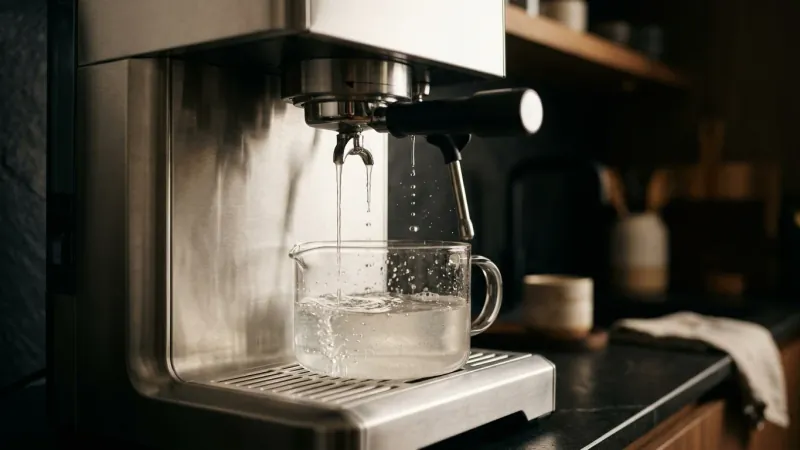
To descale an espresso machine, use the descaler your machine’s manual names, run it through the machine’s descale programme — or through the group, the steam wand and the hot-water outlet in turn — and then rinse more than the manual tells you to. Whether that descaler can be vinegar or citric acid is not a matter of taste. The makers have written it down, and they disagree: BUNN tells you to pour a quart of white vinegar into its brewers, Nespresso says vinegar “may cause damage” to its machines, and Philips forbids sulfamic acid, which makes up 10–30% of Breville’s own descaling powder. Cafiza, the third name people search with, is not a descaler at all. It is an alkaline detergent for coffee oil, and it does nothing to scale.
Three findings run under the rest of this piece, and none of the pages that rank for this question gives the evidence for them. Citric acid leaves a calcium salt that dissolves at under a gram per litre of water, against about 300 grams for vinegar’s — one reason the strength of a home-mixed citric solution matters, and Moccamaster accepts measured citric-acid descalers but not citric acid you mix yourself. A seal maker’s compatibility tables rate citric acid satisfactory for all four common seal rubbers and vinegar doubtful for two of them. And Germany’s Federal Institute for Risk Assessment found that some portafilter espresso machines released lead and nickel after descaling, so the rinse is not the formality it looks like.
Below: the two jobs and why one product cannot do both, what each maker tells you to use, what is actually in the bottles, what the chemistry says about vinegar, citric and lactic acid, how to descale each Breville espresso machine, what changes for drip, pod and high-end machines, why the rinse matters, how often to do any of it, and when backflushing helps and when it wears the group out.
Affiliate links. Some links below go to Amazon. If you buy through one I earn a commission at no extra cost to you, and it never changes which product gets named or what the measurements say. Full disclosure.
Two jobs: scale and coffee oil
Most of the confusion in this search comes from treating two problems as one. Products do not help: one descaler on this search is sold as a “Descaler & Cleaner”, and an Amazon reviewer praises a backflush detergent for its descaling.
| Scale | Coffee oil and fines | |
|---|---|---|
| What it is | Calcium and magnesium carbonate left by heated water | Oil and fine grounds from every shot |
| Where it builds | Heating element, boiler, thermoblock, valves, narrow water lines | Shower screen, group head, three-way valve, baskets |
| What removes it | An acid | An alkaline detergent |
| What sets the schedule | Your water’s hardness | How many shots you pull |
| What you notice | Slower flow, cooler brew, weaker steam | Bitter, stale-tasting shots; oil on the screen |
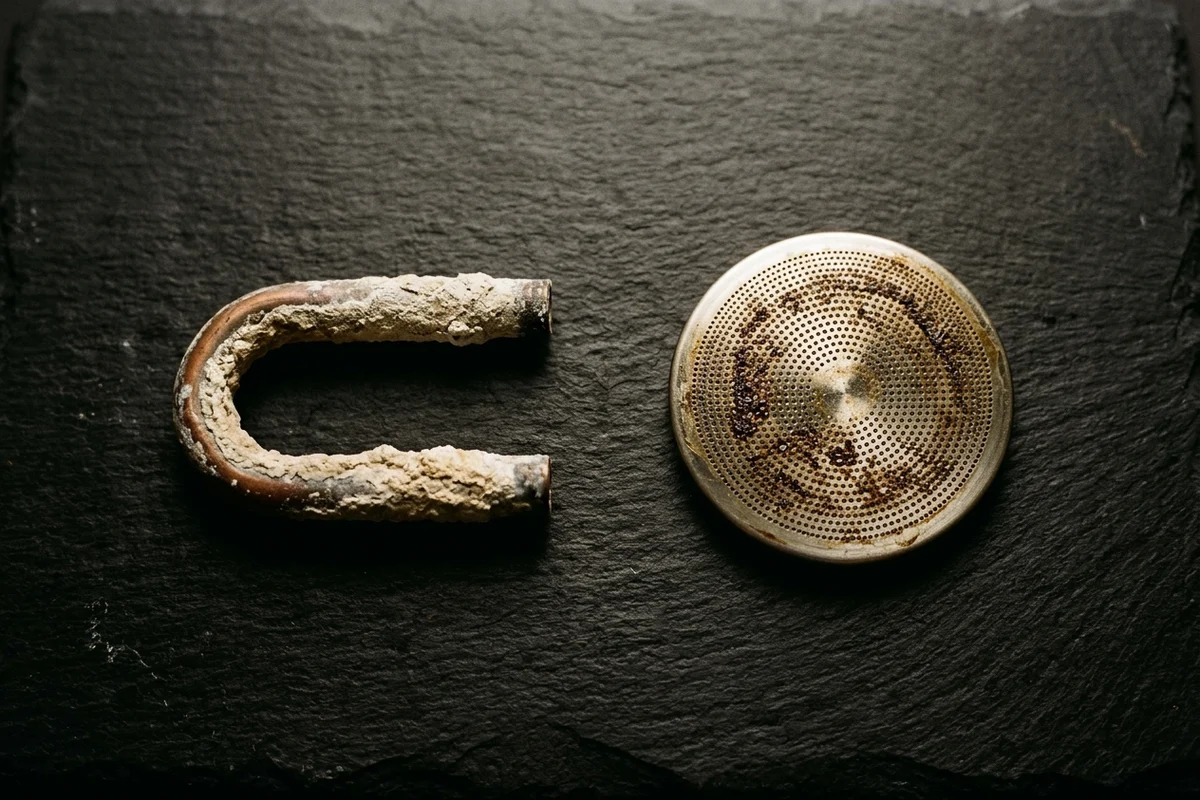
Scale is what heated water leaves behind. In Philips’ words, when water is heated the calcium and magnesium in it “break down and precipitate to form limescale,” and in the places “where the water sits still for a while, such as the boiler, scale builds up.” It slows the flow, and three makers say in writing that it lowers the brewing temperature — the subject of the piece on coffee makers that run cool.
Coffee oil is a different substance in a different place. Backflush detergents are built for it, and Cafiza is the best known of them. Urnex’s safety data sheet for the powder lists sodium percarbonate at 10–30% and a pH of 11 to 11.5 in a 10% solution: strongly alkaline, which is what lifts oil and the brown residue behind a shower screen. Pushed through a descaling cycle, it would leave scale exactly where it was. One Amazon reviewer, praising it in all sincerity, wrote: “My machine needs descaling quite often. This product works well.” It works well — at the other job.
So a machine needs both, and on different calendars. The rest of this piece is mostly about the acid, with backflushing at the end.
What your machine’s maker tells you to use
The pages that rank for this question argue about vinegar against citric acid as if the answer were the same for every machine. The makers’ own instructions show it is not. These are their words, from their manuals and support pages:
| Machine | What its maker says to descale with | Vinegar? |
|---|---|---|
| BUNN (drip, hot-tank) | “1 quart (32oz) of white vinegar”, left in the brewer “for at least 2 hours”, then fresh water three or more times | Yes, prescribed |
| Ninja CE251 (drip) | A coffee-maker descaling solution, or 16 oz of white vinegar topped up with water | Yes — “Use only white vinegar” |
| Keurig K-Elite (pod) | A whole bottle of Keurig Descaling Solution plus a bottle of water | Not mentioned |
| Moccamaster (drip) | Urnex BioCaf or Dezcal; not pure citric acid, because “An incorrect concentration … could damage the brewer” | No — “We do not recommend descaling with vinegar” |
| Breville espresso machines | “one Breville Descaling powder sachet into 34 fl. oz (1L) of water” | Not in any of five instruction books |
| Nespresso | The Nespresso Descaling Kit | No — “Other solutions (such as vinegar or store-bought descalers) may cause damage” |
| De’Longhi Dedica | “use the De’Longhi descaler only” | No — unsuitable descalers “may result in faults not covered by the manufacturer’s guarantee” |
| KitchenAid espresso | “Only use descaling solution intended for Espresso Machines” | Implicitly no |
| Philips / Saeco | Only CA6700 or CA6701; “Never use descaling agents based on … sulfamic acid” | Not addressed on that page |
| ECM (E61, dual boiler) | Water no harder than 4 °dH; “A calcified machine should only be descaled by a qualified technician” | — |
| La Marzocco (home) | Water within its specification; boilers inspected and, if needed, descaled at service | — |
The pattern is consistent. The makers who prescribe vinegar build simple drip brewers. The makers who forbid it build machines with pumps, seals and narrow passages — and Moccamaster, which rules out home-mixed citric acid too. At the top of the price range the question stops being which acid and becomes why the machine scaled in the first place.
Breville is the odd one out, because it contradicts itself. None of the five espresso instruction books I read — for the BES870, BES500, BES878, BES880 and BES920, from the Barista Express to the Dual Boiler — contains the word vinegar; every one lists Breville’s descaling powder among its accessories or in its descale steps. Breville’s own US blog, under a heading about deep cleaning, says: “If using vinegar use 1 part water to 1 part vinegar.” Its sources are a storage company’s blog and a coffee affiliate site. When the blog and the manual disagree, the manual is the document that comes with your warranty.
What is actually in a descaler
None of the ranking pages says what is in the bottle, which is a shame, because the makers publish it. Each descaler has a safety data sheet, and the composition is in section 3:
| Maker | Product | Acids, as the safety data sheet gives them | pH |
|---|---|---|---|
| Breville | the Descaler (BES007) | Malic 30–60% · sulfamic 10–30% · citric 1–10% | 2.1 (1% solution) |
| De’Longhi | EcoDecalk, now sold as Decalk Care | Lactic 30–50% | 2.5–2.8 |
| Nespresso | Descaling Agent (European sheet) | Lactic 30–50% · a phosphonate 1–5% | 2.0–2.2 |
| Urnex | Dezcal powder | Citric 30–60% · sulfamic 1–5% | — |
| Urnex | Dezcal Liquid | Sulfamic 10–30% | — |
| Urnex | Biocaf powder | Citric 80–100% | 2–3 (1% solution) |
| Jura, Nivona, Siemens | Their own tablets and liquids | Sulfamic, per Stiftung Warentest’s survey | — |
| Supermarket | White vinegar | Acetic, at least 4% under FDA policy | — |
Two things follow. First, “commercial descaler” does not mean one chemistry: Breville’s is mostly malic and sulfamic acid, De’Longhi’s and Nespresso’s are lactic, Urnex’s are citric with or without sulfamic. Second, the makers contradict each other about one of them. Philips tells Saeco owners never to use a descaler “based on mineral acids such as sulfuric acid, hydrochloric acid and sulfamic acid,” because it “may damage your coffee machine’s pipe and tube system.” Breville puts 10–30% sulfamic acid in its own powder, and Jura, Nivona and Siemens recommend sulfamic-acid products for their machines. Germany’s consumer testers, Stiftung Warentest, found De’Longhi, Krups, Melitta, Philips, Saeco and WMF recommending lactic or citric acid instead, and both they and the consumer advice centre of North Rhine-Westphalia point out that sulfamic acid passes through sewage treatment and turns up in drinking water.
That is also why the “universally compatible” claims on descaler listings deserve a second look. Urnex’s Amazon listing names Keurig, Nespresso, Breville, Jura and De’Longhi; De’Longhi’s names Breville, Ninja and Philips. Nespresso and De’Longhi themselves accept no other brand. The label on the descaler does not overrule the manual of the machine.
Vinegar, citric acid, lactic acid: what the chemistry says
Strength is not the problem
Vinegar is the weakest acid on the list — acetic acid’s pKa is 4.76, against 3.86 for lactic acid, about 3 for citric and about 1 for sulfamic, by PubChem’s figures — so it works more slowly. But it is not short of capacity. On paper, a gram of acetic acid can dissolve 0.83 g of calcium carbonate; a gram of citric acid 0.78 g; lactic acid 0.56 g. A litre of 5% vinegar could in principle dissolve about 40 g of calcium carbonate. Those figures are my stoichiometry, not a test, and they say nothing about speed. Urnex’s listing says its powder is “more effective at removing limescale than vinegar” and “works faster”; I found no controlled comparison behind that, in either direction.
What separates the acids is what they leave behind and what they do to the machine.
Citric acid’s own deposit
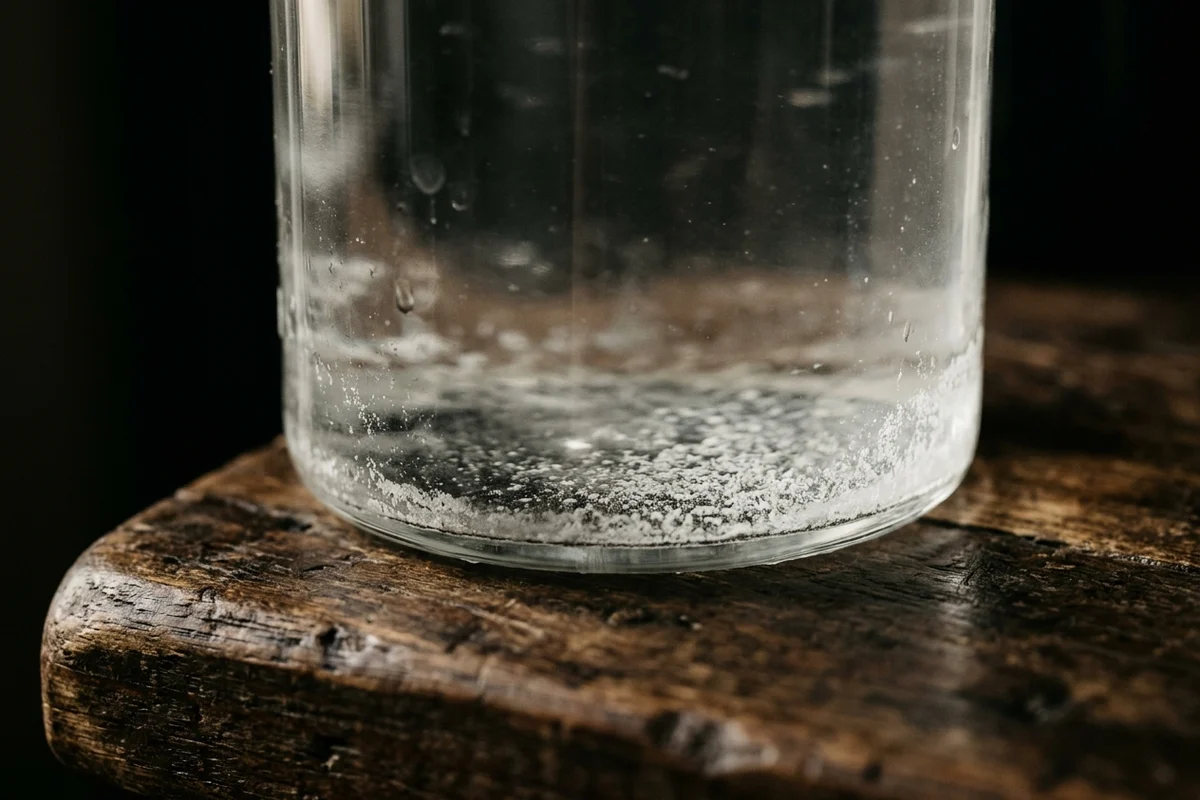
When an acid dissolves scale, the calcium does not disappear; it becomes a salt of that acid. For vinegar the salt is calcium acetate, which is extremely soluble: 374 g per litre at 0 °C and still 297 g at 100 °C. For citric acid it is calcium citrate, which dissolves at 0.85–0.96 g per litre at room temperature — some three hundred to four hundred times less.
Two studies explain when that matters. A 2016 study from the University of Copenhagen found that the common form, calcium citrate tetrahydrate, becomes less soluble as the water warms. And oil-industry research on dissolving limestone with citric acid found that calcium citrate precipitates once the solution’s pH rises to about 3 — as the acid gets used up — and forms a layer on the surface that slows further dissolving. Applying both to a coffee machine is my inference, not a test of one, but the picture is consistent: the risk is a spent solution — too little acid for the amount of scale — left hot and left long. A fresh, generous citric solution holds the calcium in solution.
That is the chemistry behind Moccamaster’s refusal of pure citric acid — “An incorrect concentration may not remove scale effectively and could damage the brewer” — while it approves Urnex’s measured citric-acid powders. It also fits the North Rhine-Westphalia consumer advice centre’s rule that acids should stay in a coffee machine only as long as descaling needs — “nicht über Nacht,” not overnight. One affiliate page in this search says citric acid “can create a different kind of build-up”; that is true, and calcium citrate is the build-up.
Seals: one engineering table
Nearly every page says vinegar damages rubber seals, and none gives a source. The nearest thing to evidence is the compatibility tables in the Parker O-Ring Handbook, the engineering reference published by Parker Hannifin’s O-ring division. Its ratings for four common seal rubbers:
| Liquid | Nitrile (NBR) | EPDM | Fluorocarbon (FKM) | Silicone |
|---|---|---|---|---|
| Acetic acid, 5% | Fair | Satisfactory | Satisfactory | Satisfactory |
| Vinegar | Fair | Fair | Doubtful | Doubtful |
| Citric acid | Satisfactory | Satisfactory | Satisfactory | Satisfactory |
| Lactic acid, cold | Satisfactory | Satisfactory | Satisfactory | Satisfactory |
| Lactic acid, hot | Unsatisfactory | Unsatisfactory | Satisfactory | Fair |
| Sulfamic acid | Doubtful | Satisfactory | Doubtful | Fair |
Parker’s own caveat applies — “ALWAYS TEST UNDER ACTUAL SERVICE CONDITIONS” — and I do not know which rubber any particular machine uses. But the table points the same way as the makers who ban vinegar: of the common descaling acids, vinegar is the one a seal maker is least sure about, and citric acid the one it is most comfortable with.
How to descale a Breville espresso machine
Every Breville espresso machine I checked has a descale programme, and the instruction books point to the same product: one sachet of Breville’s descaling powder, the BES007, dissolved in a litre of water, with the water filter taken out of the tank first. Breville sold a pack of four for $14.95 on its own site on 14 October 2026, out of stock that day. The steps differ by model:
| Model | Entering descale mode | What happens | Notes from the manual |
|---|---|---|---|
| BES870 Barista Express | Machine off: hold 2 CUP, then POWER. POWER flashes while it heats; ready when POWER, 1 CUP, CLEAN/DESCALE and HOT WATER/STEAM stay lit | 1 CUP runs the coffee path (about 25 s); steam dial right for steam (about 13 s), left for hot water (about 8 s); repeat until the tank is empty, then repeat with a full 2 L tank of fresh water; POWER to exit | Never remove or empty the tank mid-cycle; the machine turns off after 5 minutes without input |
| BES500 Bambino Plus | Turn off with 1 CUP + STEAM, let it cool, then hold 1 CUP + STEAM for 5 seconds | Fill to the DESCALE line and add the descaler; a 2 L container under the group and wand; when the solution runs out, refill to MAX and empty the waste container to finish | — |
| BES878 Barista Pro | MENU → DESCALE with the GRIND AMOUNT dial, then 1 CUP | Three stages — coffee, hot water, steam — turning the steam dial when the screen says, then an automatic rinse cycle | Filter every 2 months |
| BES920 Dual Boiler | Machine off and cool for an hour: hold 1 CUP + POWER for 3 s, choose dESC | Drain both boilers through the two screws behind the DESCALE ACCESS cover; fill with solution; the machine fills and heats the boilers; drain; flush with fresh water for 20 minutes; drain and flush again | About 1.5 hours in all; do not overtighten the drain screws |
Two details trip people up. On the Barista Express the CLEAN/DESCALE light means two different things: flashing is a cleaning cycle — coffee oil, with a tablet, covered at the end of this piece — and solid is descaling. And the Dual Boiler is the one Breville manual that allows another product: “if an alternative cleaning solution is used, please follow the manufacturer’s instructions accordingly.” The others name only Breville’s.
Buyers rate the BES007 4.8 out of 5 on Amazon, and the most useful comment is about time rather than chemistry: “Four packets means roughly a year of maintenance if you descale quarterly.”
Drip, pod and high-end machines
A drip brewer whose manual says vinegar. Do it the maker’s way, and only with white vinegar. BUNN’s deliming uses a full quart and two hours; Ninja’s uses 16 oz topped up with water. NSF, the public-health standards body, describes the common method for a reservoir brewer — after telling you to follow the maker’s instructions first: up to four cups of undiluted vinegar, 30 minutes, then two or three cycles of fresh water. Rinse until you cannot smell it. One Amazon reviewer of a branded descaler said it plainly: “if you have a basic drip I’d just stick with vinegar.”
Moccamaster. No vinegar and no home-mixed citric acid; Urnex’s Dezcal or Biocaf every 100 brews.
Capsule and pod machines. Use the maker’s kit. Nespresso’s European safety sheet gives lactic acid, and its US guide says “every 3 months or 300 capsules (whichever comes first).” Keurig’s manual specifies Keurig Descaling Solution every three to six months.
De’Longhi. The company’s US support page is explicit — “use the De’Longhi descaler only” — and its descaler is the lactic-acid EcoDecalk, now sold as Decalk Care: 100 ml per descale, a 500 ml bottle for $19.95 on De’Longhi’s site on 14 October 2026. Amazon buyers rate it 4.7 out of 5, and a frequent complaint is practical — “No instructions in English,” with reviewers finding only other languages on the bottle. So: 100 ml in the tank, then the machine’s own descale function.
E61, heat-exchanger and dual-boiler machines. Here the advice reverses. ECM asks for water “with a hardness level of up to 4° dH” and says “A calcified machine should only be descaled by a qualified technician … as it may require partial disassembly of the boiler and tubing to prevent clogging of the entire system by limescale residues.” La Marzocco does not ask owners to descale at all: it specifies water at 70–100 ppm hardness, tells owners to drain the steam boiler every two months, inspects the boilers at service, and excludes “Problems relating to water damage, poor water quality and scaling” from its warranty. Clive Coffee, which sells several of these brands, tells customers to use soft water instead and to have a professional descale if it is ever needed. The reason is in ECM’s sentence: scale that breaks off a boiler wall in flakes goes looking for the smallest hole in the machine. Scale is also what several makers’ warranties refuse to pay for, which is part of how long an espresso machine lasts and when it needs a technician.
After descaling: rinse twice what the manual says
In 2013 the German Federal Institute for Risk Assessment (BfR) tested eight new coffee machines — three portafilter espresso machines, three pod machines and two capsule machines — for metals in the water, on three days before and three days after descaling with the agent and procedure each maker’s manual specifies. The published study is blunt: “After decalcification a large increase in the amounts of elements released was encountered,” and “By far the highest leaching … was found for the portafilter machines,” with lead, nickel, manganese, chromium and zinc within and beyond the limits the Council of Europe proposes. One of the three portafilter machines released far less than the others, which the authors read as proof that high release is “technically avoidable.”
The BfR’s advice to owners is specific: “The rinsing steps specified by the manufacturer should be repeated,” and on ordinary days, run a water-only rinse before the first coffee. It does not name the machines, and it calls its sample too small to be representative. Other tests point the same way without making it universal: Stiftung Warentest found increased lead from two of seven portafilter machines in 2021, while a Danish study of coffee machines in 2000 found no significant release at all.
None of that is a reason not to descale. It is a reason to treat the rinse as part of the job:
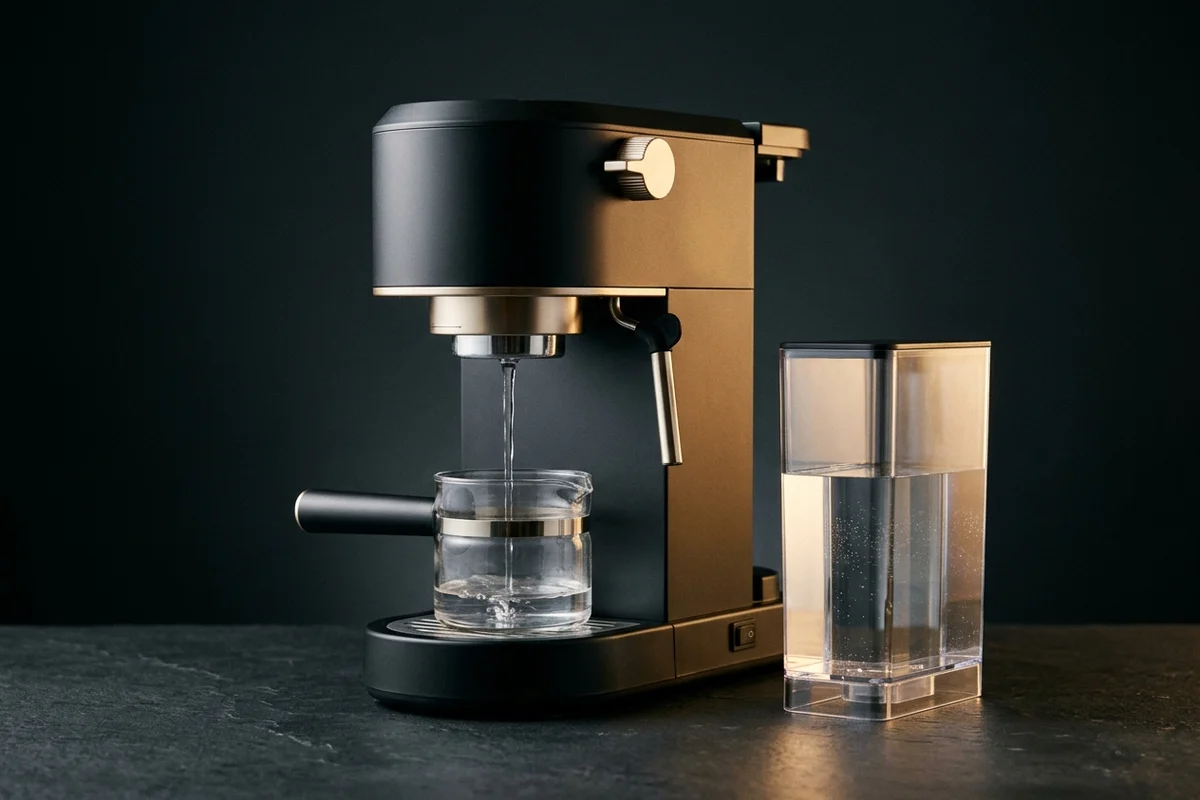
- Do the manual’s rinse twice. On a Barista Express that means two full 2 L tanks through all three paths; Urnex’s own directions already ask for three tanks.
- Throw away the first shots after descaling a portafilter machine.
- Check for leftover acid. Gaggia’s maintenance page suggests a baking-soda test: if water from the machine fizzes with baking soda, acid is still there. That tests for acid, not for metal, which is why the second rinse comes first.
How often to descale
As often as your water makes scale, which is why the makers tie it to a hardness setting or a warning light rather than a date. Their stated defaults:
| Maker | Interval it gives |
|---|---|
| Nespresso | Every 3 months or 300 capsules |
| Keurig | Every 3–6 months |
| BUNN | Every 3 months; twice a month in very hard water |
| Moccamaster | Every 100 brews |
| De’Longhi | About every 3 months in an average household; the Dedica warns you, based on the hardness you set |
| Breville | When CLEAN/DESCALE stays lit; a new water filter every 2 months “will reduce the need to de-scale” |
| ECM, La Marzocco | Not routinely — keep the water within specification |
The number that sets all of these is your water’s hardness. The U.S. Geological Survey calls 0–60 mg/L as calcium carbonate soft, 61–120 moderately hard, 121–180 hard and anything above very hard. Machine makers want less than brewing guides allow: the SCA’s brewing range goes up to 175 ppm, as the piece on the SCA water standard explains, while La Marzocco asks for 70–100 ppm and ECM’s 4 °dH works out to about 71 ppm. Water that tastes fine can still be harder than your boiler wants. Breville’s Barista Touch manual goes as far as telling owners whose water tests at level 4 or 5 to “change to an alternate water source.”
To find out where you stand, ask your water utility for its annual report or test it: an aquarium titration kit such as the API GH & KH measures hardness and alkalinity in a few minutes. Do not swing to the other extreme. Breville says never to use distilled water, and La Marzocco says water with too little mineral content can damage parts “through leaching.”
Backflushing: the other job
Backflushing pushes water — and, now and then, detergent — backwards through the shower screen and out through the three-way solenoid valve that relieves pressure after a shot. That valve is the precondition. Clive Coffee puts it bluntly: machines “with pressurized portafilters and no solenoid valve should never be backflushed.” If your manual has no backflush procedure, do not invent one.
Breville machines have a cleaning cycle instead: the grey silicone disc in the single basket, one BEC250 tablet on top, and the machine runs its own programme when the CLEAN light flashes. Its Dual Boiler manual also asks for a water-only backflush after each session — 20 seconds, five times. Amazon buyers rate the BEC250 4.8 out of 5, though its review summary notes buyers who received tablets that were not Breville’s; buy from a seller you trust.
Machines with a blind basket, the E61 and its relatives, use powder. Urnex’s directions for Cafiza: up to half a teaspoon (3 g) in the blind basket, ten seconds on and ten off, five times; five more without powder; then pull one shot through a normal basket and pour it away. For portafilters, baskets and the shower screen, soak them in 6 g per litre of hot water for 30 minutes, keeping the portafilter handle out of the water.
How often is where makers disagree, and both are right about their own machines. La Marzocco, writing for cafés, says “backflushing doesn’t harm the machine, so it’s better to do it more frequently.” ECM, writing for home E61 machines, asks for detergent every 90 to 140 cups and warns that cleaning the group with it more often can make it squeak and “will degrease all the moving parts and they will wear out quickly”; better, it says, to clean it from time to time without cleaner. Clive gives E61 owners every one to two months for the same reason — the detergent “strips the lubricant from the E61 assembly.” My reading of the difference, not either maker’s: La Marzocco was writing about café machines cleaned several times a day, ECM and Clive about the greased lever mechanism of an E61 at home.
If a spent puck sticks to the shower screen, the screen is the first thing to clean; the piece on wet pucks covers why.
What I would actually do
Read the manual before buying anything. It names the acid, the dose and the programme, and on most espresso and capsule machines it names one product. That instruction outranks every page in this search, including this one.
If it says white vinegar, use white vinegar — the full strength and time the maker gives, then rinse until the smell is gone.
If it names a descaler, buy that one. For a Breville that is the BES007; for a De’Longhi, the EcoDecalk; for a Nespresso, Nespresso’s kit.
If it names nothing, I would use Urnex’s Dezcal rather than mixing citric acid myself. It is citric acid with a little sulfamic acid, in measured 28 g packets; Moccamaster approves it; and Urnex publishes what is in it. On Amazon it is rated 4.6 out of 5 across more than 9,700 ratings, and the complaints are honest ones: one owner needed “a couple extra rinses” to lose a chemical smell, another thought it “may have caused some scarring on the chrome surfaces.” Rinse as you would after any acid. Do not use it in a Saeco machine, whose maker rules out sulfamic acid.
Rinse twice what the manual says, and pour away the first shots after descaling a portafilter machine.
Measure your water once. The hardness number decides how often you descale; a filter or softer water decides whether you need to descale much at all.
On an E61 or dual-boiler machine, prevent rather than cure. Keep the water inside the maker’s specification, and if it has scaled anyway, follow ECM’s advice and let a technician do it.
Backflush on the manual’s schedule, with water after each session and detergent only as often as the maker says.
Vinegar against citric acid is the question this search asks. The answer that protects the machine was printed before you asked it, in the manual that came in the box.
Sources
Every figure in this piece traces to one of these. Dates are when the source was read — lists and prices move.
- BUNN Speed Brew Coffee Maker — Use & Care Manual BUNN Deliming with '1 quart (32oz) of white vinegar', left in the brewer 'for at least 2 hours', then fresh water 3 or more times; every 3 months, twice a month in very hard water. Read 14 October 2026
- CE251 Owner's Guide Ninja (copy hosted by P.C. Richard & Son) A descaling solution for coffee makers, or 16 oz of white vinegar topped up with water: 'IMPORTANT: Use only white vinegar.' Read 14 October 2026
- Germiest Items in the Home NSF (Internet Archive copy) In NSF's 2011 study of 22 households the coffee reservoir ranked fifth; its suggestion for a drip brewer is up to four cups of undiluted vinegar, 30 minutes, then two or three cycles of fresh water. Read 14 October 2026
- Keurig K-Elite Use & Care Guide Keurig Keurig Descaling Solution, the whole bottle plus a bottle of water; descale every 3–6 months. Read 14 October 2026
- How frequently should I descale and clean my brewer, and what should I use? · Can I use citric acid to descale my Moccamaster? Moccamaster USA support Every 100 brew cycles; Urnex BioCaf and Dezcal; 'We do not recommend descaling with vinegar.' The citric-acid article (articles/4421958258451): pure citric acid not recommended, 'An incorrect concentration may not remove scale effectively and could damage the brewer.' Read 14 October 2026
- the Barista Express Instruction Book (BES870) · Bambino Plus (BES500) · Barista Pro (BES878) · Barista Touch (BES880) · Dual Boiler (BES920) Breville Descale procedures for each model; 'Dissolve one Breville Descaling powder sachet into 34 fl. oz (1L) of water'; filter every 2 months; Dual Boiler about 1.5 hours with both boilers drained. None of the five books mentions vinegar. Read 14 October 2026
- How to Clean an Espresso Machine: A Step by Step Guide Breville (US blog) 'If using vinegar use 1 part water to 1 part vinegar' — under a heading about deep cleaning, citing a storage company's blog and Home Grounds. Read 14 October 2026
- BES007 Breville Descaler — Safety Data Sheet (Revision 1) Breville, 20 September 2023 Malic acid 30–60%, sulfamic acid 10–30%, citric acid 1–10%; pH 2.1 at 1% w/v. Breville sold the four-pack (BES0070NUC1) for $14.95, out of stock, on this date. Read 14 October 2026
- Expert Descaling Guide Nespresso USA 'every 3 months or 300 capsules'; 'Other solutions (such as vinegar or store-bought descalers) may cause damage to your Nespresso machine.' Read 14 October 2026
- Nespresso Descaling Agent NDA-16 — Safety Data Sheet (version 2.0) Nespresso, 7 June 2021 L-(+)-lactic acid 30–50% and a phosphonate (PBTC) 1–5%; pH 2.01–2.15. Read 14 October 2026
- Dedica and Dedica Arte: Descaling and Cleaning FAQ · Decalk Care DLSC500 De'Longhi US 'It is important to use the De'Longhi descaler only. Using an unsuitable descaler and/or performing descaling incorrectly may result in faults not covered by the manufacturer's guarantee.' DLSC500 page: lactic acid of vegetable origin, 100 ml per descale, $19.95 for 500 ml on this date. Read 14 October 2026
- EcoDecalk — Safety Data Sheet (Revision 2) De'Longhi Appliances, 28 October 2016 Lactic acid 30–50%; pH 2.5–2.8. Read 14 October 2026
- Descaling my Saeco espresso machine Philips US support 'only use the Saeco descaler CA6700 or CA6701'; 'Never use descaling agents based on mineral acids such as sulfuric acid, hydrochloric acid and sulfamic acid.' The page's www address now redirects to a product listing. Read 14 October 2026
- Descaling the KitchenAid Espresso Machine KitchenAid Product Help 'IMPORTANT: Only use descaling solution intended for Espresso Machines.' Read 14 October 2026
- Cafiza Espresso Machine Cleaning Powder — product page and Safety Data Sheet (version 2.0) Urnex Brands Backflush with up to 1/2 teaspoon (3 g), 10 seconds on and 10 off, five times, then five more without powder; soak parts at 6 g per litre for 30 minutes. The SDS linked from that page: sodium percarbonate 10–30%, pH 11–11.49 at 10%. Read 14 October 2026
- Coffee and Espresso Machine Descaling Powder · Dezcal Descaler Safety Data Sheet (version 2.0) Urnex Brands One 28 g packet in 32 oz of lukewarm water, a full tank brewed through, then three tanks of fresh water; 'For espresso machines, please follow your machine's descaling instructions.' $9.99 for three packets on this date. Urnex's Dezcal Descaler SDS: citric acid 30–60%, sulfamic acid 1–5%. Read 14 October 2026
- SYNCHRONIKA II User Manual (02-2024) ECM Manufacture (copy hosted by a retailer) Water up to 4 °dH; 'A calcified machine should only be descaled by a qualified technician'; group cleaning every 90–140 cups with 3–5 g of powder; cleaning too often with cleaner 'will degrease all the moving parts'. Read 14 October 2026
- Water for Home Espresso Machines · Warranty · Water Specifications La Marzocco Home (USA) Total hardness 70–100 ppm, alkalinity 40–80; drain the steam boiler every two months; distilled water can damage parts by leaching; the warranty excludes 'Problems relating to water damage, poor water quality and scaling'. Read 14 October 2026
- Kaffeevollautomaten: So entkalken Sie umweltfreundlich Stiftung Warentest, June 2025 Jura, Nivona and Siemens recommend descalers with sulfamic acid; De'Longhi, Krups, Melitta, Philips, Saeco and WMF recommend lactic or citric acid; another maker's descaler may cause damage. Read 14 October 2026
- Umweltbewusst entkalken Verbraucherzentrale NRW Sulfamic acid passes sewage treatment and is found in drinking water; acids should stay in a coffee machine only as long as descaling needs, not overnight. Read 14 October 2026
- Metal release from coffee machines and electric kettles Müller, Hackethal, Schmidt, Kappenstein, Pfaff, Luch — Food Additives & Contaminants: Part A 32(11), 2015 Abstract read (PubMed 26436214). Eight machines tested before and after descaling with the makers' own agents: 'After decalcification a large increase in the amounts of elements released'; portafilter machines released lead, nickel, manganese, chromium and zinc within and beyond the Council of Europe's limits. Read 14 October 2026
- The release of nickel and other trace elements from electric kettles and coffee machines Berg, Petersen, Pedersen, Petersen, Madsen — Food Additives and Contaminants 17(3), 2000 Abstract read (PubMed 10827900). Danish Veterinary and Food Administration: coffee machines 'did not release aluminium, lead, chromium or nickel in quantities of any significance'; ten of 26 kettles released more than 50 µg/l nickel. Read 14 October 2026
- Some portafilter espresso machines release too much lead German Federal Institute for Risk Assessment (BfR), updated 7 May 2025 'After descaling, portafilter espresso machines can release large amounts of lead'; repeat the maker's rinsing steps; Stiftung Warentest found increased lead from two of seven portafilter machines in 2021. Read 14 October 2026
- Aqueous solubility of calcium citrate and interconversion between the tetrahydrate and the hexahydrate Vavrusova and Skibsted — International Dairy Journal 57, 2016 Abstract read: 'Aqueous solubility of calcium citrate tetrahydrate was found to decrease with increasing temperature.' Read 14 October 2026
- Impact of calcium citrate precipitation on the reaction of citric acid–calcite AlKhaldi, Nasr-El-Din and Sarma — AIChE Annual Meeting, 2008 Calcium citrate precipitates at pH near 3.0 and forms a layer on the calcite surface that slows further dissolution. Oil-well acidising research; applying it to a coffee machine is my inference. Read 14 October 2026
- Calcium citrate (CID 13136) · Calcium acetate (CID 6116) — solubility; acid dissociation constants PubChem, U.S. National Library of Medicine Calcium citrate 0.085 and 0.096 g per 100 mL at 18 and 23 °C; calcium acetate 37.4 g per 100 mL at 0 °C and 29.7 g at 100 °C; pKa of acetic acid 4.76, lactic 3.86, citric 2.79 (PubChem's listed value). Read 14 October 2026
- Parker O-Ring Handbook (ORD 5700), Section VII — Compatibility Tables Parker Hannifin (copy hosted by the University of Arizona) Ratings for nitrile, EPDM, fluorocarbon and silicone: Acetic Acid 5% 2/1/1/1; Vinegar 2/2/3/3; Citric Acid 1/1/1/1; Lactic Acid, Cold 1/1/1/1; Lactic Acid, Hot 4/4/1/2; Sulfamic Acid 3/1/3/2 (1 satisfactory, 4 unsatisfactory). 'ALWAYS TEST UNDER ACTUAL SERVICE CONDITIONS.' Read 14 October 2026
- CPG Sec. 525.825 Vinegar, Definitions U.S. Food and Drug Administration Vinegar should contain at least 4 grams of acetic acid per 100 mL. Read 14 October 2026
- Hardness of Water U.S. Geological Survey 0–60 mg/L as calcium carbonate soft, 61–120 moderately hard, 121–180 hard, over 180 very hard. Read 14 October 2026
- Semi Automatic Maintenance Gaggia North America Decalcifying in short runs through the steam arm and group; 'you can use baking soda to test if the acids from the solution are still present in the water.' Read 14 October 2026
- How Often Should You Backflush Your Espresso Machine? Clive Coffee, April 2026 Only machines with a three-way valve can be backflushed; detergent every 1–2 months on E61 groups because it 'strips the lubricant'; soft water instead of routine descaling, and a professional if descaling is needed. Read 14 October 2026
- How to backflush your espresso machine in 5 steps (and why we do it) La Marzocco USA For café machines: 'backflushing doesn't harm the machine, so it's better to do it more frequently'; keep the dispersion screen in place. Read 14 October 2026