
There is no single SCA water standard. There are four documents that have carried the name — an American standard from 2009, a European booklet from 2016, the SCA’s own table from 2018 and a 2021 equipment standard that summarises it — and their numbers do not agree. The tables that rank for this search mix all four, which is why so many of them contradict themselves.
Two numbers survived every version: total hardness, the calcium and magnesium in the water, and alkalinity, its ability to neutralise acid. The figure most people test, total dissolved solids, was dropped from the SCA’s table, and the TDS meter that reads it cannot see either of the two that remain. If the water is going into an espresso machine, the machine’s maker gets the last word on the boiler, and the makers disagree with each other about distilled water.
Below: what each document actually says, why the numbers changed, what the 50–175 range really is, what has and has not been measured about water and taste, how to find your own two numbers for the price of an aquarium test kit, what espresso machine makers specify, and where four popular bottled waters land.
Affiliate links. Some links below go to Amazon. If you buy through one I earn a commission at no extra cost to you, and it never changes which product gets named or what the measurements say. Full disclosure.
The SCA water standard, document by document
Here is each version as its own text gives it. Hardness and alkalinity are in parts per million expressed as calcium carbonate (ppm CaCO3), the unit every one of them uses even when it writes mg/L:
| Document | Hardness | Alkalinity | pH | TDS | Also |
|---|---|---|---|---|---|
| SCAA standard, 2009 — Water for Brewing Specialty Coffee, revised 21 November 2009 | Calcium hardness 68 (4 grains); acceptable 17–85 | 40, “at or near 40” | 7.0; acceptable 6.5–7.5 | 150; acceptable 75–250 | Sodium 10; chlorine 0; clean odour, clear colour |
| SCAE Water Chart, 2016 — Zurich University of Applied Sciences for the European association | Total hardness 50–175 | Near 40; acceptable 40–75 | 6.5–8 | None — “not a meaningful parameter on its own” | Hardness should exceed alkalinity; a narrower zone for espresso machines |
| SCA Coffee Standards, 2018 — §4.1, Water for Brewing Standards | Calcium hardness: target 50–175, acceptable 50–175 | Target 40; acceptable “at or near 40-70” | 7.0; acceptable 6–8 | No row | No sodium row |
| SCA Standard 310-2021 — the test water for certified home brewers | “Calcium hardness equivalent to 50 to 175” | 40–70 | 6–8 | — | Summarises “the current SCA Water standard” |
2009. The American association’s Statistics & Standards Committee set a target and a range for each characteristic, and its definition is worth keeping in mind: “The Target is the most desirable point in the Acceptable Range, although falling within the range is considered meeting the standard.” Its TDS line carries a footnote, “TDS measured based on a 4-4-2 conversion,” which matters later.
2016. The European association funded a team at the Zurich University of Applied Sciences — Marco Wellinger, Samo Smrke and Chahan Yeretzian — to build a new framework. Their booklet, The SCAE Water Chart: Measure, Aim, Treat, reduces water for coffee to two axes, total hardness and alkalinity, and drops TDS as a target. It was funded, the acknowledgements say, by the SCAE, the university “and water companies: Brita Water and BWT water+more.” Both sell water filters.
2018. After what the SCA calls “the unification of the heritage organizations as the SCA,” its Coffee Standards booklet printed a new table. It took the 2016 numbers but called 50–175 “calcium hardness” rather than total hardness, gave it as both the target and the whole acceptable range, and lowered the alkalinity ceiling from 75 to 70. The TDS and sodium rows are gone. The footnote “TDS measured based on 4-4-2 conversion” is still printed underneath, attached to nothing. The table refers readers to the SCA Water Quality Handbook for testing details; that handbook is a paid download, and I have not read it.
2021. Standard 310, which governs the SCA’s certified home brewers, specifies its test water by summarising the 2018 table: calcium hardness 50 to 175, alkalinity 40 to 70, pH 6 to 8.
The label change is not pedantry. Total hardness counts magnesium; calcium hardness does not. A water built mostly on magnesium, which is how some mineral recipes work, can sit inside the 2016 range and outside the 2018 one on the same reading.
Why the tables you find don’t add up
With four documents to draw from, most of the pages that rank for this search assemble a fifth. The 2009 TDS range sits next to the 2018 hardness label, the 2016 alkalinity ceiling and the 2009 pH. A few go further:
- One roaster’s table gives total hardness a target of 50–175 and an acceptable range of 17–85 — a target wider than the range it is supposed to sit inside. It is the 2016 number stacked on the 2009 one.
- One review site says the SCA wants a TDS of 50–175 and a calcium hardness of 40–75. Those are the hardness and alkalinity ranges, each moved one row down.
- An equipment brand lists an SCA “magnesium hardness” of 10–20 ppm. No SCA document has a magnesium figure.
- A café guide says the SCA recommends “less than 40 ppm” of alkalinity. In the Water Chart, 40 is the floor; below it the water is too weakly buffered and starts to corrode equipment. The same page cites a 2023 study on magnesium that I could not find in Crossref under the author’s name.
- One widely ranked guide says the SCA’s water preferences were found in the 1960s and have held across cultures since. That is the story of the Golden Cup brew-strength chart, not of the water standard.
If you want a single table to work from, the 2016 Water Chart is the one with its reasoning published, and its two numbers are the ones every later document kept.
What the 50–175 ppm range really is
The width of the hardness range looks like tolerance — as if anything from 50 to 175 makes equally good coffee. It is not. The Water Chart’s authors collected the existing recommendations, from coffee books, from the 2009 standard and from competition, and 50–175 is the distance between them: “Lowest suggested optimum is from the 2016 World Brewers Cup at 51 ppm CaCO3,” and the highest, 175 ppm, came from the book Water for Coffee. The range is the size of a disagreement.
Alkalinity is different. Every recommendation the authors found put it between 40 and 75, and they allow 75 only when hardness is near the top, at 150–175.
They were also candid about how far the evidence goes:
“We have to acknowledge that there is currently not enough data available to describe in greater detail the effects of total hardness and alkalinity of water on aroma and flavour of the coffee extract, considering different coffee origin and varieties, roasting processes and degrees, and extraction techniques.”
For espresso machines and hot-water boilers, they drew something much tighter: a “core zone” bounded on one side by corrosion and on the other by how much scale can form in a steam boiler at 130 °C. Read off their chart, it runs from an alkalinity of about 40 to about 63 ppm and a hardness of roughly 55 to 110 ppm. That is a small corner of the 50–175 range, and it is the one that applies to a machine with a boiler.
Hardness, alkalinity and taste: what has been measured
Alkalinity is the number with the clearest effect. Bicarbonate neutralises acids; the more of it, the less acidity you taste. The Water Chart states it directly — “The higher the alkalinity the lower the perceived acidity” — and adds that above about 100 ppm, the carbon dioxide released as bicarbonate meets coffee acid can lengthen extraction. Older work points the same way: in a 1971 study with a trained panel, coffee made from carbonate solutions was the least liked, described as “flat, insipid.” If every coffee you brew tastes muted and chalky whatever you change, the water’s alkalinity is a suspect worth testing before the grinder.
The magnesium story is mostly a calculation. The claim that magnesium “extracts more flavour” appears on nearly every page in this search, usually as “research shows.” The research is a 2014 paper by Christopher Hendon and Lesley and Maxwell Colonna-Dashwood, and it used density functional theory: a computer calculation of how strongly sodium, magnesium and calcium bind to coffee acids, caffeine and one flavour compound. No coffee was brewed or tasted in it.
When others went looking for the effect in a cup, it was hard to find:
- The Water Chart’s authors: “Higher total hardness is assumed to increase extraction efficiency (Hendon et al., 2014). In our own test series we could not verify this effect by means of a coffee refractometer, though a clear impact on flavour balance and aroma was detected.”
- In the same project, they brewed filter coffee with three waters of identical hardness and alkalinity but different magnesium-to-calcium ratios. The strength of the coffee was 1.58% in all three. The taste was not the same: with the most calcium, three cuppers found it more astringent and bitter and a little less fruity. That study was funded by BWT.
- A 2024 paper from Umeå University added magnesium and calcium salts either before or after brewing and measured four organic acids. At the concentrations found in drinking water, the salts made little or no difference, and adding them after brewing gave much the same result as before — so, in the authors’ words, “extraction of acids proceeds independent of the water composition.” They suggest the minerals change how the coffee tastes after it is made, not what comes out of the grounds.
So the minerals do something you can taste. What the evidence does not support is the mechanism almost every page gives for it.
Distilled water is where the evidence openly disagrees. In the 1971 study, coffee from distilled water was “excessively sour.” In a 2018 double-blind cupping by five tasters at Royal Coffee, distilled water earned the highest total score of the table, ahead of a carefully built calcium water. Neither is the last word: one is half a century old, the other is five people and one coffee. What both agree on is that very hard, bicarbonate-heavy water scored badly.
Why a TDS meter can’t check your water against the standard
A TDS meter does not count dissolved solids. It measures how well the water conducts electricity and multiplies by a factor that assumes what is dissolved. The Water Chart is blunt about the result: TDS readings have “a typical error range of +/-30% (and in rare cases over 50% error),” because the right factor “depends strongly on the exact composition,” and most cheaper meters do not measure and correct for water temperature. Its conclusion is that conductivity is useful for one thing — noticing that a supply or a filter has changed — and “not a meaningful parameter” for judging water for coffee.
There is a second problem hiding in that 2009 footnote. The “4-4-2 conversion” the standard specified uses a factor of about 0.7, the figure the Water Chart attributes to the SCAA. The best-known pocket meter, HM Digital’s TDS-3, uses a sodium chloride factor of about 0.5, according to its maker. On the same water, the pocket meter reads roughly 30% lower — its 150 is about 210 on the scale the 2009 range was written in. That is my arithmetic from the two factors, and the real factor wanders anyway: Evian’s own 2018 lab report gives a TDS of 340 mg/L at a conductance of 600 µS/cm, a factor of 0.57, and Acqua Panna’s label works out at 0.63.
And a TDS meter cannot tell you which minerals are there. A household water softener swaps calcium and magnesium for sodium; the hardness falls towards zero while the conductivity changes far less. Two waters can read the same on a TDS meter, one fine for coffee and one with no hardness at all. Even Third Wave Water, which sells a TDS meter, says on its product page that it “will not define which minerals are present in your water, only that something is there.”
Water TDS is also not the same number as coffee TDS. Water is measured in parts per million and describes what goes in; brew strength is measured in percent with a coffee refractometer and describes what comes out.
How to find your two numbers
Start with the water report. In the United States, every community water system has to send customers an annual Consumer Confidence Report — “each year by July 1,” the EPA says — and you can ask your supplier for it or look it up with the EPA’s CCR search. Look for hardness and alkalinity; if either is missing, ask the utility or test it. For a sense of scale, the US Geological Survey calls water soft up to 60 mg/L as calcium carbonate, moderately hard to 120, hard to 180 and very hard above that, so the SCA’s 50–175 runs from the top of “soft” to the end of “hard.”
Reports and bottle labels use different units. These conversions come from the Water Chart’s table, rounded:
| Your report or label gives | Multiply by | To get ppm as CaCO3 |
|---|---|---|
| Grains per gallon (gpg) | 17.1 | hardness |
| German degrees (°dH) | 17.8 | hardness or alkalinity |
| French degrees (°f) | 10 | hardness or alkalinity |
| Calcium, mg/L | 2.5 | the calcium part of hardness |
| Magnesium, mg/L | 4.1 | the magnesium part of hardness |
| Bicarbonate (HCO3), mg/L | 0.82 | alkalinity |
| “mg/L as CaCO3” or “ppm CaCO3” | 1 | already done |
Total hardness is the calcium part plus the magnesium part. A water with 20 mg/L of calcium and 5 mg/L of magnesium has about 50 + 21 = 71 ppm of hardness.
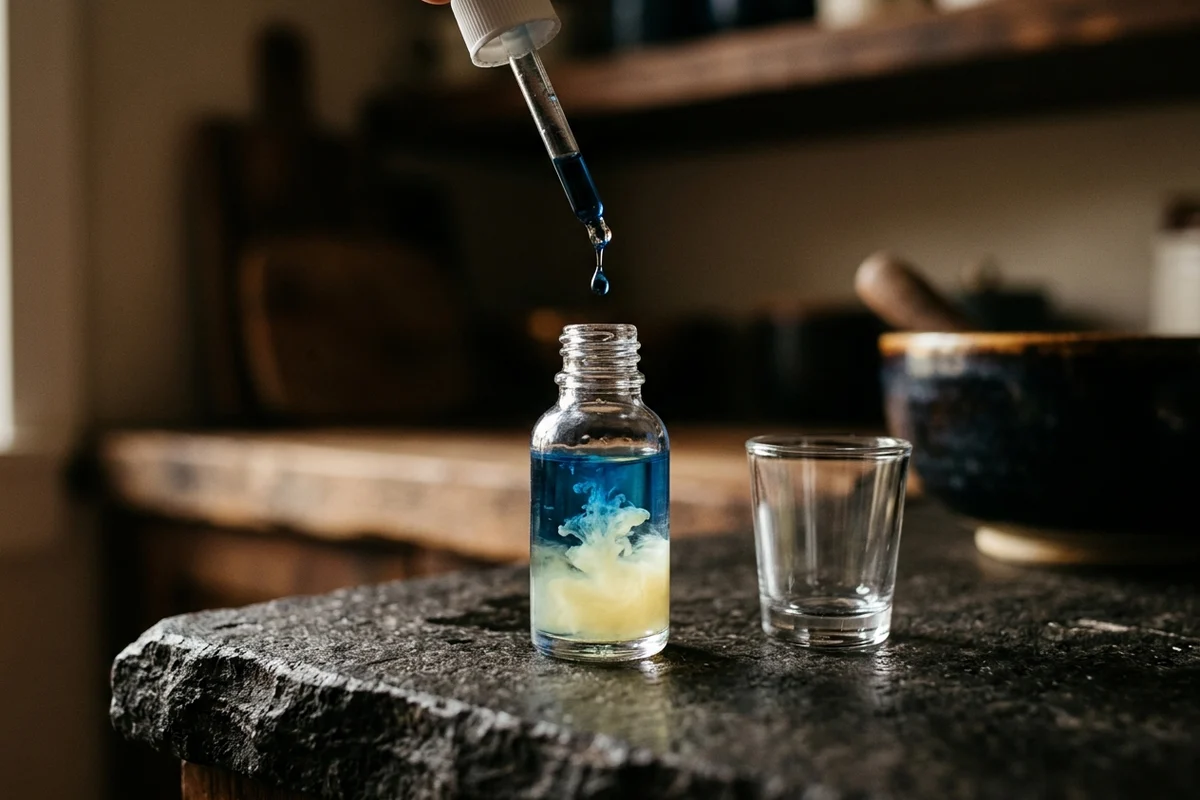
Or measure it, the way the Water Chart describes. Hardness and alkalinity are measured by titration: you add a reagent drop by drop until the sample changes colour and count the drops. The booklet points readers to kits “from water treatment suppliers or also in aquarium stores,” with a resolution of at least 20 ppm, and warns that “alkalinity test kits are often incorrectly marketed as carbonate hardness test kits.” In the aquarium aisle, that is a GH and KH kit: GH is general hardness, and KH, in the maker’s own words for the API GH & KH kit, is “carbonate hardness, also known as alkalinity.”
That kit’s leaflet counts 17.9 ppm per drop in a 5 ml sample. At that resolution, the Water Chart’s hardness range is three to nine drops, and its alkalinity range is only three or four: two drops is under 40, five is nearly 90. The booklet’s own fix is to use more water. Weigh 10 g of sample into a clean glass instead of filling the tube to its 5 ml line — a scale that reads 0.1 g is enough — and each drop is worth about 9 ppm, so the alkalinity range becomes five to eight drops. (The method is the booklet’s; the drop counts are my arithmetic.) One buyer’s review of the kit adds a practical reason to do it: at low readings, “The color change is just a little too subtle.” A larger sample takes more drops and makes the change easier to call.
Leave pH for last. The Water Chart notes that most tap water carries excess carbon dioxide, and that “most tap water will increase by approximately one pH unit when left standing in an open container for a day.” The current window is 6 to 8. A pH strip mostly tells you how long the glass has been standing.
The best water for an espresso machine is the one its maker specifies
The SCA’s numbers are about the cup. For the boiler, the maker’s specification outranks them, and the makers do not agree with each other:
| Maker | On distilled or reverse-osmosis water | Its water specification |
|---|---|---|
| La Marzocco | “Water that is very pure, like distilled or rainwater, has this corrosive effect, and sometimes won’t work with the machine’s sensors, in which case it won’t fill or heat up.” | TDS 90–150 · total hardness 70–100 · alkalinity 40–80 · chloride 0–30 ppm · pH 6.5–8 · caution with ion-exchange softeners |
| Breville | “We do not recommend the use of de-mineralized or distilled water … as this may affect the taste of the espresso and how the machine is designed to function.” | Cold, filtered water; some models ship with a hardness test strip used to set the filter reminder |
| Decent | Reverse-osmosis or distilled water “are actually the ideal water choices” for its machines; stainless steel passivates, and it would take “roughly a millennium” to corrode through | Under about 30 ppm, no descaling; 30–120 ppm, descale yearly with citric acid; keep chloride low |
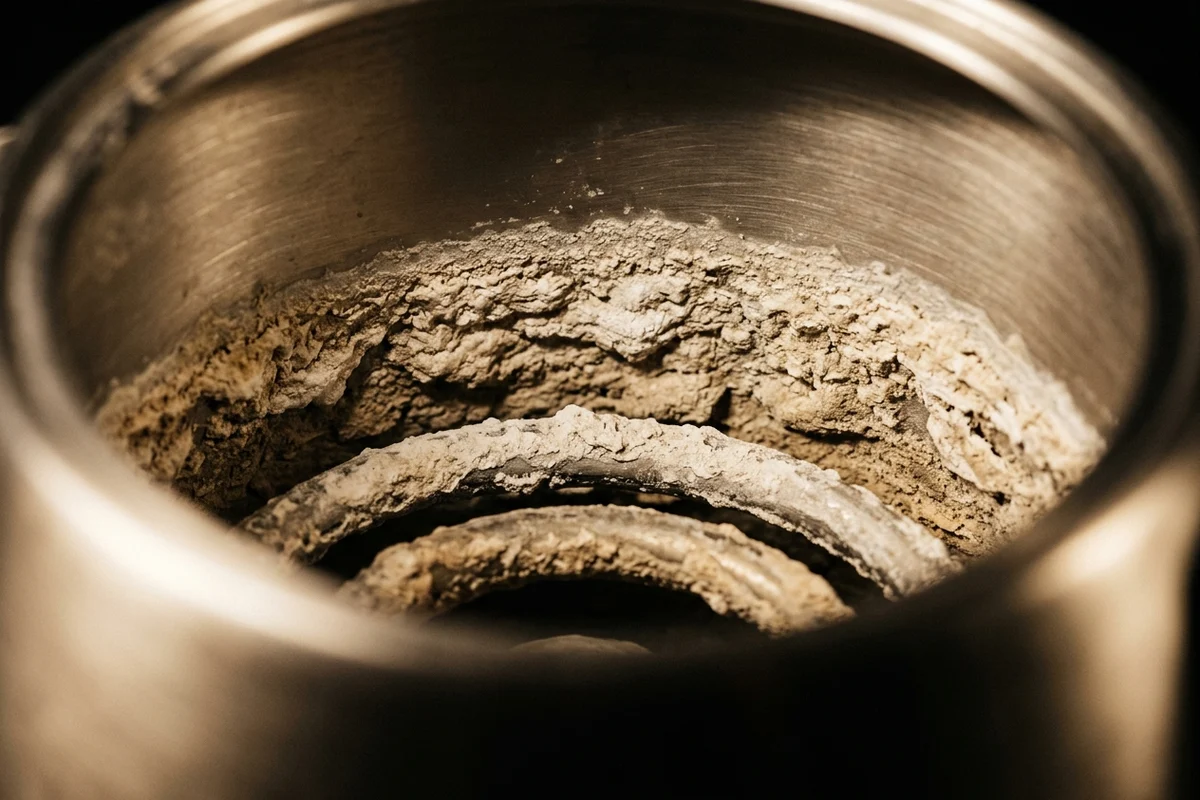
Three things follow. First, read your manual before you change your water: a La Marzocco filled with distilled water may simply refuse to heat, while a Decent is designed around it. Second, chloride is the ion both La Marzocco and Decent single out — La Marzocco caps it at 30 ppm, and Decent names it as a main corrosion risk — so recipes built on calcium or magnesium chloride belong in a kettle, not a boiler. Third, a jug filter is not a fix for scale. La Marzocco says common drinking-water filters “have little effect on the mineral content,” and Decent says carbon filters “do not appreciably change how much your water will deposit scale.” They remove chlorine and taste. The minerals pass through.
If your machine’s maker publishes nothing, the Water Chart’s core zone — hardness roughly 55 to 110 ppm, alkalinity roughly 40 to 63 — is the most careful general target I found.
Bottled water for coffee, on the SCA’s chart
Bottled water is the shortcut most pages recommend, usually by brand and adjective. The labels are more useful than the adjectives. I took each maker’s own mineral analysis and converted it with the factors above:
| Water | Hardness (ppm CaCO3) | Alkalinity (ppm CaCO3) | Inside 50–175? | Inside 40–75? | From |
|---|---|---|---|---|---|
| Volvic | 63 | 61 | Yes | Yes | Maker’s UK page: calcium 12, magnesium 8, bicarbonate 74 mg/L |
| Acqua Panna | 108 | 88 | Yes | No, above | Maker’s analysis: calcium 32.2, magnesium 6.7, bicarbonate 107 mg/L |
| FIJI | 103 | 130 | Yes | No, above — and higher than its hardness | Maker’s 2026 water quality report |
| Evian | 320 | 300 | No — nearly double | No — four times the ceiling | NSF lab report for Evian, January 2018 |
Volvic is the only one of the four inside both ranges. One US roundup calls Evian’s “balanced mineral composition” “a solid, all-purpose foundation for coffee”; on its own lab report it has nearly twice the hardness the SCA allows and four times the alkalinity. FIJI’s report has a small inconsistency of its own — its bicarbonate works out to about 104 ppm of alkalinity, while the same report states 130 — but either figure is above the range and above its hardness.
Change the standard and the verdicts move. Under the 2009 rule, which counted calcium alone, Volvic (30), Acqua Panna (80) and FIJI (45) all pass. The same bottle can meet one “SCA standard” and fail the next, which is the whole problem in one row.
Three cautions: Evian’s figures are from 2018; the Volvic figures are from its UK site, and I have not confirmed it is sold where you are; and Decent’s guide names Crystal Geyser and Poland Spring as very soft options without figures, so I have left them out rather than guess.
Third Wave Water: what is in the sticks
Third Wave Water sells powdered minerals in sticks: one to a gallon of distilled or reverse-osmosis water. It is the best-known way to make water to a recipe without weighing anything, and its maker is more forthcoming about ingredients than about amounts — “We are unable to provide the exact amounts of each mineral in each profile.” What it does publish:
| Profile | Ingredients | Maker’s targets | For a boiler? | Price |
|---|---|---|---|---|
| Classic Light Roast | Magnesium sulfate, calcium citrate, sodium chloride | ~150 mg/L dissolved solids; ~40 mg/L alkalinity, “buffering from the citrate” | Contains chloride; the maker recommends its chloride-free profiles for espresso machines | Check price → |
| Espresso Machine | Magnesium sulfate, calcium citrate, potassium bicarbonate | ~150 mg/L dissolved solids; ~80 mg/L alkalinity | Chloride-free; alkalinity above the Water Chart’s 75, inside La Marzocco’s 80 | Check price → |
The Classic Light Roast Profile carries no bicarbonate at all; its chief executive told Royal Coffee in 2018 that the profile was settled “primarily at the cupping table,” and its alkalinity comes from citrate. For a kettle and a dripper, that is a reasonable recipe for light roasts. For a machine, the Espresso Machine Profile is the one its maker intends.
One claim deserves care. Third Wave Water’s FAQ says its profiles contain no calcium carbonate, so “limescale is not a concern,” and that a machine maker’s hardness ceiling — it names La Marzocco’s 100 ppm — will not apply. But “ppm as calcium carbonate” is a unit for counting minerals, not an ingredient; the Water Chart is built on exactly that convention. And Decent, which otherwise recommends the product, reports that it “is possible for TWW to cause buildup in the steam heater over time,” and suggests running it at three-quarter strength or less, with a descale once a year at half strength and twice a year at full. If your machine’s maker gives a hardness ceiling, I would follow the maker.
On price, the maker’s own store charges $18.00 for twelve one-gallon sticks, about $1.50 a gallon before the distilled water, on 3 October 2026. Buyers’ reviews are mostly warm and not blind; the useful complaints are specific. One four-star reviewer of the Classic profile found that “the crystals are very slow to dissolve” even with shaking; another, brewing East African light roasts, thought it “makes water a bit too hard still”; and a third, comparing it with plain reverse-osmosis water, wrote: “When compared to RO water, the difference is minimal.” Another splits each stick across two jugs and runs it at half strength.
Fixing your water
Once you have your two numbers, the fix follows from where they sit:
Chlorine or a smell. Activated carbon removes chlorine and chloramines, which the Water Chart says “impart a strongly unpleasant flavour in the resulting brew” even below the level you can taste in the water. A carbon jug or tap filter does this job. It does not change hardness much.
Too hard, or too alkaline. Blend with distilled or reverse-osmosis water. Mixing two waters moves both numbers proportionally, along a straight line on the chart: tap water at 240 ppm hardness and 200 ppm alkalinity, cut one part tap to two parts distilled, comes out near 80 and 67. (My arithmetic; the mixing rule is the Water Chart’s.) Blending cannot change the ratio between the two, though. If alkalinity is high relative to hardness, start from distilled or reverse-osmosis water and add minerals instead. Hard water also leaves scale, which Breville, Philips and Nespresso all say lowers brewing temperature — how to check whether your brewer runs cool.
Too soft. Add minerals to distilled or reverse-osmosis water, from a stick or from a recipe. If you make your own, the arithmetic from molar masses is simple: in one litre, about 0.12 g of Epsom salt adds 50 ppm of hardness, and about 0.08 g of baking soda adds 50 ppm of alkalinity, along with about 23 mg of sodium; 0.10 g of potassium bicarbonate adds the same alkalinity with potassium in place of the sodium. Those are small weights — a 0.01 g scale, or a concentrate you dilute, makes them practical. That is a recipe for a kettle; for a machine, its maker’s numbers come first.
Softened water. A salt-based softener removes the hardness and leaves the alkalinity, which is the wrong half to keep for coffee. La Marzocco asks for caution with softeners. If your house water is softened, draw coffee water from a tap before the softener or start from distilled.
What I would actually do
Get the two numbers before buying anything. Read the water report; if it gives hardness but not alkalinity, buy the drop kit and test 10 ml. Then you know which of the fixes above, if any, you need.
Judge them against the 2016 Water Chart: total hardness 50–175 ppm, alkalinity near 40 and no more than 75, hardness above alkalinity. If you want the stricter reading, the current SCA table caps alkalinity at 70 — but I found no taste study that separates 70 from 75.
For an espresso machine, use the maker’s specification, and if there is none, aim for the core zone: hardness around 55–110, alkalinity around 40–63, chloride low. Do not put distilled water in a machine whose maker says not to.
Retire the TDS meter as a test of coffee water. Keep it, if you own one, to notice when your supply or your filter changes. That is the only job the SCA’s own research gives it.
The standard has changed four times. The two numbers it kept are the ones worth knowing, and you can measure both at home.
Sources
Every figure in this piece traces to one of these. Dates are when the source was read — lists and prices move.
- SCAA Standard: Water for Brewing Specialty Coffee Specialty Coffee Association of America, Statistics & Standards Committee — revised 21 November 2009, version 21NOV2009A (copy hosted by a water-treatment company; the SCA's own link no longer resolves) Source of the 2009 figures: TDS 150 mg/L target, 75–250 acceptable, 'measured based on a 4-4-2 conversion'; calcium hardness 4 grains or 68 mg/L, acceptable 1–5 grains or 17–85 mg/L; total alkalinity 40 mg/L, 'at or near 40'; pH 7.0, 6.5–7.5; sodium 10 mg/L; total chlorine 0. Also of the definition of target versus acceptable range. Read 3 October 2026
- The SCAE Water Chart: Measure, Aim, Treat Marco Wellinger, Samo Smrke and Chahan Yeretzian, Zurich University of Applied Sciences — Speciality Coffee Association of Europe, 2016 (Internet Archive copy) Read in full, 36 pages. Source of total hardness 50–175 ppm and alkalinity 40–75 ppm as CaCO3, pH 6.5–8; of the spread of existing recommendations from 51 to 175 ppm; of 'not enough data available'; of the authors being unable to verify with a refractometer that hardness raises extraction; of the ±30% typical TDS-meter error and the 0.7 conversion factor used by the SCAA; of titration kits with 20 ppm resolution from aquarium stores; of the unit conversion factors; of the one-pH-unit rise in standing tap water; of the core zone for espresso machines; and of its funding by SCAE, ZHAW, Brita and BWT. Read 3 October 2026
- Charting Water for Better Coffee Café Europa (SCAE), Winter 2016 — reprint published by BWT Source of the Water Chart's core-zone figure, from which its approximate corners are read here, and of the magnesium-to-calcium experiment: fixed 70 ppm hardness and 40 ppm alkalinity, three ratios, TDS and total solids unchanged at 1.58%, more astringency and bitterness at 1:3. Three cuppers; funded by BWT. Read 3 October 2026
- Coffee Standards, revised 2018 — §3.4 Cupping Water and §4.1 Water for Brewing Standards Specialty Coffee Association (Internet Archive copy) Source of the current table: calcium hardness target 50–175 and acceptable 50–175 ppm CaCO3; alkalinity target 40 ppm, acceptable 'at or near 40-70 ppm CaCO3'; pH 7.0, 6–8; no TDS or sodium row, with the footnote 'TDS measured based on 4-4-2 conversion' still printed. Also of the rule that cupping water must meet the water standard. Read 3 October 2026
- SCA Standard 310-2021 — Home Coffee Brewers: Specifications and Test Methods Specialty Coffee Association §7.1.4, the test water for brewer certification: 'calcium hardness equivalent to 50 to 175 ppm CaCO3, alkalinity equivalent to 40 to 70 ppm CaCO3, and pH of 6 to 8.' Read 3 October 2026
- The 2018 SCA Water Quality Handbook Specialty Coffee Association store A paid digital download, $45.00 on this date. Not read for this piece; cited only because the 2018 standard refers to it for testing details. Read 3 October 2026
- Standard Development at the SCA: A Tool to Create Value for the Community Mario Fernández-Alduenda, SCA Technical Officer — SCA News, Issue 17, 25 April 2022 (Internet Archive) Source of the SCA's own phrase for the merger of the American and European associations, 'the unification of the heritage organizations as the SCA'. Read 3 October 2026
- The Role of Dissolved Cations in Coffee Extraction Hendon, Colonna-Dashwood & Colonna-Dashwood — Journal of Agricultural and Food Chemistry 62(21), 4947–4950 (2014) Abstract read via PubMed. A density functional theory study of the binding energies of coffee acids, caffeine and eugenol with sodium, magnesium and calcium. No coffee was brewed or tasted. Read 3 October 2026
- Influence of divalent cations on the extraction of organic acids in coffee determined by GC-MS and NMR Bratthäll, Figueira & Nording — Heliyon 10(5), e26625 (2024) Open access, read in full. Magnesium and calcium chloride added before and after brewing; at drinking-water concentrations, limited variation in citric, malic, lactic and quinic acid, and the conclusion that 'extraction of acids proceeds independent of the water composition'. Read 3 October 2026
- Analysis of coffee, tea and artificially flavored drinks prepared from mineralized waters Pangborn, Trabue & Little — Journal of Food Science 36, 355–362 (1971) Abstract read via Crossref. Source of carbonate solutions producing the least desirable coffee, 'flat, insipid', and of coffee from distilled water being 'excessively sour'. Read 3 October 2026
- Water quality for Espresso coffee Navarini & Rivetti — Food Chemistry 122, 424–428 (2010) A review; abstract read. Cited by the Water Chart for high alkalinity lengthening extraction through carbon dioxide. Read 3 October 2026
- A Practical Water Guide for Coffee Professionals, Part II: The Sensory Data Chris Kornman — Daily Coffee News, 29 August 2018 Not peer-reviewed. A double-blind cupping by a five-person panel at Royal Coffee: distilled water earned the highest total score, bicarbonate-only waters the lowest sweetness. Also the source of Third Wave Water's chief executive saying the Classic profile has no bicarbonate. Read 3 October 2026
- Water Specification · La Marzocco Water Specifications La Marzocco USA · La Marzocco UK TDS 90–150, total hardness 70–100, alkalinity 40–80, chloride 0–30 ppm, pH 6.5–8, and caution with ion-exchange softeners. The UK page (lamarzocco.com/uk/en/technical-questions/la-marzocco-water-specifications/) is the source of the warnings on distilled water, sensors and drinking-water filters. Read 3 October 2026
- Barista Express Instruction Book (BES870) Breville, 2020 'We recommend using cold, filtered water. We do not recommend the use of de-mineralized or distilled water …' Read 3 October 2026
- Water recommendations for the DE1 and Bengle Decent Espresso — updated 11 April 2026 Source of reverse-osmosis or distilled water as 'the ideal water choices' for its machines, of chloride as a main corrosion risk, of carbon filters not changing scale deposition, and of its advice to run Third Wave Water at three-quarter strength. Read 3 October 2026
- TDS-3 HM Digital 'EC-to-TDS Conversion Factor: NaCl (avg. 0.5)', factory calibrated with a 342 ppm NaCl solution. Read 3 October 2026
- API General & Carbonate Hardness Test Kit · GH & KH Test Kit instructions API, Mars Fishcare (leaflet: copy hosted by a retailer, Arcata Pet) 'Carbonate hardness, also known as alkalinity.' The leaflet (arcatapet.com/API/kh.pdf) gives a 5 ml sample and a conversion chart of 17.9 ppm per drop. Read 3 October 2026
- What is IN Third Wave Water? · Classic Light Roast Profile · Espresso Machine Profile Third Wave Water Ingredients and targets for each profile, and the statement that exact amounts are not published. Prices and barcodes from the maker's product pages (thirdwavewater.com/products/1-gallon-classic-profile and 1-gallon-espresso-profile); the 'limescale is not a concern' claim from its FAQ (thirdwavewater.eu/pages/faq). Read 3 October 2026
- CCR Information for Consumers US Environmental Protection Agency 'Reports must be sent by your water supplier each year by July 1.' The rule is 40 CFR 141.152(b). Read 3 October 2026
- Hardness of Water US Geological Survey Soft 0–60, moderately hard 61–120, hard 121–180, very hard over 180 mg/L as calcium carbonate. Read 3 October 2026
- Bottled water analyses: Volvic, Acqua Panna, FIJI, Evian Volvic (volvic.co.uk) · Acqua Panna (acquapanna.com/intl) · FIJI Water 2026 California Water Quality Report · NSF laboratory report for Evian, 2018 (Consumer Reports copy) Mineral figures from each maker's own analysis; converted to ppm as CaCO3 here with the Water Chart's factors. Acqua Panna: acquapanna.com/intl/33-cl-plastic-bottle. FIJI: Table 1 of its 2026 report, February 2026 sampling. Evian: alkalinity 300 and hardness 320 mg/L as CaCO3, TDS 340 mg/L and conductance 600 µS/cm, sampled 24 January 2018. Read 3 October 2026