
Every page that tells you to buy a coffee scale quotes the same number. Zero point one grams. It appears in the product title, in the review headline, in the comparison table, and in the sentence explaining why the good ones cost two hundred dollars more than the one in your kitchen drawer.
That number is real. It is also not what almost anybody thinks it is, and the company that sells the most expensive scale in the category says so on its own website.
So the short answer comes in three parts. Yes, weigh your coffee — but the error a scale removes is roughly three grams, not a tenth of one. Yes, your kitchen scale can probably do it — the thing likely to defeat it is the auto-off timer, not the precision. And the money in an expensive scale does not buy accuracy — it buys speed, control and a specification sheet that exists.
Here is the evidence for each.
What 0.1 g on the box actually means
There are two different properties hiding behind the word “accuracy” on a scale listing, and weighing standards keep them strictly apart.
The first is the actual scale interval — the smallest step the display prints. In the international recommendation that governs non-automatic weighing instruments, OIML R 76-1, this is d. It is a property of the screen. The second is the verification scale interval, e, which is the unit the instrument’s permitted error is measured in. That is a property of the machine. An instrument can print a finer number than it can stand behind, and R 76 accounts for this explicitly: for instruments with an auxiliary indicating device, e and d need not be equal at all.
Consumer scales publish only d, and the marketing calls it accuracy.
The exception is instructive. Here is what the four makers actually publish, read from their own pages on 7 September 2026, with every price re-read there on 12 September 2026:
| Scale | Price | Readability | Repeatability | Linearity | Auto-off |
|---|---|---|---|---|---|
| Acaia Lunar 2021 | $250.00 | 0.1 g / 0.01 g | 0.1 g | 1 d | adjustable, or off |
| Acaia Original Pearl | — | 0.1 g | 0.1 g | 1 d | adjustable, or off |
| Hario V60 Drip Scale | $60.00 | 0.1 g / 0.5 g / 1 g by range | not published | not published | 5 min |
| Timemore Basic 2.0 | $55.00 | 0.1 g | not published | not published | 3 min |
| Etekcity EK3551 | $16.99 | 1 g | not published | not published | 2 min |
Two qualifications on that price column, since a good deal of what follows is priced against it. The Timemore’s $55.00 is a sale price sitting under a $59.00 list, and the Hario was showing sold out at $60.00 when the column was last checked. Both are the manufacturer’s own listing rather than a retailer’s, which is the comparison that matters here — but neither is a number to treat as permanent.
Read the top row again. The most expensive scale here displays hundredths of a gram and repeats to a tenth. The two rightmost digits on that screen are, by the manufacturer’s own published figure, finer than the instrument’s own agreement with itself.
Acaia does not leave this to be inferred. Its help page on weighing resolution puts it flatly:
Changing this does not change the actual accuracy of your scale, but rather how granular the number displayed on your scale is.
And, about the high-resolution mode on that same scale:
the hundredths digit of this measurement is more or less an estimation. It is unlikely that a change in ±0.01 g will make a noticeable difference in your coffee, regardless of brew method
There is a longer piece on the same site, Accuracy vs. Display, which says the quiet part directly — higher readability does not equate to higher accuracy — and then works an example: if the Lunar shows 55.3 g, the true weight is guaranteed to sit between 55.2 and 55.4 g. That is ±0.1 g, on a $250 instrument. (The same article slips once, describing readings of 15.1, 15.2 and 15.3 g as a spread of about 1.1 grams; it is 0.2. The definitions around it are sound.)
Then comes the sentence that is worth more to a buyer than any review:
A scale that does not provide specs on an error range likely means that it is a consumer build. Providing only a range and readability does not guarantee accuracy.
By that test, three of the five rows above are consumer builds — including two scales sold specifically for coffee.
One more piece of arithmetic, derived here rather than taken from the standard. A 2000 g scale reading in 0.1 g steps is claiming 20,000 divisions. In legal metrology that division count belongs to class II, high accuracy; the ceiling for medium-accuracy class III at that interval is 10,000. A 5000 g kitchen scale reading to 0.1 g claims 50,000. Division counts are capped in the standards precisely because printing more of them is free, while earning them is not.
The error a scale actually removes
If the case for weighing were about tenths of a gram, it would be a weak case. It isn’t, and the real number has been measured.
Nakilcioğlu-Taş and Ötleş took one Arabica, roasted it to three degrees, ground it all below 300 µm and measured the bulk density of each:
| Sample | Bulk density | Particle density |
|---|---|---|
| Green | 0.43 ± 0.015 g/cm³ | ~0.91 g/cm³ |
| Light roast | 0.39 ± 0.011 g/cm³ | ~0.92 g/cm³ |
| Medium roast | 0.33 ± 0.009 g/cm³ | ~0.91 g/cm³ |
| Dark roast | 0.28 ± 0.012 g/cm³ | ~0.92 g/cm³ |
The right-hand column is the part people miss. Particle density does not change — there was no statistically significant difference between the three roasts. What changes is packing. Roasting opens the bean up, so the same volume holds progressively less coffee, and a scoop is a volume.
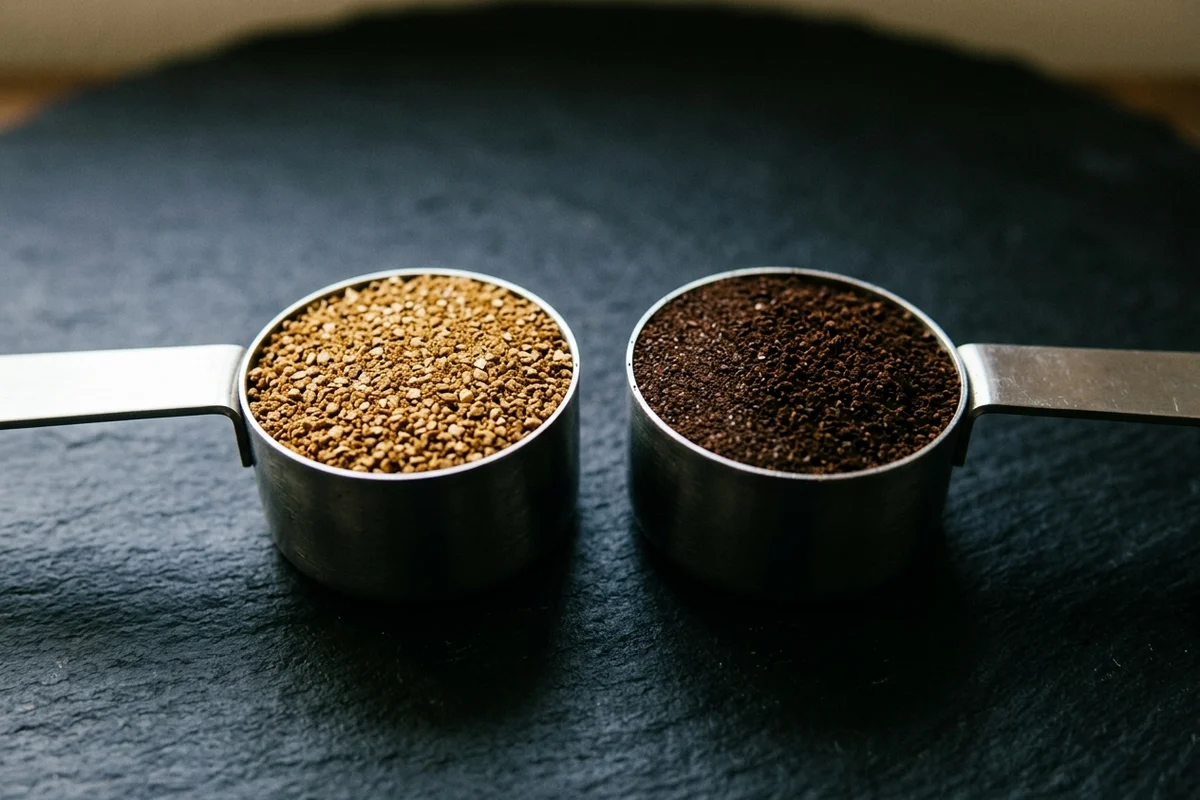
Two level US tablespoons is 29.57 ml. Run the three densities through it:
| Roast | Two scoops hold | Ratio into 350 g of water |
|---|---|---|
| Light | 11.5 g | 1:15.2 |
| Medium | 9.8 g | 1:17.9 |
| Dark | 8.3 g | 1:21.1 |
A 3.2 gram spread on a nominal 10 grams, from nothing but roast level. And the ratio consequence is the striking part: the SCA Brewing Control Chart rules its diagonals from 1:12 to 1:22, so that one substitution eats about sixty percent of the chart’s entire ratio range — without you changing anything you thought was a variable.
This is the honest answer to “do I need a scale.” Not because a tenth of a gram matters. Because a scoop is not a unit of coffee, and the ratio is the axis everything else hangs from. If what you want is the dose itself rather than the argument for weighing it, that is a separate question — how many grams per cup — and it starts where this one leaves off.
Water is the forgiving half
The other half of the ratio is more relaxed than the internet suggests, and saying so is part of making the first half credible.
Water density from the NIST Chemistry WebBook, at atmospheric pressure:
| Temperature | Density | One litre weighs |
|---|---|---|
| 20 °C | 998.21 kg/m³ | 998.2 g |
| 60 °C | 983.20 kg/m³ | 983.2 g |
| 90 °C | 965.31 kg/m³ | 965.3 g |
| 95 °C | 961.89 kg/m³ | 961.9 g |
Assume 1 ml = 1 g and measure cold, and you are wrong by 0.18%. That is nothing. Measure the same litre at brewing temperature — around 963 g at 93 °C — and you are wrong by 3.7%, consistently in one direction.
Most people fill a kettle or a reservoir cold, which means the water side of their ratio is already close to right. So if you are only going to weigh one thing, weigh the coffee. Volume costs you two tenths of a percent on the water and up to thirty percent on the grounds.
Espresso is the one you cannot eyeball
For espresso the argument gets sharper, because the two official definitions of the drink disagree about what unit it is even measured in.
| Italian disciplinare | WBC 2026 rulebook | |
|---|---|---|
| Dose | 7–9 g | not specified |
| In the cup | 13–26 g (mass) | around 1 fl. oz. / 30 ml (volume) |
| Flow | 0.48–1.3 g/s | not specified |
The disciplinare describes espresso entirely in grams, down to grams per second of flow. The competition rulebook describes it as a volume.
That volume includes crema, and crema volume is not a property of your extraction. Navarini and colleagues measured espresso foam ranging from about 2.5 ml to about 12 ml as a function of one variable — how much carbon dioxide the coffee still held. Crema is a gas gauge, not a quality gauge, which means a fill line on a shot glass is partly measuring how long ago your beans were roasted.
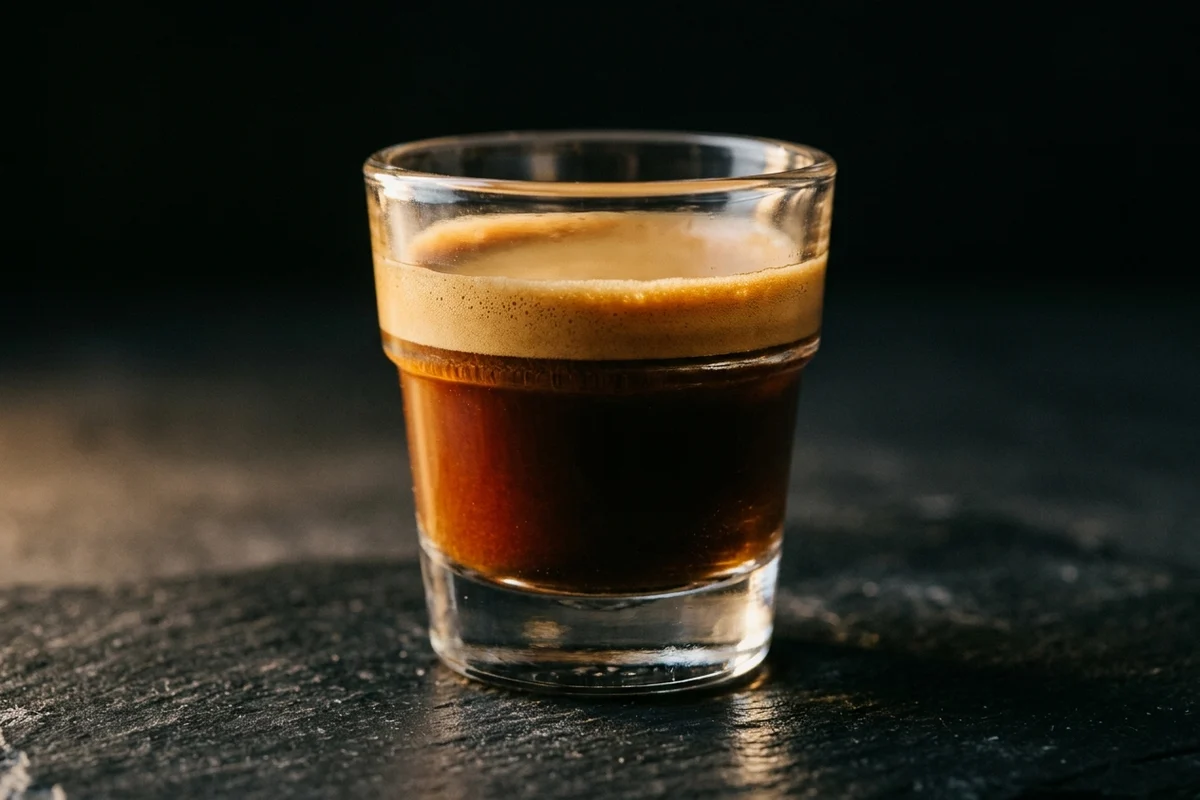
Weigh the shot and that contamination disappears. It is the cleanest single argument for a scale anywhere in coffee, and it is why the disciplinare’s authors wrote 13–26 g rather than 25–30 ml.
The standard that never names a scale
Here is the strangest thing I found while researching this.
SCA Standard 310-2021, the document behind the Certified Home Brewer programme, is written in mass from beginning to end. Fifty-five grams of coffee per 1.000 kg of water. Eight grams of dried grounds sampled from the bed. Ninety-two grams of distilled water added to the sample cup. Less than 12% by mass of grinds above 850 µm.
It also specifies its instruments carefully. Brewing temperature must be measured with three K-type thermocouples of ±1.1 °C or ±0.4% tolerance, recorded every second, and the standard requires that the brand, size, grade, precision and response time of the sensors be reported in all cases. The drying oven is pinned at 103 ± 2 °C. The sample water at 15 ± 5 °C.
Search the whole four-thousand-word document for weigh, weighed, weighing, scale, scales, balance, balances or apparatus and you get zero hits.
A standard that writes its brew ratio to four significant figures, and reports the make of its thermometer, never once says what to put the coffee on. That is not a scandal — it is a reasonable assumption that anybody running the test has a laboratory balance. But it does mean that when the Golden Cup numbers reach a home kitchen, the one instrument the whole recipe rests on is the one nobody wrote a requirement for.
Where a kitchen scale actually breaks
Now the practical question. Not “is it precise enough” — it almost certainly is — but “will it get through the brew.”
Auto-off is the real killer. These are published figures, not opinions:
| Scale | Auto-off | Survives a 3-minute pour-over? |
|---|---|---|
| ProScale XC2000 | 30 s, cannot be disabled | no |
| Etekcity EK9000 | 120 s | no |
| Etekcity EK3551 | 2 min | borderline |
| Etekcity EK8060 / EK7090 | 180 s | borderline |
| Timemore Black Mirror Plus | 3 min | borderline |
| Hario V60 Drip Scale | 5 min | yes |
| Acaia Lunar / Pearl | 5–60 min, or off | yes |
A pour-over runs two and a half to three and a half minutes. A French press runs four. A $17 scale that shuts down at two minutes is not imprecise — it is simply not there when you need the number. For espresso, at twenty-five to thirty seconds, none of this matters.
Zero-tracking can eat your first flow. This one is invisible and almost nobody mentions it. R 76-1 §4.5.7 permits a zero-tracking device to operate when the indication is at zero, the reading is stable, and the corrections are no more than 0.5 d per second. On a 0.1 g scale that is up to 0.05 g every second quietly pulled back to zero. The opening drips of a bloom, or the first weep from a portafilter, can fall under that rate and never appear on the display at all.
Creep is a real, regulated phenomenon. Leave a load on a scale and the reading drifts. R 76 §3.9.4.1 caps this for verified instruments: the indication may not move more than 0.5 e over thirty minutes, and no more than 0.2 e between the fifteen-minute and thirty-minute marks. §3.9.4.2 adds that after half an hour under load, returning to zero must be good to 0.5 e. A dripper sitting on a scale for four minutes is a mild version of the same test. Your kitchen scale owes you nothing here.
Heat moves the zero. R 76 §3.9.2.3 allows the zero indication to shift by one verification interval for every 5 °C of ambient change. Acaia describes the same effect in plainer language, noting that every one of its scales has a load beam whose performance is affected by extreme temperatures, and that this is why the company supplies a heat-resistant pad for longer extractions. The same page lists vibration, humidity, draughts and uneven surfaces.
The division changes without telling you. Several of these are multi-interval instruments — one weighing range split into bands with different steps. Hario’s drip scale reads in 0.1 g only from 2 to 200 g, then 0.5 g to 500 g, then whole grams. Acaia’s Original Pearl defaults to 0.1 g up to 1000 g and 0.5 g above it. Etekcity’s 0.1 g models step to 1 g past 1000 g. So “a 0.1 g scale” prints tenths in the bottom band and something coarser everywhere else.
R 76 recognises this instrument type and requires a verified one to declare each band. Consumer scales simply do it. Before you panic, though: weighing 320 g of water in 0.5 g steps is a 0.16% error, which is nothing. I mention it because it sounds alarming and turns out not to be — and because the standard has a useful rule attached. §3.3.4 says the range requirements apply to the net load, for every possible tare, so on a compliant instrument taring a heavy portafilter puts you back in the fine band. Whether your kitchen scale behaves that way is undocumented, and testable in thirty seconds.
The minimum weight myth
One claim I want to knock down, because it appears on several pages selling coffee scales and it is wrong.
The story is that a kitchen scale cannot register an 18 g dose because its minimum weight is too high. The published figures say otherwise: Etekcity’s 0.1 g models start at 1 g, the Hario starts at 2 g, and Acaia’s Lunar lists a minimum weight of 0.1 g. Even the strictest reading of R 76 — class II at a 0.1 g interval — puts the minimum capacity at 50 e, which is 5 g.
An espresso dose clears all of these by an order of magnitude. Minimum weight becomes a genuine constraint when you are weighing two or three grams of something, not eighteen.
So what does the money buy?
Given all of the above, the honest list of what you get for $250 instead of $17 does not include accuracy.
| What you are buying | Cheap scale | Coffee scale |
|---|---|---|
| A published error range | none | Acaia: repeatability, linearity, minimum weight |
| Auto-off you control | 30 s to 3 min, often fixed | adjustable or defeatable |
| Settling time | ~1.5–2 s measured | under 1 second at 1 g division |
| Water resistance | none | anodised or hydrophobic surfaces |
| Flow rate, auto-tare, auto-start | none | firmware features |
| A documented calibration routine | none | published procedure |
| Better accuracy | — | not claimed |
Settling time is the one that genuinely earns its money, and it can be quantified. Prima Coffee timed a 264 g mug settling in about 1.5 seconds on the Hario and about 2 on a ProScale; Acaia states under a second at a 1 g division for its own scales, though the sentence covering the 0.1 g case is cut off mid-word on their specification page.
Take the disciplinare’s upper flow limit of 1.3 g/s. A 1.5 second display lag is about 2 grams of espresso past your target — 5.4% on a 36 g shot. Prima’s practical advice matches the arithmetic: on a slow scale, cut the shot three to four grams early.
So the correct answer to “why are coffee scales so expensive” is not resolution. It is latency. You are paying for the number to arrive while it is still actionable.
How precise does it actually have to be?
The most useful number I found for this article is buried in the methods section of a peer-reviewed espresso paper.
Cameron and colleagues, modelling espresso extraction in Matter in 2020, describe their recipe like this:
We elected to use a representative modern espresso recipe (i.e., 20.0(5) g of dry ground coffee in, 40.0(5) g of beverage out).
That bracket notation means ±0.5 g. And their quality control:
Espresso shots were discarded if, due to human error, the shot mass was outside a ±1 g tolerance. Exact beverage masses were included in each calculation of EY.
Three things follow, and they reframe the whole question.
First, published espresso research specifies its dose to half a gram, not to five hundredths. A 0.1 g scale is five times finer than the tolerance a laboratory found sufficient. Second, the rounding error of a 1 g kitchen scale — ±0.5 g — sits inside the ±1 g window those researchers accepted. Third, and most usefully: they did not need to hit the target. They recorded what they actually got and used the real number in the calculation.
That last point is what a scale is for. Not gatekeeping, bookkeeping. A shot you weighed at 37.4 g and wrote down is more useful than a shot you aimed at 36 g and didn’t. (The paper names its instrument, incidentally — Acaia’s Lunar, which the authors note was donated by the manufacturer.)
For a sense of scale on the other end: sensory studies build their designs on brew strengths a quarter of a percentage point apart — 1.00, 1.25 and 1.50% TDS in Batali and colleagues’ work. At a fixed extraction yield, a ±0.5 g error on an 18 g dose moves strength by roughly 0.04 points. That is not a claim that 0.04 points is imperceptible; nobody has published a difference threshold for coffee strength. It is a statement about proportion. The steps at which measured sensory differences get established are an order of magnitude larger than the ones your scale’s rounding produces.
Audit your own scale in twenty minutes
I do not own the hardware in this article and do not publish measurements of my own. But the weighing standards publish their test procedures, and most of them adapt to a kitchen worktop without any equipment at all. Five of the seven below need no reference weight — they use the same object, moved or waited on.
These are not certification tests. A kitchen scale is not a verified instrument and owes no compliance to any of these limits. They are simply the questions legal metrology asks, in a form you can ask them.
| Check | Clause | How | What you are looking for |
|---|---|---|---|
| Off-centre load | R 76 §3.6.2 | Put one object on each corner, then the middle | The reading should not change as it moves |
| Repeatability | R 76 §3.6.1 | Lift and replace the same object five times | Compare the spread to the maker’s figure, if there is one |
| Creep | R 76 §3.9.4.1 | Load it, read at 0, 15 and 30 minutes | Verified instruments hold 0.5 e over 30 min, 0.2 e over the last 15 |
| Zero return | R 76 §3.9.4.2 | Remove the load after half an hour | It should come back to zero, not near it |
| Zero-tracking | R 76 §4.5.7 | Drip water onto the platform very slowly | If the number stays at 0, your scale is eating slow flow |
| Auto-off | product spec | Switch it on, start a timer, walk away | Compare to your longest brew |
| Temperature | R 76 §3.9.2.3 · R 60 §5.6.1.3 | Put a hot cup on it and watch the zero | Drift means you want a pad under the dripper |
Only linearity needs a reference, and the honest answer there is a proper calibration weight — the one that came in the box, or an inexpensive OIML M1 100 g weight. Pocket change is not a standard: coins are struck to a tolerance and then wear.
The zero-tracking test is the one I would run first. Most people have never checked it, and if your scale is quietly absorbing the first few grams of a pour, every ratio you have ever recorded is off by that much in the same direction.
What I would buy
Three situations, and they genuinely have different answers.
If you only weigh the dose. Use the scale you already own. An 18 g dose is far above its minimum, the rounding is inside the tolerance published research works to, and the auto-off is irrelevant over ten seconds of scooping beans. Spending money here buys you nothing you can taste. Check it against the table above and move on.
Affiliate links. Some product names below link to Amazon. If you buy through one I earn a commission at no extra cost to you, and it never changes which product gets named or what the measurements say. Full disclosure.
If you brew filter and want to weigh the pour. This is where a purpose-built scale starts to pay, and the feature that matters is the auto-off, followed by the timer. The Hario V60 Drip Scale is the modest option and its five-minute shutdown clears any normal brew; the Timemore Black Mirror sits at a similar price with a faster display. Neither publishes an error range, which by Acaia’s own test makes them consumer builds — but for filter coffee, where a half-gram is 0.15% of the water, that matters far less than being awake at three minutes.
If you pull espresso. Latency is the spec to buy, because two seconds of lag is two grams of shot. This is the one place the Acaia Lunar earns its price, and the reason is not the hundredths digit its own manufacturer calls an estimation — it is that the number arrives while you can still act on it, the auto-off can be switched off entirely, and the surface survives a drip tray. What you then do with those two numbers is the dial-in.
And in all three cases the same thing is true. The scale is not there to make your coffee precise. It is there so that when a cup is good, you can find out what you did.
Sources
Every figure in this piece traces to one of these. Dates are when the source was read — lists and prices move.
- OIML R 76-1: Non-automatic weighing instruments, Part 1 — Metrological and technical requirements: Tests International Organization of Legal Metrology, Edition 2006 (E) Read in full. Source of the readability/verification-interval distinction, the accuracy-class table, the maximum permissible errors, and the clauses on eccentric loading (3.6.2), temperature effect on zero (3.9.2.3), creep and zero return (3.9.4), zero-tracking (4.5.7) and multi-interval tare behaviour (3.3.4). Read 7 September 2026
- OIML R 60-1: Metrological regulation for load cells, Part 1 International Organization of Legal Metrology, Edition 2021 (E) Read in full. Load cell accuracy classes and interval counts, the minimum load cell verification interval, the apportioning factor, and the 30-minute creep and temperature requirements that sit underneath any weighing instrument. Read 7 September 2026
- SCA Standard 310-2021: Home Coffee Brewers — Specifications and Test Methods Specialty Coffee Association Read via the public mirror on the Internet Archive, as in the Golden Cup piece. Searched for every weighing term; there are none. Source of the 55 g per 1.000 kg brew ratio, the thermocouple tolerance of ±1.1 °C, and the 103 ± 2 °C drying oven. Read 7 September 2026
- Acaia Scale Comparison Table Acaia Help Center The manufacturer's own matrix of readability, repeatability, linearity, minimum weight and capacity across ten scales. The only published error figures in this article that come from a scale maker. Read 7 September 2026
- Weighing Resolution Acaia Help Center States that changing resolution does not change accuracy, and that the hundredths digit on the Lunar is more or less an estimation. Read 7 September 2026
- Acaia University: Accuracy vs. Display Acaia The manufacturer's own explanation of accuracy, readability and measurement uncertainty, including the ±1 division worked example and the line about scales that publish no error range. Its own worked example mis-states a 0.2 g spread as 1.1 g. Read 7 September 2026
- Lunar (2021) — product page Acaia The $250.00 list price this piece keeps returning to, read from the manufacturer's own store. The product page itself publishes no error figure; those come from the help-centre comparison table above. Read 12 September 2026
- Systematically Improving Espresso: Insights from Mathematical Modeling and Experiment Cameron, Morisco, Hofstetter, Uman, Wilkinson, Kennedy, Fontenot, Lee, Hendon & Foster — Matter 2(3), 631–648 (2020) Source of the mass tolerances actually used in peer-reviewed espresso work: a 20.0(5) g dose, a 40.0(5) g beverage, and shots discarded outside a ±1 g tolerance. The authors note that the balance was donated by Acaia Corp. Read 7 September 2026
- Physical characterization of Arabica ground coffee with different roasting degrees Nakilcioğlu-Taş & Ötleş — Anais da Academia Brasileira de Ciências 91(2) (2019) Open access. Bulk density of the same Arabica at three roast levels — 0.39, 0.33 and 0.28 g/cm³ — with particle density statistically unchanged, which places the difference in packing rather than in the material. Read 7 September 2026
- Thermophysical Properties of Fluid Systems: water NIST Chemistry WebBook, SRD 69 Density of liquid water at 1.01325 bar from 20 °C to 100 °C. Source of the 998.2 g and 963 g figures for a litre measured cold and hot. Read 7 September 2026
- V60 Drip Scale — product page Hario USA Capacity, the three separate division bands (0.1 g only from 2–200 g), and the price. No error figure is published. Re-read 12 September 2026: still $60.00, still the same three bands, and showing sold out. Read 12 September 2026
- EK3551 Digital Kitchen Scale — product page Etekcity A 1 g division, a two-minute auto-off and a $16.99 price, with no accuracy or tolerance figure anywhere on the page. All three unchanged on re-read, 12 September 2026. Read 12 September 2026
- Coffee Scale collection Timemore Current prices for the Basic 2.0, Basic 3.0 and Black Mirror Nano. Divisions only; no error range published. Re-read 12 September 2026: the Basic 2.0 is $55.00 on sale against a $59.00 list, the Basic 3.0 from $59.00, the Black Mirror Nano $99.00 from $109.99. Read 12 September 2026
- A Comparison of Brewing Scales Prima Coffee Equipment, 29 October 2020 A retailer's hands-on comparison of eleven scales. Source of the settling times (about 1.5 to 2 seconds for a 264 g mug) and of the auto-off behaviour across models, including the ProScale's non-defeatable 30-second shutdown. Read 7 September 2026
- Brew temperature, at fixed brew strength and extraction, has little impact on the sensory profile of drip brew coffee Batali, Ristenpart & Guinard — Scientific Reports 10, 16450 (2020) Open access. The design steps sensory work is built on — brew strengths of 1.00, 1.25 and 1.50% TDS — which is the yardstick used here for how large a dose error would have to be to matter. Read 7 September 2026
- Neglected Food Bubbles: The Espresso Coffee Foam Illy & Navarini — Food Biophysics 6(3), 335–348 (2011) Open access. Source of the foam volume range of 2.5 to 12 ml as a function of carbon dioxide content, which is why a volume line on a shot glass measures something other than coffee. Read 5 September 2026
- Disciplinare Caffè Espresso Italiano Tradizionale Consorzio di Tutela del Caffè Espresso Italiano Tradizionale, INEI and the Comitato Italiano del Caffè Defines espresso entirely in mass: a 7–9 g dose, 13–26 g in the cup, and an average flow of 0.48 to 1.3 g/s. Read 5 September 2026
- 2026 World Barista Championship Rules and Regulations World Coffee Championships / Specialty Coffee Association Defines espresso as a beverage of around 1 fl. oz. / 30 ml — a volume, with no mass anywhere in the definition. Read 5 September 2026